
Greek · Mainland and islands · mezze
Taramosalata (Fish Roe Spread)
ταραμοσαλάτα
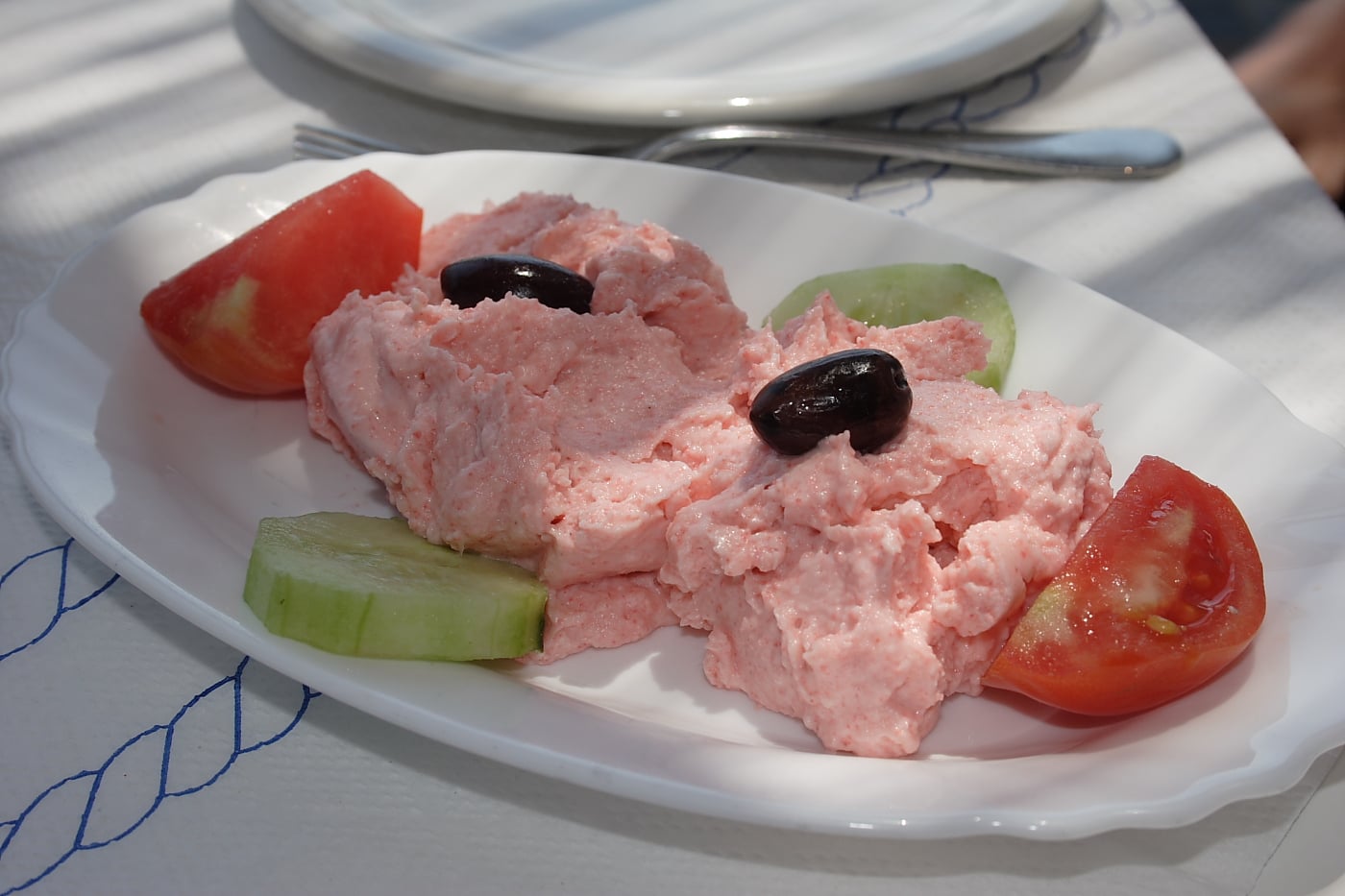
Taramosalata is one of the great mezze of the Greek table — a silky, pale-pink spread made from salt-cured fish roe whipped with soaked bread, olive oil, and lemon until it turns light and almost mousse-like. Forget the fluorescent magenta dip in plastic tubs; the real thing is a creamy off-white with a subtle blush, briny and bright without being fishy. It belongs on every mezze spread alongside olives, warm pita, and a cold glass of ouzo.
Scan to log · 93 kcal · 7g protein
Point a phone camera at the code to open this recipe — or scan it from a printout to drop today's serving straight into your food log.
Add to today's log →Prep
20 min
Cook
0 min
Total
20 min
Servings
6
Difficulty
Easy
What you need
Ingredients
tarama (pale salt-cured cod or carp roe)
3 oz
85g
Substitution · specialty — find at Greek or Middle Eastern grocery stores, or online (Krinos brand is widely available); avoid bright-red or magenta jars
Original: tarama — pale salt-cured cod roe (tarama). Krinos brand tarama is sold at many US groceries and online. In a pinch, smoked whitefish roe (from a Jewish deli) gives a different but acceptable result — use the same amount and expect a smokier flavor. Do not substitute tobiko or salmon roe — the texture won't emulsify correctly.
day-old white sandwich bread, crusts removed
4 slices (about 3 oz)
85g
cold water, for soaking bread
1/2 cup
120ml
small yellow onion, roughly chopped
1/4 medium onion (about 2 tbsp grated)
30g
fresh lemon juice
3 tbsp
45ml
Greek extra-virgin olive oil (fruity, Kalamata-style)
3/4 cup
180ml
cold water, for adjusting consistency
1 to 3 tbsp
15 to 45ml
How to cook it
Steps
- 01
6 min
Soak the bread: Place the crustless bread slices in a shallow bowl and pour the 1/2 cup (120ml) cold water over them. Let sit for 5 minutes until thoroughly saturated, then pick up the bread with both hands and squeeze out as much water as you can — really wring it. You want damp, not wet. Set aside.
- 02
2 min
Grate the onion: Using the fine side of a box grater (or a microplane), grate the onion directly over a small bowl to catch the juice. You want about 2 tablespoons of onion pulp and juice combined. Grating rather than chopping is important — it integrates smoothly and avoids any raw onion crunch in the finished spread.
- 03
2 min
Start the emulsion in a food processor: Add the tarama, squeezed bread, and grated onion (with its juice) to a food processor. Pulse 8 to 10 times until the mixture comes together into a rough paste. Scrape down the sides.
- 04
4 min
Emulsify with oil and lemon — this is the key step: With the food processor running continuously, add the olive oil in a very slow, thin stream — think salad dressing, not pouring. Alternate: add a little oil, then a little lemon juice, then more oil, then more lemon, continuing until both are fully incorporated. This slow alternation is what makes the spread light and creamy rather than greasy. The mixture should visibly lighten in color and become fluffy as you go. Total time for this step: about 3 to 4 minutes of patient pouring.
- 05
2 min
Adjust consistency: Stop and taste. The spread should be smooth, light, and hold a soft peak — similar to a thick hummus. If it's too thick, add cold water one tablespoon at a time with the processor running until you reach a spreadable consistency. Taste for balance: it should be briny, lemony, and rich. If it tastes flat, add a few more drops of lemon juice.
- 06
1 min
Chill before serving: Transfer to a serving bowl, cover with plastic wrap pressed directly onto the surface (to prevent a skin forming), and refrigerate for at least 30 minutes. The flavor improves noticeably as it rests — the onion mellows and the oil integrates further. When ready to serve, drizzle generously with olive oil and, if you like, a few Kalamata olives on the side.
Chef notes
Notes & variations
The color question: Real taramosalata made from pale (white/beige) tarama is creamy ivory with a faint blush — not pink, not magenta. The bright-pink supermarket versions use food coloring. If your tarama jar is very red, the finished spread will be more pink, but the flavor is the same.
Bread vs. potato: Some Greek cooks — particularly on the islands — use boiled potato instead of bread as the base. It gives a slightly denser, starchier texture and a more neutral flavor that lets the roe shine. Use about 5 oz (140g) of cooled mashed potato in place of the soaked bread.
Food processor vs. by hand: Traditionally this was made with a mortar and pestle or by hand in a bowl, which gives a slightly coarser, more rustic texture. The food processor is faster and produces a fluffier result. Both are correct.
Make-ahead: Taramosalata keeps well refrigerated for up to 4 days. Stir before serving and re-drizzle with olive oil.
Serving: Serve with warm pita, sliced crusty bread, or raw vegetables. It belongs on any mezze spread alongside tzatziki, olives, feta, and dolmas.
Per serving
Nutrition
Calories
93
Protein
7.2 g
Carbs
4.6 g
Fat
5.6 g
Fiber
0.3 g
Sugars
0.6 g
Sat fat
5.8 g
Sodium
391 mg
Minerals & vitamins
Potassium
34 mg
Calcium
21 mg
Iron
18.2 mg
Magnesium
4 mg
Vit D
0 IU
Vit B12
0.1 mcg
Cholesterol
168 mg
Glycemic profile
GI
15.5
GL
0.7
Storage
How long it keeps
Fridge
3 days
Freezer
3 months
Room temp
2 hours
Reheating · Fish dries quickly when reheated. Use low heat with moisture, or serve cold over salad.
Source: foodkeeper
Real products
Where to buy
Real grocery products surfaced via Open Food Facts. Click a product to see its OFF page (ingredients, allergens, Nutri-Score breakdown).
tarama (pale salt-cured cod or carp roe)
- Tarama carp roe caviar
Nutri-Score E
cold water, for soaking bread
fresh lemon juice
- Evolution fresh, vegetable and fruit juice blend, sweet greens and lemon, sweet greens and lemon
Evolution Fresh
Nutri-Score B
Greek extra-virgin olive oil (fruity, Kalamata-style)
cold water, for adjusting consistency


On the same table
Pairs with
Greek · mezze
Tzatziki
Tzatziki is the cool, creamy anchor of any Greek mezze spread — thick yogurt, cucumber, garlic, dill, and a generous pour of olive oil. It doubles as a dip, a sauce for grilled lamb or souvlaki, and a condiment that makes everything better. The secret isn't the ingredients; it's removing every drop of water from the cucumber so the yogurt stays luxuriously thick.
Greek · mezze
Dolmades (Stuffed Grape Leaves)
These cold, lemon-bright dolmades are the heart of any Greek mezze spread — little parcels of rice, dill, mint, pine nuts, and currants, rolled tight and simmered until tender, then finished with enough olive oil and lemon to make you close your eyes. They travel well, keep beautifully in the fridge, and taste better the next day, which is why Greek grandmothers always make a big batch.
Greek · mezze
Spanakopita (Spinach + Feta Phyllo Pie)
Spanakopita is one of Greece's great communal pies — made in every household, every bakery, every church festival from Thessaloniki to Crete. Layers of buttered phyllo encase a savory filling of wilted spinach, crumbled feta, fresh dill, and scallions. It's a mezze centerpiece, a lunch on its own, and one of those dishes that's genuinely better the day after it's made.