
Greek · Mainland and islands · mezze
Dolmades (Stuffed Grape Leaves)
ντολμάδες
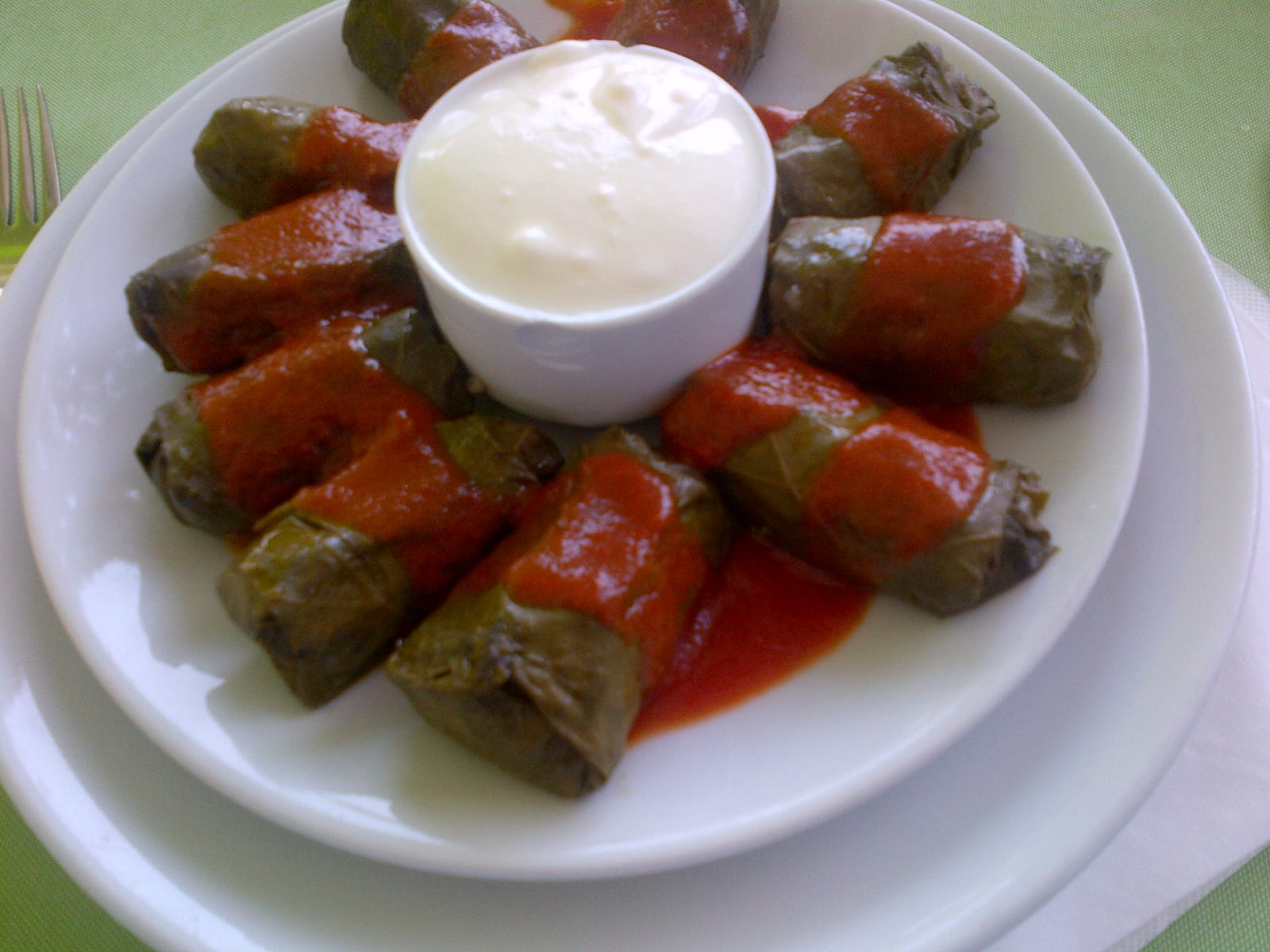
These cold, lemon-bright dolmades are the heart of any Greek mezze spread — little parcels of rice, dill, mint, pine nuts, and currants, rolled tight and simmered until tender, then finished with enough olive oil and lemon to make you close your eyes. They travel well, keep beautifully in the fridge, and taste better the next day, which is why Greek grandmothers always make a big batch.
Scan to log · 214 kcal · 7g protein
Point a phone camera at the code to open this recipe — or scan it from a printout to drop today's serving straight into your food log.
Add to today's log →Prep
45 min
Cook
55 min
Rest
60 min
Total
160 min
Servings
6
Difficulty
Medium
What you need
Ingredients
jarred grape leaves in brine (about 40–45 leaves)
1 jar (16 oz)
450g
Greek extra-virgin olive oil, divided
1/2 cup + 2 tbsp
150ml
yellow onion, finely diced
1 medium (about 1 cup)
150g
medium-grain white rice (such as Arborio or Calrose), uncooked
3/4 cup
150g
pine nuts
1/4 cup
35g
dried currants
3 tbsp
30g
Substitution · hard-to-find
Original: Zante currants (tiny dried wine grapes). Regular dried currants work perfectly. In a pinch, use raisins chopped roughly — they're sweeter, so use a touch less.
fresh dill, finely chopped
1/3 cup packed
15g
fresh mint leaves, finely chopped
3 tbsp packed
8g
fresh flat-leaf parsley, finely chopped
3 tbsp packed
8g
lemon juice, freshly squeezed, divided (about 3 lemons)
1/2 cup
120ml
lemon zest
1 tsp
2g
fine sea salt
1 tsp, plus more to taste
5g
black pepper, freshly ground
1/2 tsp
1g
water or light vegetable broth
1 cup
240ml
How to cook it
Steps
- 01
10 min
Rinse the grape leaves well under cold running water to remove excess brine — this takes about a minute. Gently separate them and lay them flat on a clean kitchen towel or paper towels. Trim any tough stems flush with the leaf base using scissors or a small knife. Set aside. If a few leaves tear, save them for lining the pot.
- 02
12 min
Warm 2 tablespoons (30ml) of the olive oil in a medium skillet over medium heat. Add the diced onion with a pinch of salt and cook, stirring occasionally, until softened and just translucent — about 7 minutes. Don't let it brown. Remove from heat and let cool for 5 minutes.
- 03
5 min
In a large bowl, combine the uncooked rice, pine nuts, currants, dill, mint, parsley, lemon zest, 3 tablespoons (45ml) of the lemon juice, 3 tablespoons (45ml) of the olive oil, the cooked onion, 1 teaspoon salt, and the black pepper. Stir well — the mixture will look loose and that's fine. The rice cooks inside the rolls.
- 04
3 min
Line the bottom of a wide, heavy-bottomed pot (at least 4-quart / 3.8L) with a single layer of the less-perfect grape leaves — torn ones are ideal here. This protects the dolmades from scorching and adds flavor to the liquid.
- 05
25 min
Roll the dolmades: Place one grape leaf shiny-side down on your work surface, stem end toward you. Put about 1 heaping teaspoon (roughly 10g) of filling near the stem end — don't overfill, the rice expands. Fold the bottom of the leaf up over the filling, fold in the sides, then roll firmly away from you into a tight cylinder about the size of your index finger. Place seam-side down in the lined pot. Repeat, packing the rolls snugly in a single layer, then stacking a second layer on top. Tight packing keeps them from unrolling during cooking.
- 06
3 min
Mix the remaining olive oil (about 1/4 cup / 60ml), the remaining lemon juice (about 5 tablespoons / 75ml), and the water or broth together in a measuring cup. Pour evenly over the dolmades. The liquid should come about halfway up the rolls — add a splash more water if needed. Place a small heatproof plate directly on top of the dolmades to weigh them down and keep them from floating apart.
- 07
50 min
Bring to a gentle boil over medium-high heat, then reduce heat to low, cover tightly, and simmer for 45 minutes. The rice should be fully cooked and the leaves tender. Resist the urge to stir — just let them be.
- 08
60 min
Remove from heat and let the dolmades cool in the pot, covered, for at least 1 hour before serving. They firm up as they cool and the flavors come together. For best results, refrigerate overnight and serve at room temperature — they genuinely improve with time.
- 09
3 min
Arrange on a platter and finish with a generous drizzle of your best olive oil and a few thin lemon slices. Serve with cold Greek yogurt or tzatziki alongside for dipping, and plenty of crusty bread.
Chef notes
Notes & variations
The filling uses raw rice — this is correct. It cooks inside the leaf during simmering and absorbs all the lemony olive oil liquid. Don't pre-cook the rice.
Jarred grape leaves are sold at most US grocery stores in the international or pickle aisle (Orlando and Peloponnese are common brands). They work beautifully — fresh grape leaves are a spring treat if you happen to have a vine.
These keep refrigerated for up to 5 days. The flavor on day 2 and 3 is noticeably better than day 1.
For a Cretan variation, add 2 tablespoons of finely chopped fennel fronds to the filling in place of some of the dill — earthy and wonderful.
If your pot is narrower, roll in two tight layers. If you run out of filling before leaves (or vice versa), adjust — the exact count per leaf varies with leaf size.
Per serving
Nutrition
Calories
214
Protein
6.5 g
Carbs
37.6 g
Fat
5.8 g
Fiber
8.9 g
Sugars
4.1 g
Sat fat
4.4 g
Sodium
2591 mg
Minerals & vitamins
Potassium
224 mg
Calcium
241 mg
Iron
4.2 mg
Magnesium
42 mg
Vit D
0 IU
Vit B12
0 mcg
Cholesterol
0 mg
Glycemic profile
GI
60
GL
22.6
- · LLM tiebreak failed for "fresh mint leaves" — picked first result as fallback
Storage
How long it keeps
Fridge
5 days
Freezer
2 months
Room temp
2 hours
Reheating · Muhammara, ajvar, romesco. Often improves after a day as flavors meld.
Source: foodkeeper
Real products
Where to buy
Real grocery products surfaced via Open Food Facts. Click a product to see its OFF page (ingredients, allergens, Nutri-Score breakdown).
Greek extra-virgin olive oil, divided
yellow onion, finely diced
pine nuts
dried currants
fresh dill, finely chopped
lemon juice, freshly squeezed, divided (about 3 lemons)
lemon zest
fine sea salt
black pepper, freshly ground


On the same table
Pairs with
Greek · mezze
Tzatziki
Tzatziki is the cool, creamy anchor of any Greek mezze spread — thick yogurt, cucumber, garlic, dill, and a generous pour of olive oil. It doubles as a dip, a sauce for grilled lamb or souvlaki, and a condiment that makes everything better. The secret isn't the ingredients; it's removing every drop of water from the cucumber so the yogurt stays luxuriously thick.
Greek · mezze
Spanakopita (Spinach + Feta Phyllo Pie)
Spanakopita is one of Greece's great communal pies — made in every household, every bakery, every church festival from Thessaloniki to Crete. Layers of buttered phyllo encase a savory filling of wilted spinach, crumbled feta, fresh dill, and scallions. It's a mezze centerpiece, a lunch on its own, and one of those dishes that's genuinely better the day after it's made.
Greek · mezze
Taramosalata (Fish Roe Spread)
Taramosalata is one of the great mezze of the Greek table — a silky, pale-pink spread made from salt-cured fish roe whipped with soaked bread, olive oil, and lemon until it turns light and almost mousse-like. Forget the fluorescent magenta dip in plastic tubs; the real thing is a creamy off-white with a subtle blush, briny and bright without being fishy. It belongs on every mezze spread alongside olives, warm pita, and a cold glass of ouzo.