
Greek · Mainland Greece and islands · mezze
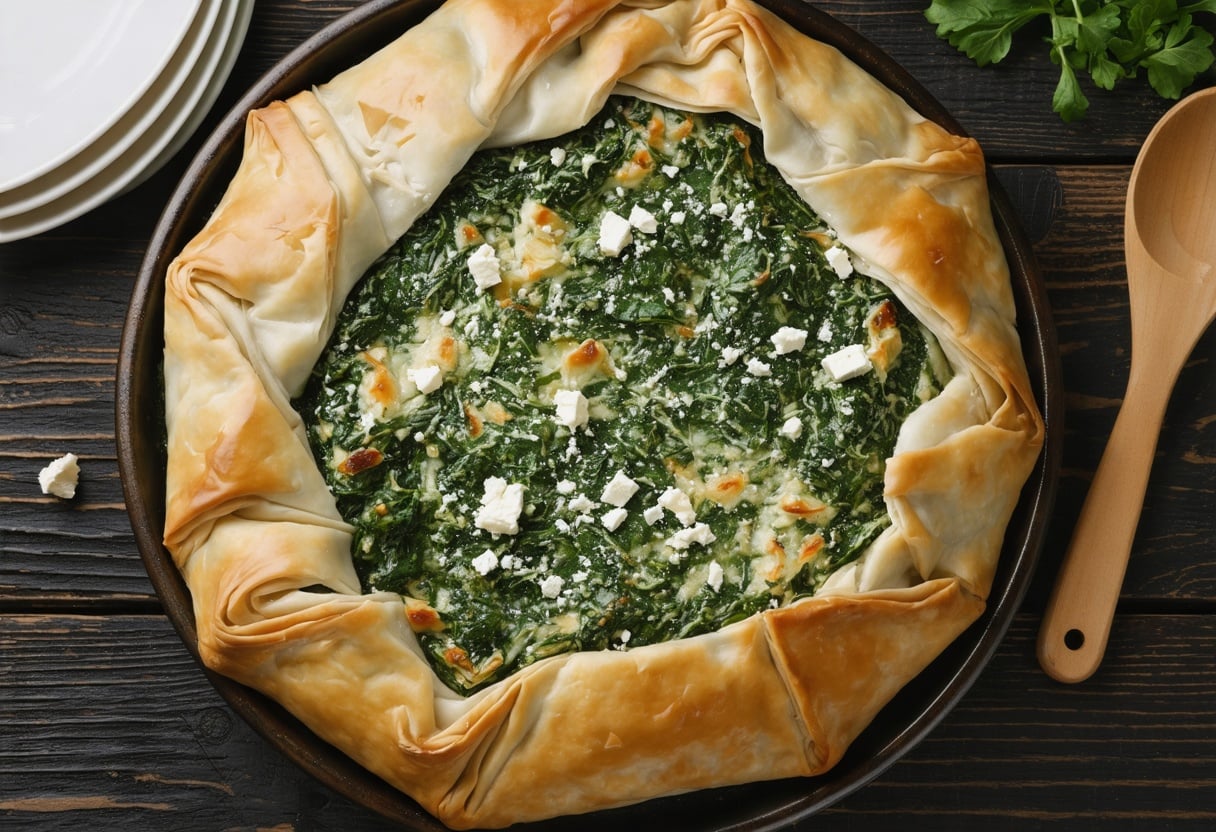
Spanakopita (Spinach + Feta Phyllo Pie)
σπανακόπιτα
Spanakopita is one of Greece's great communal pies — made in every household, every bakery, every church festival from Thessaloniki to Crete. Layers of buttered phyllo encase a savory filling of wilted spinach, crumbled feta, fresh dill, and scallions. It's a mezze centerpiece, a lunch on its own, and one of those dishes that's genuinely better the day after it's made.
Scan to log · 389 kcal · 15g protein
Point a phone camera at the code to open this recipe — or scan it from a printout to drop today's serving straight into your food log.
Add to today's log →Prep
40 min
Cook
50 min
Total
90 min
Servings
9
Difficulty
Medium
What you need
Ingredients
frozen phyllo dough (thawed overnight in refrigerator)
1 lb (about 18–20 sheets)
450g
fresh spinach, washed and roughly chopped
2 lbs
900g
Greek PDO feta cheese, crumbled
3 cups
400g
Substitution · flavor note
Original: Greek PDO feta (sheep's milk, brined block). Greek PDO feta is now at most US groceries (Whole Foods, Trader Joe's, many supermarkets — look for 'Product of Greece' on the label). Domestic feta-style cheese works but is milder and less tangy; if using it, add an extra pinch of salt and a squeeze of lemon to the filling.
scallions (green onions), thinly sliced
1 bunch (about 6–8 scallions)
100g
fresh dill, chopped
1/2 cup loosely packed
20g
fresh flat-leaf parsley, chopped
1/4 cup loosely packed
10g
large eggs
3
3
extra-virgin olive oil (Greek if you have it)
3 tbsp
45ml
unsalted butter, melted
1/2 cup (1 stick)
115g
freshly ground black pepper
1/2 tsp
1g
ground nutmeg
1/4 tsp
0.5g
fine sea salt (for spinach — taste before adding more, feta is salty)
1/2 tsp
2g
How to cook it
Steps
- 01
5 min
Take your phyllo out of the refrigerator 30 minutes before you start so it comes to room temperature — cold phyllo tears more easily. Keep it in the sealed package until you're ready to use it. Preheat your oven to 375°F (190°C). Lightly oil a 9×13-inch (23×33cm) baking pan with olive oil.
- 02
15 min
Wilt the spinach: Heat the 3 tablespoons of olive oil in a large skillet or pot over medium heat. Add the scallions and cook, stirring, for 2 minutes until softened. Add the spinach in batches — it will look like a mountain but collapses quickly. Stir and cook until all the spinach is wilted and most of the liquid has evaporated, about 5–7 minutes. Season with the salt. Transfer to a colander and let it cool for 10 minutes.
- 03
5 min
Squeeze out the spinach: This step matters. Take handfuls of the cooled spinach and squeeze firmly over the sink to remove as much liquid as possible. Wet filling makes soggy phyllo. Chop the squeezed spinach a bit more if the pieces are large, then place in a large mixing bowl.
- 04
5 min
Make the filling: To the bowl with the spinach, add the crumbled feta, chopped dill, chopped parsley, eggs, black pepper, and nutmeg. Mix well with a fork or your hands. Taste before adding more salt — feta is quite salty on its own. The filling should be savory, herby, and cohesive.
- 05
3 min
Melt the butter in a small saucepan or microwave. Have a pastry brush ready. Open the phyllo package and unroll the sheets onto a clean surface. Immediately cover them with a slightly damp kitchen towel — phyllo dries out fast and becomes brittle. Keep the towel over the stack whenever you're not pulling a sheet.
- 06
10 min
Layer the bottom phyllo: Lay one sheet of phyllo in the oiled pan — it will likely hang over the edges, and that's fine. Brush it generously with melted butter. Lay another sheet on top and brush again. Repeat until you have 8–9 sheets layered on the bottom, buttering every single one. Don't skip sheets; don't skimp on butter. Tears in the phyllo are fine — just patch them with the next sheet.
- 07
3 min
Add the filling: Spread the spinach and feta filling evenly over the bottom phyllo layers. Use your hands or a spatula to press it into an even layer all the way to the corners.
- 08
10 min
Layer the top phyllo: Lay the remaining sheets over the filling one at a time, brushing each with butter just as you did the bottom. Aim for 8–9 sheets on top. Fold any overhanging edges up and over the top, tucking them in neatly, and brush those folds with butter too. Brush the entire top surface generously.
- 09
2 min
Score the top: Before baking, use a sharp knife to score the top layers of phyllo (not all the way through to the filling) into squares or triangles — about 9 squares for a 3×3 grid, or 18 triangles. This prevents the top from shattering when you cut it after baking. Scoring now also lets steam escape.
- 10
50 min
Bake: Place the pan on the center rack and bake for 45–50 minutes, until the top is deep golden brown and the phyllo is crisp. If the top is browning too fast after 30 minutes, lay a loose sheet of foil over it. Let the spanakopita rest in the pan for at least 15 minutes before cutting — this helps it hold together cleanly.
- 11
5 min
Cut and serve: Follow your scored lines to cut through completely. Serve warm or at room temperature — both are traditional and both are good. Leftovers reheat beautifully in a 350°F (175°C) oven for 10 minutes to re-crisp the phyllo. Do not microwave; it makes the phyllo soggy.
Chef notes
Notes & variations
Frozen spinach shortcut: You can use two 10-oz (280g) packages of frozen chopped spinach instead of fresh. Thaw completely, then squeeze out every drop of water you can — this is even more important with frozen spinach, which holds more liquid. The flavor is slightly less bright but perfectly acceptable.
Olive oil–only version: Some Greek cooks use only olive oil (no butter) to brush the phyllo — especially in Crete, where butter is less traditional. The result is a slightly less rich but equally crisp pie. Use about 3/4 cup (180ml) good olive oil total.
Make-ahead: Assemble the unbaked pie, cover tightly with plastic wrap, and refrigerate up to 24 hours before baking. Add 5 minutes to the bake time if going straight from fridge to oven.
Greek mountain oregano note: This recipe doesn't call for oregano, but if you want a more rustic, island-style filling, add 1/2 tsp dried oregano (Greek rigani if you can find it at a Greek or Middle Eastern market; otherwise standard dried oregano plus a tiny pinch of dried mint).
Serving size: Cut into 9 squares for generous mezze portions, or 12–18 smaller pieces for a party spread.
Per serving
Nutrition
Calories
389
Protein
14.9 g
Carbs
32.6 g
Fat
21.6 g
Fiber
3.7 g
Sugars
0.1 g
Sat fat
12.9 g
Sodium
866 mg
Minerals & vitamins
Potassium
134 mg
Calcium
278 mg
Iron
5.2 mg
Magnesium
20 mg
Vit D
0 IU
Vit B12
0 mcg
Cholesterol
54 mg
Glycemic profile
GI
14.6
GL
4.8
Storage
How long it keeps
Fridge
5 days
Freezer
2 months
Room temp
2 hours
Reheating · Muhammara, ajvar, romesco. Often improves after a day as flavors meld.
Source: foodkeeper
Real products
Where to buy
Real grocery products surfaced via Open Food Facts. Click a product to see its OFF page (ingredients, allergens, Nutri-Score breakdown).
frozen phyllo dough (thawed overnight in refrigerator)
- White meat chicken with basil pesto, mozzarella & parmesan cheeses in phyllo dough bites, chicken & pesto
Signature Select
Nutri-Score C
Greek PDO feta cheese, crumbled
- Feta
Nutri-Score UNKNOWN
scallions (green onions), thinly sliced
fresh dill, chopped
large eggs
extra-virgin olive oil (Greek if you have it)
unsalted butter, melted
freshly ground black pepper
fine sea salt (for spinach — taste before adding more, feta is salty)


On the same table
Pairs with
Greek · mezze
Tzatziki
Tzatziki is the cool, creamy anchor of any Greek mezze spread — thick yogurt, cucumber, garlic, dill, and a generous pour of olive oil. It doubles as a dip, a sauce for grilled lamb or souvlaki, and a condiment that makes everything better. The secret isn't the ingredients; it's removing every drop of water from the cucumber so the yogurt stays luxuriously thick.
Greek · mezze
Melitzanosalata (Smoky Eggplant Dip)
Melitzanosalata is the Greek answer to the question of what to do with fire and an eggplant — char the skin until it collapses, then coax the smoky flesh into a chunky, lemon-bright dip. Unlike baba ghanouj, there's no tahini here: just good olive oil, raw garlic, parsley, and a splash of red wine vinegar. It shows up on nearly every mezze table in Greece, and once you taste it you'll understand why.