
Greek · Mainland Greece and islands · mezze
Melitzanosalata (Smoky Eggplant Dip)
μελιτζανοσαλάτα
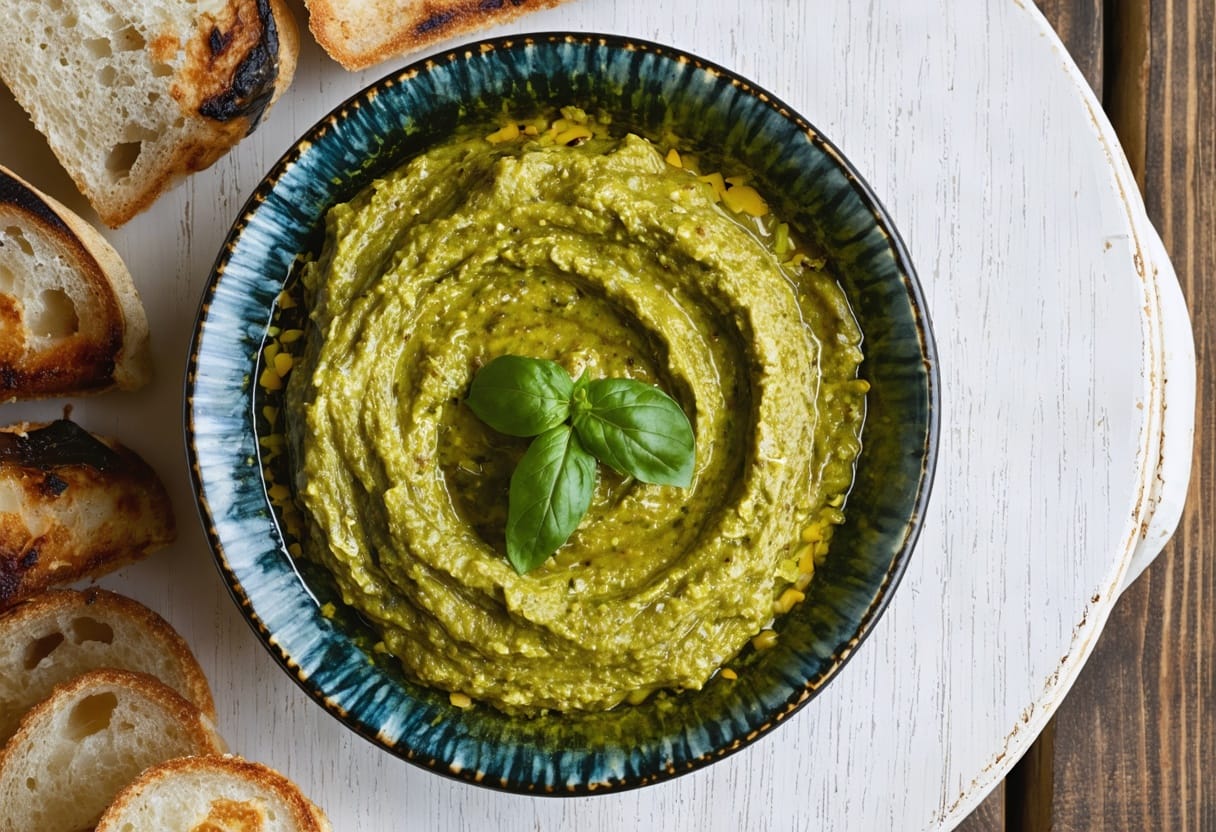
Melitzanosalata is the Greek answer to the question of what to do with fire and an eggplant — char the skin until it collapses, then coax the smoky flesh into a chunky, lemon-bright dip. Unlike baba ghanouj, there's no tahini here: just good olive oil, raw garlic, parsley, and a splash of red wine vinegar. It shows up on nearly every mezze table in Greece, and once you taste it you'll understand why.
Scan to log · 66 kcal · 2g protein
Point a phone camera at the code to open this recipe — or scan it from a printout to drop today's serving straight into your food log.
Add to today's log →Prep
15 min
Cook
45 min
Rest
15 min
Total
75 min
Servings
6
Difficulty
Easy
What you need
Ingredients
large globe eggplants
2 large (about 2 lb total)
900g total
extra-virgin olive oil
1/3 cup
80ml
Substitution · accessibility
Original: Greek extra-virgin olive oil. Greek EVOO (from brands like Gaea, Iliada, or Costco's Kirkland Greek) has a grassy, slightly peppery character that suits this dish particularly well. Any good-quality extra-virgin olive oil from a major supermarket works fine — just use the best you have, since the oil is a primary flavor here, not a background note.
fresh lemon juice (from about 1 large lemon)
3 tablespoons
45ml
red wine vinegar
1 teaspoon
5ml
garlic cloves, minced or grated
2 cloves
10g
fresh flat-leaf parsley, finely chopped
1/4 cup packed
15g
roasted red bell pepper, finely chopped
1/2 medium pepper (about 1/3 cup)
60g
Substitution · optional traditional variation
Original: freshly fire-roasted red pepper. A jarred roasted red pepper, drained and patted dry, works perfectly here — it's what most Greek home cooks use outside summer.
sea salt
3/4 teaspoon
4g
freshly ground black pepper
1/4 teaspoon
0.5g
dried oregano
1/4 teaspoon
0.5g
Substitution · accessibility
Original: Greek mountain oregano (rigani). Greek mountain oregano (rigani) has a pinier, more resinous, and more intensely floral character than standard Italian-style dried oregano. To approximate it, use standard dried oregano plus a tiny pinch of dried mint. If you find Greek oregano (sold as 'rigani' at Greek, Middle Eastern, or specialty grocery stores, or online), use it — the difference is noticeable and worth it.
Kalamata olives, for serving
1/4 cup (about 10 olives)
40g
Substitution · availability
Original: Kalamata olives. Kalamatas are now widely available at most US grocery stores. Any brine-cured black olive works as a fallback — Nicoise or oil-cured black olives are fine alternatives.
extra-virgin olive oil, for finishing drizzle
1 tablespoon
15ml
Substitution · accessibility
Original: Greek extra-virgin olive oil, for finishing drizzle. The finishing drizzle is meant to be a fruity, high-quality Greek EVOO — it's the last flavor the diner tastes. Any good supermarket extra-virgin olive oil works, but if you can find a Greek variety (Gaea, Iliada, or similar, available at Whole Foods, Wegmans, and many Kroger/Publix stores), use it here especially, since it's used raw and its character comes through clearly.
How to cook it
Steps
- 01
25 min
Char the eggplants directly over a gas burner flame or under a broiler. Gas burner method (preferred for smoke): Set two burners to medium-high, place one eggplant directly on each grate. Roast, turning with tongs every 5–6 minutes, until the skin is completely blackened and the eggplant has collapsed and feels very soft when pressed — about 20–25 minutes total. Broiler method: Halve the eggplants lengthwise, brush cut sides with a little olive oil, place cut-side down on a foil-lined baking sheet, and broil 4 inches from the element for 25–30 minutes until the skin is charred and the flesh is completely tender. The gas-burner method gives noticeably more smoke flavor, which is the point.
- 02
15 min
Transfer the charred eggplants to a colander set over the sink. Let them cool until you can handle them comfortably, about 15 minutes. Don't rush this — they need to steam and release liquid.
- 03
8 min
Peel away and discard all the charred skin. It should slip off easily. If you charred over a flame, you'll see some blackened bits clinging to the flesh — leave a few, they add flavor, but scrape off any large chunks of pure char. Place the peeled flesh in the colander and let it drain for another 5 minutes, then gently press it with the back of a spoon to squeeze out as much liquid as you can. Excess water is the enemy of a good melitzanosalata.
- 04
3 min
Transfer the drained eggplant flesh to a cutting board and chop it roughly with a knife — you want a coarse, chunky texture, not a purée. Melitzanosalata should have body. Move the chopped eggplant to a mixing bowl.
- 05
3 min
Add the minced garlic, lemon juice, red wine vinegar, and salt to the bowl. Stir to combine, then let it sit for 2 minutes so the garlic mellows slightly into the acid.
- 06
3 min
Pour in the olive oil in a steady stream while stirring — you're not emulsifying like mayonnaise, just incorporating it into the chunky mixture. Add the chopped roasted red pepper, parsley, dried oregano, and black pepper. Stir everything together. Taste and adjust: more lemon if it needs brightness, more salt if it's flat, a touch more vinegar if you want a sharper edge.
- 07
2 min
Cover the bowl and refrigerate for at least 15 minutes before serving — the flavors come together as it sits. It's even better after an hour. When ready to serve, spoon into a shallow bowl or plate, make a shallow well in the center with the back of a spoon, drizzle generously with the finishing olive oil, scatter the Kalamata olives around the edge, and add a few extra parsley leaves if you like. Serve with warm pita or crusty bread.
Chef notes
Notes & variations
The smoke is non-negotiable. A charcoal grill gives the deepest flavor of all — if you're already grilling for a mezze spread, throw the whole eggplants on the coals first.
Walnut variation: Some mainland Greek versions fold in 2–3 tablespoons of finely chopped toasted walnuts (about 20g) for texture and a slightly bitter richness. Add them with the parsley in step 6.
This keeps well covered in the fridge for up to 3 days. The flavor actually improves overnight. Bring to room temperature before serving and re-drizzle with olive oil.
If your eggplants are very seedy, you can scrape out some of the seed clusters before chopping — seeds can add a slightly bitter note, though most Greek cooks don't bother.
For a creamier version (more common in some Cypriot households), you can mash the eggplant with a fork rather than chopping, but the chunky texture is the mainland standard.
Per serving
Nutrition
Calories
66
Protein
1.6 g
Carbs
10.9 g
Fat
1.6 g
Fiber
4.4 g
Sugars
0.6 g
Sat fat
2.7 g
Sodium
435 mg
Minerals & vitamins
Potassium
378 mg
Calcium
23 mg
Iron
0.2 mg
Magnesium
23 mg
Vit D
0 IU
Vit B12
0 mcg
Cholesterol
0 mg
Glycemic profile
GI
15
GL
1.6
Storage
How long it keeps
Fridge
4 days
Freezer
2 months
Room temp
2 hours
Reheating · Texture softens further on day 2 — fine for stews and baba ghanouj, less ideal for charred-eggplant dishes.
Source: foodkeeper
Real products
Where to buy
Real grocery products surfaced via Open Food Facts. Click a product to see its OFF page (ingredients, allergens, Nutri-Score breakdown).
Greek extra-virgin olive oil
fresh lemon juice (from about 1 large lemon)
- Evolution fresh, vegetable and fruit juice blend, sweet greens and lemon, sweet greens and lemon
Evolution Fresh
Nutri-Score B
red wine vinegar
garlic cloves, minced or grated
- Whole garlic cloves in brine
Nutri-Score C
roasted red bell pepper, finely chopped
sea salt
freshly ground black pepper
dried Greek oregano (rigani)
Kalamata olives, for serving
extra olive oil drizzle, for finishing


On the same table
Pairs with
Greek · mezze
Tzatziki
Tzatziki is the cool, creamy anchor of any Greek mezze spread — thick yogurt, cucumber, garlic, dill, and a generous pour of olive oil. It doubles as a dip, a sauce for grilled lamb or souvlaki, and a condiment that makes everything better. The secret isn't the ingredients; it's removing every drop of water from the cucumber so the yogurt stays luxuriously thick.
Greek · mezze
Taramosalata (Fish Roe Spread)
Taramosalata is one of the great mezze of the Greek table — a silky, pale-pink spread made from salt-cured fish roe whipped with soaked bread, olive oil, and lemon until it turns light and almost mousse-like. Forget the fluorescent magenta dip in plastic tubs; the real thing is a creamy off-white with a subtle blush, briny and bright without being fishy. It belongs on every mezze spread alongside olives, warm pita, and a cold glass of ouzo.
Greek · mezze
Spanakopita (Spinach + Feta Phyllo Pie)
Spanakopita is one of Greece's great communal pies — made in every household, every bakery, every church festival from Thessaloniki to Crete. Layers of buttered phyllo encase a savory filling of wilted spinach, crumbled feta, fresh dill, and scallions. It's a mezze centerpiece, a lunch on its own, and one of those dishes that's genuinely better the day after it's made.