
Turkish · Southeastern Turkey / nationwide meze tradition · mezze
Ezme (Spicy Turkish Tomato + Pepper Salad)
ezme
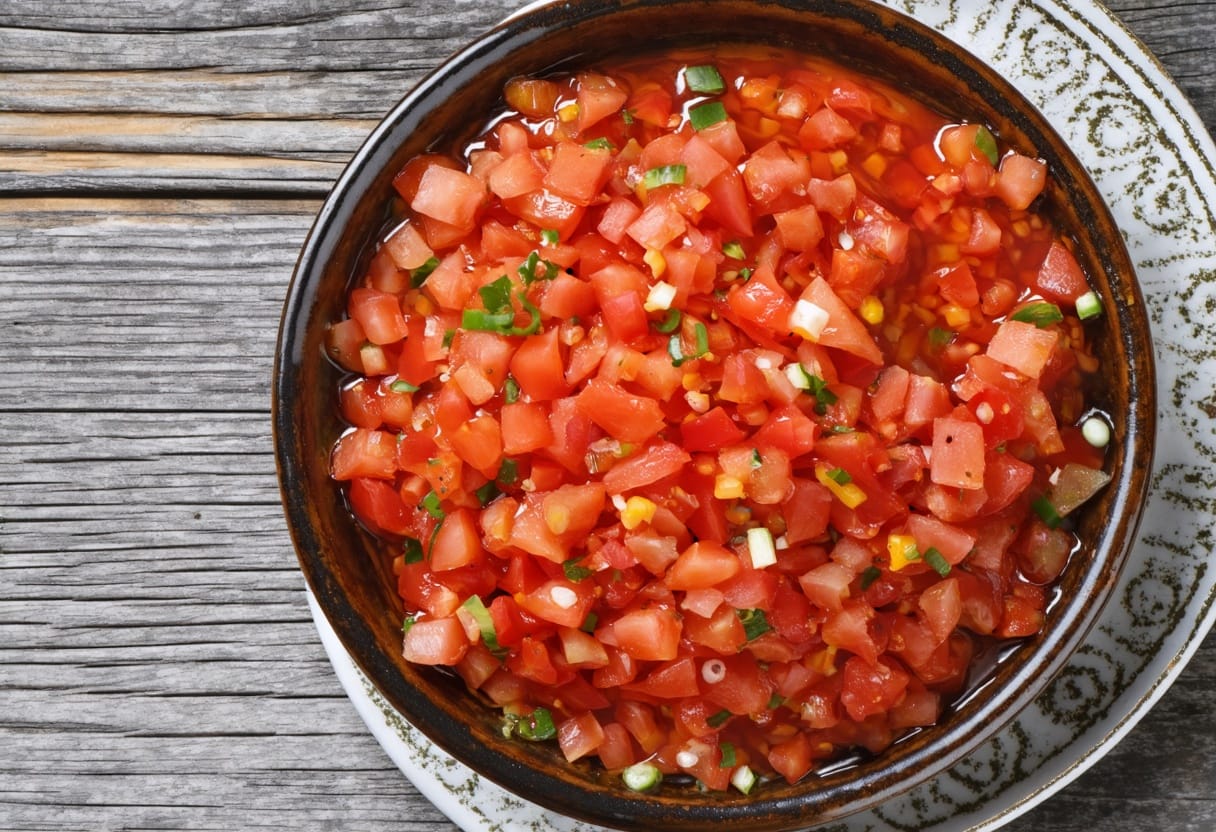
Ezme is the fiery, finely chopped relish that appears on nearly every meze table in Turkey — especially in the southeast, where the peppers are hotter and the pomegranate molasses flows freely. It's not a salsa and it's not a salad; it's somewhere between the two, intensely flavored, meant to be scooped up with warm bread while you're waiting for the kebabs. Once you taste it, you'll want it with everything.
Scan to log · 53 kcal · 2g protein
Point a phone camera at the code to open this recipe — or scan it from a printout to drop today's serving straight into your food log.
Add to today's log →Prep
25 min
Cook
0 min
Rest
15 min
Total
40 min
Servings
4
Difficulty
Easy
What you need
Ingredients
ripe Roma tomatoes, seeded
4 medium (about 1 lb)
450g
long green Turkish or Italian frying peppers (cubanelle), seeded
2 medium (about 5 oz)
140g
small fresh jalapeño or serrano pepper, seeded (keep seeds for more heat)
1 small
15g
white or yellow onion
1/2 medium (about 3 oz)
85g
fresh flat-leaf parsley, leaves and tender stems
1/2 cup packed
20g
pul biber (Aleppo pepper)
1 1/2 tsp
4g
Substitution · specialty — found at Whole Foods or Middle Eastern markets
Original: pul biber (Aleppo/Maraş pepper). Mix 1 tsp sweet paprika + 1/2 tsp red pepper flakes. It won't have quite the same fruity warmth, but it works.
sumac
1 tsp
3g
Substitution · specialty — found at Whole Foods or online
Original: sumac. Use 1/2 tsp lemon zest plus a tiny pinch of citric acid (or just a small extra squeeze of lemon at the end).
pomegranate molasses
1 1/2 tsp
10ml
Substitution · specialty — Whole Foods carries it; also Middle Eastern markets
Original: nar ekşisi (pomegranate molasses). Simmer 1 tbsp cranberry juice down to about 1 tsp, then stir in 1/2 tsp balsamic vinegar. Sweet-tart and close enough.
extra-virgin olive oil
3 tbsp
45ml
fresh lemon juice
1 tbsp
15ml
fine salt
3/4 tsp, plus more to taste
4g, plus more to taste
tomato paste
1 tsp
6g
How to cook it
Steps
- 01
12 min
Seed and roughly chop the tomatoes, then spread them on a double layer of paper towels or a clean kitchen towel for 10 minutes. This step matters — tomatoes hold a lot of water, and skipping it gives you a watery ezme that slides off the bread. While they drain, roughly chop the frying peppers, jalapeño, onion, and parsley separately.
- 02
10 min
Work in batches with a large chef's knife (or a mezzaluna if you have one): finely chop each vegetable individually, then combine them on the board and chop everything together until the mixture is very fine — almost a coarse paste — but not puréed. You want tiny distinct pieces, not mush. A food processor can work in a pinch, but pulse carefully in 1-second bursts; it turns to soup fast. Total chopping time is about 8–10 minutes.
- 03
2 min
Transfer the chopped mixture to a medium bowl. Add the tomato paste, pul biber, sumac, pomegranate molasses, olive oil, lemon juice, and salt. Stir well to combine everything.
- 04
2 min
Taste carefully. Ezme should hit all four notes: spicy (pul biber + jalapeño), tart (sumac + lemon + pomegranate molasses), savory (salt + tomato paste), and bright (parsley + fresh tomato). Adjust with a pinch more salt, a drop more lemon, or another pinch of pul biber until it's lively and a little aggressive — this is not a mild condiment.
- 05
15 min
Let the ezme rest at room temperature for at least 15 minutes before serving — the salt draws out a little more juice and the flavors knit together. If it gets too wet, tilt the bowl and spoon off excess liquid. Serve at room temperature, not cold. A drizzle of olive oil and a pinch of pul biber on top to finish.
Chef notes
Notes & variations
Ezme is best the day it's made, but it keeps refrigerated for up to 2 days. The heat mellows slightly overnight, which some people prefer.
In southeastern Turkey, ezme is often made with a higher ratio of hot peppers and no pomegranate molasses — more fire, less sweet-tart. In western Turkey and restaurants, the molasses is more common. Both are correct.
If your tomatoes are pale or out of season, the extra teaspoon of tomato paste helps compensate for lost flavor. Don't skip it.
Traditionally served with warm pide or lavash. Any flatbread works. It's also excellent alongside grilled lamb köfte or chicken.
Per serving
Nutrition
Calories
53
Protein
1.6 g
Carbs
10.1 g
Fat
0.8 g
Fiber
2.3 g
Sugars
1.7 g
Sat fat
1.8 g
Sodium
420 mg
Minerals & vitamins
Potassium
359 mg
Calcium
25 mg
Iron
0.6 mg
Magnesium
18 mg
Vit D
0 IU
Vit B12
0 mcg
Cholesterol
0 mg
Glycemic profile
GI
15.2
GL
1.5
- · LLM tiebreak failed for "pul biber" — picked first result as fallback
Storage
How long it keeps
Fridge
5 days
Freezer
2 months
Room temp
2 hours
Reheating · Muhammara, ajvar, romesco. Often improves after a day as flavors meld.
Source: foodkeeper
Real products
Where to buy
Real grocery products surfaced via Open Food Facts. Click a product to see its OFF page (ingredients, allergens, Nutri-Score breakdown).
white or yellow onion
sumac
- Power, energy & stamina herbal tea, nettles, sumac, sassafras
Nutri-Score UNKNOWN
pomegranate molasses
extra-virgin olive oil
fresh lemon juice
- Evolution fresh, vegetable and fruit juice blend, sweet greens and lemon, sweet greens and lemon
Evolution Fresh
Nutri-Score B
fine salt
tomato paste


On the same table
Pairs with
Turkish · mezze
Haydari (Strained Yogurt + Herb Dip)
Haydari is the richer, more assertive cousin of tzatziki — thick strained yogurt beaten with garlic, fresh dill, dried mint, crushed walnuts, and a generous pour of olive oil. It's a fixture on any Turkish meze table, served cold alongside warm bread, olives, and whatever else is coming. The straining step is non-negotiable: you need that dense, almost cream-cheese texture for the dip to hold its character.
Turkish · mezze
Cacık (Cucumber-Yogurt-Mint Soup/Dip)
Cacık is Turkey's answer to a dish that nearly every Mediterranean culture has claimed — cold yogurt with cucumber and garlic — but the Turkish version is distinctly its own: dried mint (not fresh), a generous pour of olive oil, and the option to thin it with ice-cold water into a proper chilled soup. On a hot summer afternoon in Istanbul, you'll get it in a bowl with ice cubes floating in it. At a meze spread, you'll get it thick as a dip alongside warm bread. Both are right.