
Provençal French · Nice and the Côte d'Azur · mezze
Pissaladière
pissaladière
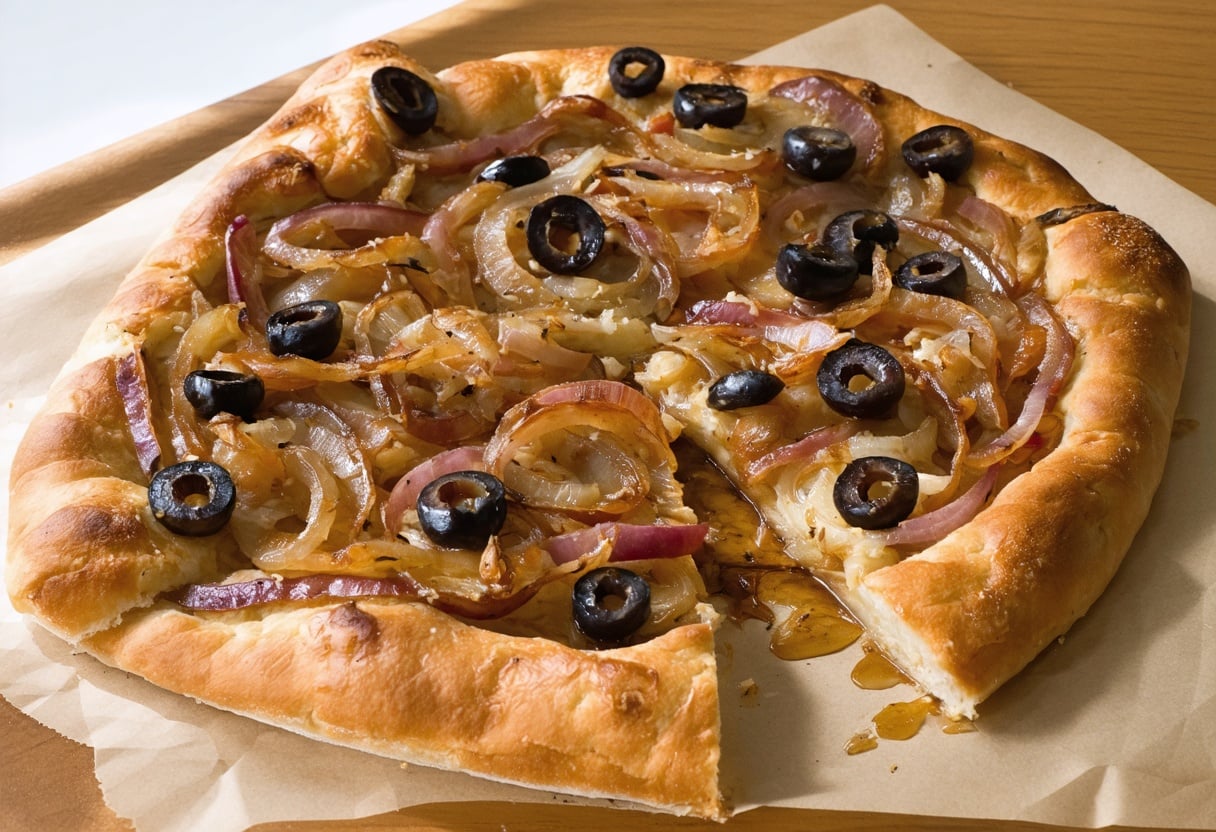
Pissaladière is the street food and home cook's tart of Nice — a thick, focaccia-like base blanketed with onions cooked down to a sweet, jammy mass, then finished with anchovies in a crosshatch and small black olives. No tomato, no cheese: the onions are the whole point. It's sold by the slice at Niçois bakeries and makes a perfect apéritif spread or a light lunch at room temperature.
Scan to log · 380 kcal · 9g protein
Point a phone camera at the code to open this recipe — or scan it from a printout to drop today's serving straight into your food log.
Add to today's log →Prep
30 min
Cook
65 min
Rest
75 min
Total
170 min
Servings
8
Difficulty
Medium
What you need
Ingredients
all-purpose flour
2 1/4 cups
280g
instant (rapid-rise) yeast
1 tsp
3g
fine sea salt, for dough
3/4 tsp
4g
warm water (about 100°F / 38°C)
3/4 cup
180ml
olive oil, for dough
2 tbsp
30ml
olive oil, for the onions
1/4 cup
60ml
large yellow onions, thinly sliced (about 1/8 inch)
4 lbs (about 6 large)
1.8kg
garlic cloves, thinly sliced
4 cloves
20g
fresh thyme sprigs
4 sprigs
4g
bay leaves
2 leaves
1g
fine sea salt, for onions
1 tsp
6g
black pepper, freshly ground
1/4 tsp
1g
oil-packed anchovy fillets
2 oz (about 16 fillets)
55g
Castelvetrano or Cerignola olives, pitted
3/4 cup
100g
Substitution · hard-to-find
Original: Niçoise olives (unpitted). Niçoise olives are the traditional choice — small, brine-cured, slightly bitter. Castelvetrano or Cerignola are widely available and work beautifully; Kalamata halves are a fine backup. If you find Niçoise olives at a specialty store or Whole Foods, use them whole and unpitted — diners expect to work around the pits.
olive oil, for finishing
1 tbsp
15ml
kosher salt or coarse sea salt, for finishing
1/4 tsp
1g
Substitution · accessibility
Original: fleur de sel or flaky sea salt (such as Maldon). Fleur de sel and flaky salts like Maldon provide a delicate, mineral crunch that is part of the finishing experience in Provençal cooking. Kosher salt is a workable stand-in — use it sparingly since the crystals are denser. If you can find Maldon flaky sea salt (stocked at Whole Foods, Wegmans, and many Kroger/Safeway locations), use it instead for a closer result.
How to cook it
Steps
- 01
75 min
Make the dough. In a large bowl, whisk together the flour, yeast, and fine sea salt. Add the warm water and 2 tbsp olive oil. Stir with a wooden spoon until a shaggy dough forms, then turn out onto an unfloured surface and knead for 6–8 minutes until smooth and slightly tacky but not sticky. Shape into a ball, place back in the bowl, cover with a clean kitchen towel or plastic wrap, and let rise at room temperature until roughly doubled — about 1 hour.
- 02
55 min
While the dough rises, cook the onions — this is the heart of the dish, so don't rush it. Warm the 1/4 cup olive oil in a large, wide pot or Dutch oven over medium heat. Add all the sliced onions, garlic, thyme sprigs, bay leaves, and 1 tsp fine sea salt. Stir to coat everything in oil. Cook uncovered over medium-low heat, stirring every 5–7 minutes, for 45–55 minutes. The onions should slowly collapse, turn golden, and become deeply jammy and sweet — not browned or crispy, just meltingly soft. If they start to color too fast, lower the heat. Remove the thyme sprigs and bay leaves, season with black pepper, and taste for salt. Set aside to cool slightly.
- 03
20 min
Preheat your oven to 425°F (220°C). Lightly oil a half-sheet pan (18×13 inches / 46×33 cm) or a large rimmed baking sheet with olive oil.
- 04
20 min
Once the dough has risen, turn it out onto the oiled pan. Using your fingers and palms, press and stretch it to fill the pan — it should be roughly 1/2 inch (1.2 cm) thick. If it springs back, let it rest 5 minutes and try again. Cover loosely and let rest 15 minutes while the oven finishes heating.
- 05
3 min
Spread the cooled onion mixture evenly over the dough all the way to the edges — use every bit of it. The onion layer should be generous, about 1/2 inch thick.
- 06
5 min
Arrange the anchovy fillets in a classic diamond or crosshatch pattern across the top: lay half the fillets diagonally one way, then the other half crossing them. Place one olive in the center of each diamond. This isn't just decorative — it ensures every slice gets anchovy and olive in every bite.
- 07
25 min
Drizzle the 1 tbsp finishing olive oil over the top. Bake on the middle rack for 20–25 minutes, until the edges of the dough are golden brown and the bottom is set (lift a corner with a spatula to check — it should be firm and lightly colored). The onions will look slightly darker at the edges; that's good.
- 08
10 min
Remove from the oven and let the pissaladière rest on the pan for at least 10 minutes before cutting. Finish with a very light scatter of kosher salt or coarse sea salt (use a restrained hand — the anchovies are already salty). Cut into squares or rectangles and serve warm or at room temperature. It's excellent either way, and arguably better once it's cooled a bit and the flavors settle.
Chef notes
Notes & variations
The onions are everything. Four pounds sounds like a lot — it is — but they cook down to a fraction of that volume. Don't be tempted to rush them over high heat; you want sweet and golden, not brown and bitter.
Pissaladière is traditionally served at room temperature, which makes it ideal for entertaining. You can bake it up to 4 hours ahead and leave it on the pan, loosely covered.
Anchovy-averse guests: the anchovies mellow considerably in the oven and provide salt and depth more than fishiness. That said, you can leave them off one half of the tart for mixed crowds — just mark which side is which.
Leftover pissaladière keeps well wrapped at room temperature for a day, or refrigerated for up to 3 days. Reheat in a 350°F (175°C) oven for 8–10 minutes to revive the crust.
Some Niçois bakers add a thin scrape of pissalat — a fermented anchovy paste — under the onions before baking. If you can find anchovy paste, a thin layer (about 1 tsp / 5g) spread on the raw dough before the onions adds an extra layer of depth.
Herbes de Provence can be added to the onions (1/2 tsp / 1g) if you like a more herbaceous flavor, though the classic version relies on thyme and bay alone.
Per serving
Nutrition
Calories
380
Protein
8.6 g
Carbs
47.2 g
Fat
17.9 g
Fiber
4.5 g
Sugars
0 g
Sat fat
2.5 g
Sodium
1029 mg
Minerals & vitamins
Potassium
448 mg
Calcium
66 mg
Iron
1.8 mg
Magnesium
38 mg
Vit D
0 IU
Vit B12
0.9 mcg
Cholesterol
0 mg
Glycemic profile
GI
10
GL
4.7
- · LLM tiebreak failed for "instant" — picked first result as fallback
Storage
How long it keeps
Fridge
3 days
Freezer
3 months
Room temp
2 hours
Reheating · Fish dries quickly when reheated. Use low heat with moisture, or serve cold over salad.
Source: foodkeeper
Real products
Where to buy
Real grocery products surfaced via Open Food Facts. Click a product to see its OFF page (ingredients, allergens, Nutri-Score breakdown).
all-purpose flour
instant (rapid-rise) yeast
fine sea salt, for dough
olive oil, for dough
olive oil, for the onions
garlic cloves, thinly sliced
- Whole garlic cloves in brine
Nutri-Score C
bay leaves
fine sea salt, for onions
black pepper, freshly ground
olive oil, for finishing


On the same table
Pairs with
Provencal · lunch
Salade Niçoise
This is the real thing from Nice — no lettuce, no cooked vegetables, no compromises. Tuna, hard-boiled eggs, raw vegetables, anchovies, and olives arranged on a platter and dressed simply with olive oil. It's a full lunch on its own, best eaten at room temperature on a warm afternoon.
Provencal · mezze
Black Olive Tapenade
Tapenade takes its name from 'tapeno' — the Provençal word for caper — which tells you something about how central that little ingredient is. This is the classic spread of the Côte d'Azur: briny olives, anchovies, capers, and olive oil pulsed together into something deeply savory and completely addictive. Set it out with a baguette before dinner and watch it disappear.