
Cool-down · Beginner
Hamstring Foam Roll (SMR)
This is a self-massage technique using a foam roller to release tension in the back of your thighs. Tight hamstrings are one of the most common contributors to low back pain and stiff hips, especially after long periods of sitting. Spending a minute or two rolling them out after activity helps your muscles recover faster and keeps your legs feeling looser day to day.
Category
Cool-down
Difficulty
Beginner
Equipment
Foam Roller
MET
2.5
Primary muscles
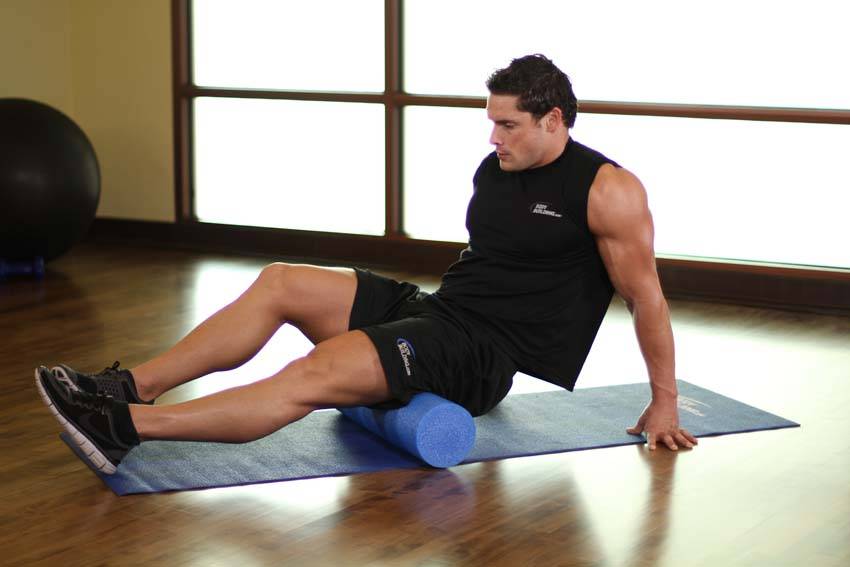
The movement
Form cues
- 01
Sit on the floor and place the foam roller under the back of one thigh, just above the knee.
- 02
Put both hands flat on the floor behind your hips, fingers pointing away from you, to hold yourself up.
- 03
Lift your hips off the floor by pressing into your hands so your weight rests on the roller, not the floor.
- 04
Shift most of your weight onto the leg you want to work — let the other foot rest lightly on the floor for balance.
- 05
Slowly push yourself forward with your hands so the roller travels up toward your hip, then ease back down toward the knee.
- 06
When you hit a spot that feels tight or tender, stop and hold there for 20 to 30 seconds — let the muscle soften under the pressure.
- 07
Keep your foot relaxed and your hamstring loose — you are not flexing, you are letting the roller do the work.
- 08
Breathe slowly and steadily throughout; holding your breath makes the muscles tighten up.
Dosage
How long, how many
Sets
1
Reps
60-90 seconds per leg
Rest
0 sec
Watch for
Common mistakes
Rolling too fast — if you zip back and forth quickly, you won't release anything. Slow down to about two inches per second.
Sitting on the floor instead of lifting your hips — if your hips are down, almost no weight is on the roller and you'll feel very little effect.
Tensing the leg being rolled — if your foot is flexed hard or your thigh feels rigid, consciously let it go limp.
Skipping the tender spots — the urge is to roll past the sore areas, but those are exactly the spots that need the pause.
Rolling directly over the back of the knee — keep the roller above the knee crease at all times to avoid pressing on the joint.
Scale it
Easier and harder variations
Easier
Keep both legs on the roller at the same time so less of your body weight presses down, reducing the intensity.
Use this when the pressure on one leg feels too sharp or uncomfortable to hold.
Harder
Cross your free ankle over the working thigh to stack more weight on the roller and increase the pressure.
Use this when you can no longer feel much sensation rolling one leg alone.
Note
Sit in a sturdy chair and use a small massage ball or a rolled-up towel placed under your thigh instead of a foam roller on the floor.
Use this if getting down to the floor and back up is difficult due to knee, hip, or balance concerns.
Sources
Form descriptions and cues are sourced from wger (CC-BY-SA 4.0) and the Free Exercise DB (public domain), edited for the 60+ audience. MET value cites Ainsworth BE, et al. 2011 Compendium of Physical Activities. Med Sci Sports Exerc 43(8):1575-1581.
- free-exercise-db · Unlicense / Public Domain
- claude