
Turkish · Adana · dinner
Adana Kebabı (Spicy Hand-Minced Lamb Kebab)
Adana kebabı
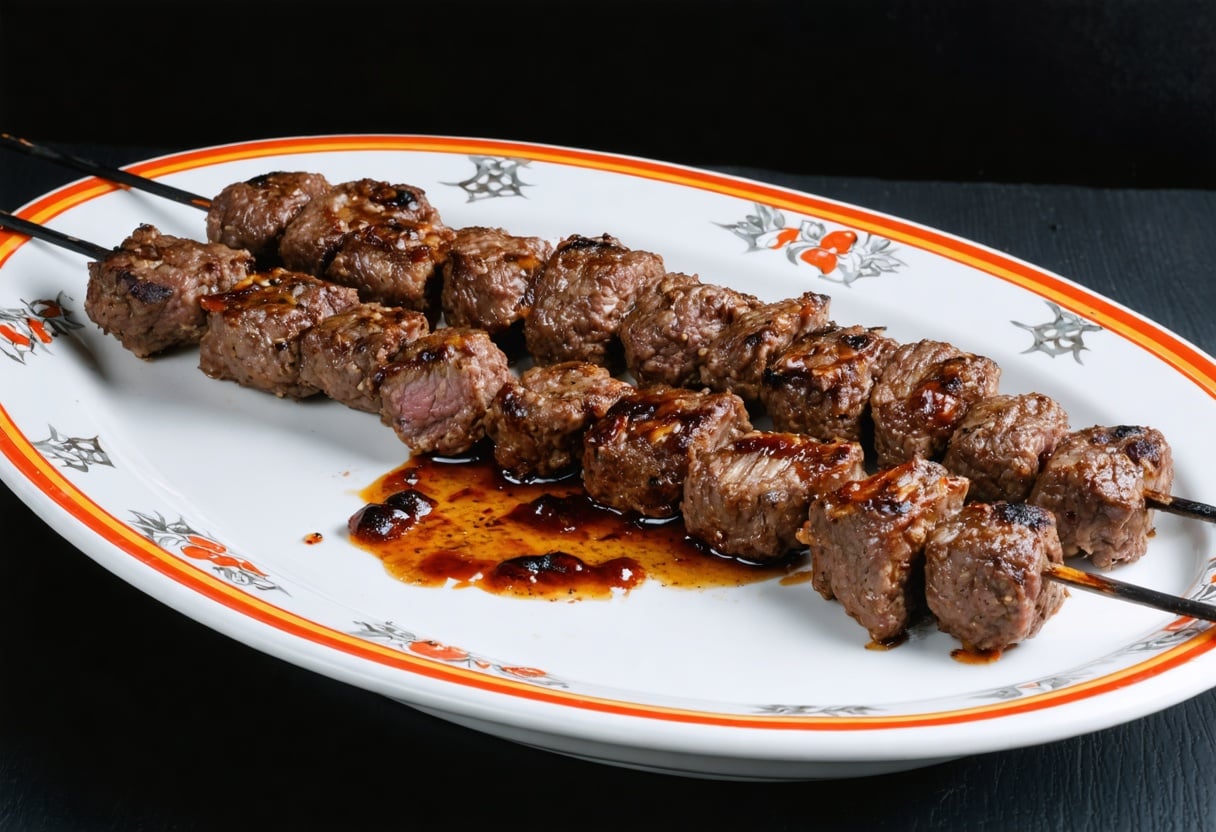
Adana kebabı comes from Turkey's southern city of the same name, where butchers still hand-chop lamb shoulder and tail fat together into a coarse, sticky paste that grills into something no food processor can replicate. It's the spicier, bolder cousin of Urfa kebab — red with pul biber and pepper paste, charred on the outside and juicy within — and it's the kind of meal that turns a backyard grill into a proper occasion.
Scan to log · 906 kcal · 47g protein
Point a phone camera at the code to open this recipe — or scan it from a printout to drop today's serving straight into your food log.
Add to today's log →Prep
45 min
Cook
20 min
Rest
60 min
Total
125 min
Servings
4
Difficulty
Medium
What you need
Ingredients
bone-in lamb shoulder, deboned and trimmed to ~20% fat (ask your butcher, or use 80/20 ground lamb as a fallback)
2 lbs
900g
lamb fat trimmings (from the shoulder above) — or substitute beef suet or beef fat from butcher
3 oz
85g
Substitution · hard-to-find
Original: kuyruk yağı (lamb tail fat). Lamb tail fat is the authentic choice and gives a sweeter, richer result. Use fat trimmings from the shoulder, beef suet, or ask a butcher for beef fat. Avoid pork fat — it changes the flavor profile entirely.
Aleppo pepper (pul biber) — see substitution note
2 tbsp
16g
Substitution · specialty-store
Original: pul biber (Maraş or Aleppo pepper). Aleppo pepper is available at Whole Foods and Middle Eastern markets. If you can't find it, mix 1½ tbsp sweet paprika + ½ tbsp red pepper flakes. The real thing has a fruity, oily quality no blend quite matches, but the sub works.
Turkish or Middle Eastern red pepper paste (biber salçası) — see substitution note
1½ tbsp
22g
Substitution · specialty-store
Original: biber salçası (Turkish red pepper paste). Find it at Middle Eastern or Turkish grocery stores. Substitute: 1 tbsp tomato paste + ½ tbsp sweet paprika + a tiny pinch of cayenne, stirred together. The paste adds depth and a slight sweetness — don't skip it entirely.
garlic cloves, minced to a paste
3 cloves
12g
fine sea salt
1¼ tsp
7g
black pepper, freshly ground
½ tsp
1g
ground cumin
½ tsp
1g
red onion, very finely grated (squeeze out excess liquid)
½ medium onion (about ¼ cup grated)
60g
flat-leaf parsley, leaves only, finely chopped
3 tbsp
10g
lavash or thin flatbread (store-bought is fine)
4 large pieces
4 pieces (approx. 200g total)
Roma or plum tomatoes, halved lengthwise
4 medium (about 1 lb)
450g
long mild green peppers (Anaheim, Italian frying, or Turkish sivri biber if available)
4 peppers (about 10 oz)
280g
red onion, thinly sliced into half-moons (for sumac onion salad)
1 large (about 1½ cups sliced)
150g
sumac — see substitution note
1½ tsp
4g
Substitution · specialty-store
Original: sumac. Sumac is worth finding — Whole Foods, Middle Eastern markets, or online. Substitute: 1 tsp lemon zest plus a tiny pinch of citric acid (or an extra squeeze of lemon juice). It won't be quite as floral, but it does the job on the onion salad.
flat-leaf parsley, roughly chopped (for sumac onion salad)
¼ cup loosely packed
8g
kosher salt (for onion salad)
¼ tsp
1.5g
vegetable oil or olive oil (for brushing grill and vegetables)
2 tbsp
30ml
Substitution · accessibility
Original: neutral oil or olive oil. The original called for a neutral oil (such as grapeseed or avocado oil) or olive oil. Plain vegetable oil or canola oil — available at every major chain — works perfectly here for brushing the grill and vegetables. Olive oil is equally fine and widely available; use whichever you have on hand. There is no meaningful flavor or authenticity loss at these quantities.
How to cook it
Steps
- 01
15 min
HAND-MINCE THE MEAT (or prep your ground lamb): If you're starting with bone-in lamb shoulder, chill the meat and fat in the freezer for 20 minutes — cold fat is easier to work with. Using a large, heavy knife or cleaver, chop the meat and fat together on a large cutting board, working in a rocking motion, folding the pile back on itself every minute or so. You're aiming for a coarse, sticky paste — finer than a rough chop, but not as smooth as a food processor grind. This takes about 8–10 minutes of active chopping. If using pre-ground lamb, skip this step but know the texture will be softer.
- 02
8 min
MIX THE KEBAB PASTE: Transfer the minced lamb and fat to a large bowl. Add the Aleppo pepper, red pepper paste, minced garlic, salt, black pepper, cumin, grated onion (squeeze it in your fist first to remove liquid — too much moisture and the kebab won't hold the skewer), and chopped parsley. Mix with your hands for 3–4 minutes, kneading and folding like a dough. You want the mixture to become cohesive and slightly tacky — it should pull away from the bowl cleanly. This kneading is not optional; it develops the protein bonds that keep the kebab on the skewer.
- 03
60 min
REST THE MIXTURE: Cover the bowl tightly with plastic wrap and refrigerate for at least 1 hour (up to overnight). The rest lets the spices bloom into the fat and firms the mixture so it grips the skewer. Don't skip this.
- 04
5 min
MAKE THE SUMAC ONION SALAD: While the meat rests, combine the sliced red onion, sumac, salt, and chopped parsley in a small bowl. Toss well and squeeze the onion gently with your hands — this softens it slightly and helps the sumac coat everything. Taste and adjust salt. Set aside at room temperature; it gets better as it sits.
- 05
25 min
PREPARE YOUR GRILL: Light a charcoal grill and let it burn down to glowing coals with a white-gray ash — this takes 20–25 minutes. You want high, direct heat. If using a gas grill, preheat all burners to high for 10 minutes. Brush the grates clean and oil them lightly with vegetable oil or olive oil using a folded paper towel held with tongs. Charcoal is strongly preferred here; the fat dripping onto coals creates the smoke that defines this dish.
- 06
10 min
FORM THE KEBABS: Divide the rested meat into 8 equal portions (about 3.5 oz / 100g each). Have a small bowl of cold water nearby to wet your hands — this prevents sticking. Take one portion and press it firmly around a wide flat metal skewer (at least ¾ inch / 2cm wide — a round skewer won't work; the meat will spin and fall off). Squeeze and press the meat along the skewer in a long, even cylinder about 8–9 inches long, pinching the ends to seal. Repeat with remaining portions. If you don't have flat skewers, shape the kebabs into flattened logs and grill them directly on the grates, turning carefully.
- 07
10 min
GRILL THE VEGETABLES: Brush the tomato halves and whole green peppers with vegetable oil or olive oil. Place them on the hot grill alongside the kebabs (or just before). Grill the peppers, turning occasionally, until charred and softened, about 8–10 minutes. Grill the tomatoes cut-side down first for 3–4 minutes until charred, then flip for 2 more minutes. Remove and keep warm.
- 08
10 min
GRILL THE KEBABS: Place the skewers on the hottest part of the grill. Grill for 3–4 minutes per side — you want a deep char on the outside while the inside stays just cooked through and juicy. Don't press them down. Total grill time is about 8–10 minutes. The fat will drip and flare; that's correct and desirable. If flare-ups are out of control, shift the skewers briefly to a cooler zone.
- 09
5 min
WARM THE LAVASH AND PLATE: In the last 2 minutes of grilling, lay the lavash pieces directly on the grill grates for 30–45 seconds per side — just enough to warm and pick up a little char. To serve the traditional way: lay a piece of warm lavash on each plate, slide the kebabs off the skewer onto the bread (the bread catches the juices — eat it), and arrange the grilled tomatoes and peppers alongside. Pile the sumac onion salad on top of or beside the kebabs. Serve immediately.
Chef notes
Notes & variations
The wide flat skewer is not optional if you want to grill on a skewer — the meat is too soft for a round skewer. Flat metal skewers (also called 'sword skewers') are inexpensive online and worth owning.
Authentic Adana kebab is genuinely spicy. If you're heat-sensitive, reduce the Aleppo pepper to 1 tablespoon. If you want to go the other direction, add a pinch of cayenne.
The hand-mincing step is what separates this from a standard ground lamb kebab. The coarser, uneven texture gives the finished kebab a better bite. If you use pre-ground lamb, buy it from a butcher and ask for a coarse grind with fat included.
Leftover kebab meat (uncooked) freezes beautifully on the skewer, wrapped tightly. Grill from frozen over medium heat, adding a few extra minutes per side.
A simple full-fat plain yogurt thinned with a little water and seasoned with garlic and salt (cacık-style) makes an excellent sauce alongside this — it cools the heat and rounds out the meal.
In Adana, this is always served with şalgam suyu (fermented purple turnip juice) — bracingly sour and funky. You can find it at Turkish or Middle Eastern markets. Ayran (salted yogurt drink) is the more widely available pairing.
Per serving
Nutrition
Calories
906
Protein
46.7 g
Carbs
34 g
Fat
63.3 g
Fiber
6.8 g
Sugars
1.2 g
Sat fat
28.7 g
Sodium
1113 mg
Minerals & vitamins
Potassium
1077 mg
Calcium
80 mg
Iron
5.7 mg
Magnesium
75 mg
Vit D
0 IU
Vit B12
5.9 mcg
Cholesterol
179 mg
Glycemic profile
GI
12.1
GL
4.1
- · Unknown unit "each"; assumed 50g per quantity
- · LLM tiebreak failed for "sumac — see substitution note" — picked first result as fallback
Storage
How long it keeps
Fridge
4 days
Freezer
3 months
Room temp
2 hours
Reheating · Reheat to 165°F / 74°C internal. Slice cold for salads.
Source: foodkeeper
Real products
Where to buy
Real grocery products surfaced via Open Food Facts. Click a product to see its OFF page (ingredients, allergens, Nutri-Score breakdown).
garlic cloves, minced to a paste
- Whole garlic cloves in brine
Nutri-Score C
fine sea salt
black pepper, freshly ground
ground cumin
red onion, very finely grated (squeeze out excess liquid)
red onion, thinly sliced into half-moons (for sumac onion salad)
kosher salt (for onion salad)


