
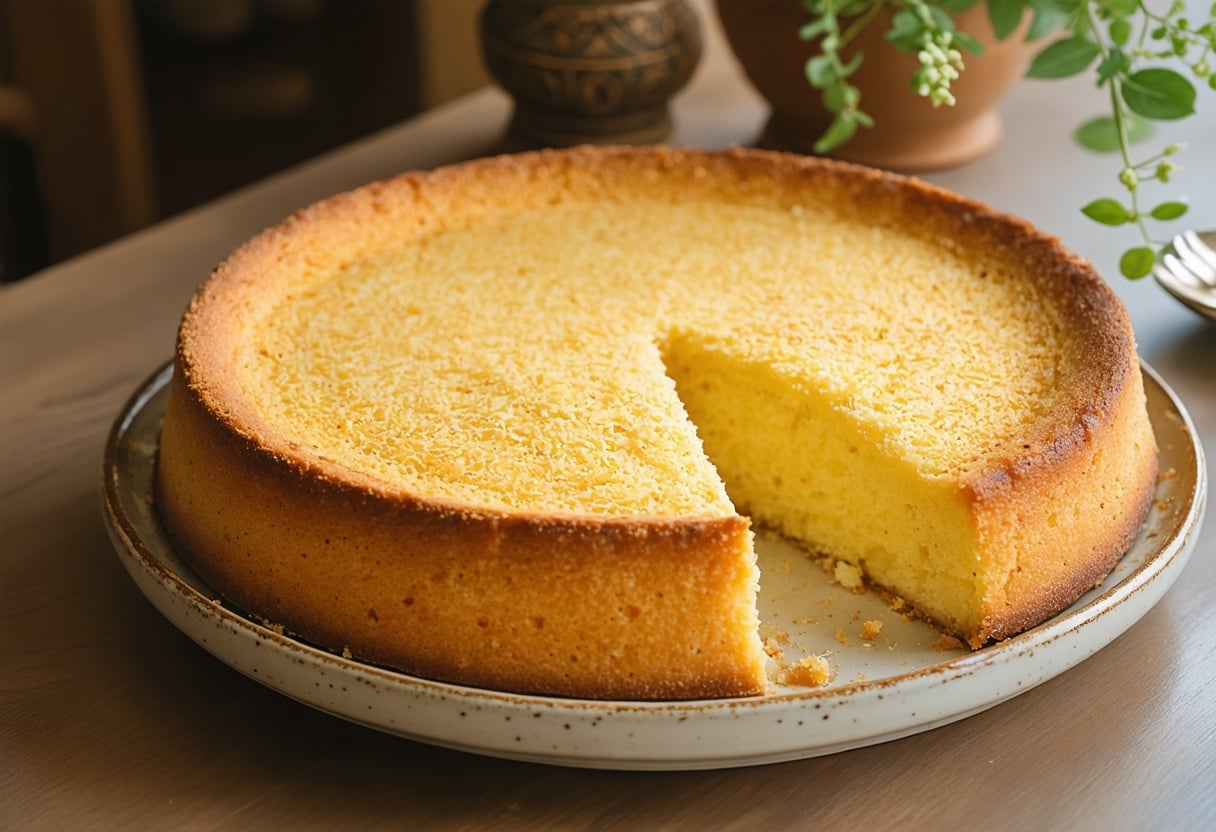
Egyptian · Nationwide; a staple from Alexandria to Aswan · dessert
Basbousa (Semolina Yogurt Cake)
بسبوسة
Basbousa is Egypt's beloved semolina cake — dense, moist, and fragrant with citrus and warm vanilla. It's served at celebrations and everyday gatherings alike, cut into diamonds and soaked in syrup while still hot so every bite is tender all the way through. Egyptian basbousa leans a touch less sweet than its Lebanese cousin namoura, letting the yogurt's gentle tang and the semolina's nuttiness come forward. Note: authentic basbousa is perfumed with rose water and orange blossom water; this version substitutes fresh orange zest and a hint of almond extract for supermarket accessibility — the cake is wonderful, but the true floral character comes through only with the traditional waters.
Scan to log · 280 kcal · 5g protein
Point a phone camera at the code to open this recipe — or scan it from a printout to drop today's serving straight into your food log.
Add to today's log →Prep
15 min
Cook
35 min
Rest
15 min
Total
65 min
Servings
12
Difficulty
Easy
What you need
Ingredients
coarse semolina (semolina flour will not give the right texture — look for 'coarse' or 'durum semolina')
2 cups
340g
full-fat plain yogurt
1 cup
245g
granulated sugar
1/2 cup
100g
unsalted butter, melted and cooled slightly
6 tablespoons
85g
baking powder
1 teaspoon
4g
vanilla extract
1 teaspoon
5ml
whole blanched almonds (for topping — one per diamond)
about 24 almonds
30g
almond extract
1/8 teaspoon
0.6ml
Substitution · accessibility
Original: rose water (maa ward) — 1 tablespoon. Rose water provides a distinctly floral, perfumed quality that is central to authentic Egyptian basbousa. This substitution (extra vanilla + a whisper of almond extract) adds gentle warmth and a faint nuttiness but cannot replicate the true floral character. If you can find rose water at a Middle Eastern, Indian, or international grocery store, or online, use 1 tablespoon of it in the syrup in place of this almond extract and reduce vanilla to 1/2 teaspoon total.
finely grated orange zest
1 teaspoon
2g
Substitution · accessibility
Original: orange blossom water (maa zahr) — 1 tablespoon. Orange blossom water has a heady, floral citrus fragrance quite different from fresh orange zest, which is brighter and more straightforwardly citrusy. The zest keeps a citrus note in the syrup but loses the blossom character. If you can find orange blossom water at a Middle Eastern, Indian, or international grocery store, or online, use 1 tablespoon in the syrup instead of the zest.
granulated sugar (for syrup)
1 cup
200g
water (for syrup)
3/4 cup
180ml
fresh lemon juice (for syrup)
1 teaspoon
5ml
How to cook it
Steps
- 01
10 min
Make the syrup first so it has time to cool. Combine 1 cup sugar, 3/4 cup water, and 1 teaspoon lemon juice in a small saucepan. Bring to a boil over medium heat, stirring until the sugar dissolves. Reduce heat and simmer 8 minutes until slightly thickened — it should coat a spoon lightly but not be sticky-thick. Remove from heat, stir in the orange zest, and set aside to cool completely. (Active time: about 10 minutes.)
- 02
5 min
Preheat your oven to 350°F (175°C). Butter a 9×13-inch (23×33 cm) baking pan generously, or use an equivalent round or square pan — the cake should be about 1 inch thick.
- 03
15 min
In a large bowl, whisk together the semolina, 1/2 cup sugar, and baking powder. Add the yogurt, melted butter, vanilla extract, and almond extract. Stir with a wooden spoon or spatula until a thick, uniform batter forms. It will be quite stiff — that's right. Let the batter rest 10 minutes so the semolina absorbs the moisture; it will firm up further. (Active time: 5 minutes, then 10 minutes rest.)
- 04
5 min
Spread the batter evenly into the prepared pan, pressing it out with wet fingers or the back of a damp spoon to an even layer. Score the top with a sharp knife into diamond or square shapes — cut about halfway through. Press one blanched almond into the center of each diamond. (Active time: 5 minutes.)
- 05
35 min
Bake for 30–35 minutes, until the top is deep golden brown and the edges have pulled away slightly from the pan. The color matters here — pale basbousa is underbaked. (Active time: 2 minutes to check; oven does the work.)
- 06
18 min
As soon as the cake comes out of the oven, re-cut along your scored lines all the way through. Immediately pour the cooled syrup evenly over the hot cake — go slowly and cover every section. You'll hear it sizzle. Let the cake rest at room temperature for at least 15 minutes before serving; this is when it transforms from dry to moist. (Active time: 3 minutes, then 15 minutes rest.)
- 07
2 min
Serve at room temperature, directly from the pan. Basbousa is best the day it's made but keeps well covered at room temperature for 2 days, or refrigerated for up to 5 days. Bring refrigerated pieces back to room temperature before eating — cold basbousa loses its texture.
Chef notes
Notes & variations
Coarse semolina is the key to basbousa's characteristic grainy-yet-moist texture. Fine semolina or semolina flour makes a smoother, denser cake that's closer to a polenta cake — fine in a pinch, but not quite the same. Look for 'coarse semolina' or 'durum wheat semolina' at Middle Eastern grocery stores or online.
The syrup must be cool when it hits the hot cake (or vice versa — hot syrup on cool cake also works). Same-temperature syrup and cake leads to a soggy result. Since you make the syrup first here, it will be ready.
This version substitutes rose water and orange blossom water — the traditional fragrant waters that define authentic basbousa's floral perfume — with vanilla extract, a touch of almond extract, and fresh orange zest. The cake will be delicious and recognizably basbousa, but the signature floral character is muted. If you can source rose water and orange blossom water (Middle Eastern or Indian grocery stores, or online), use 1 tablespoon of each in the cooled syrup, replace the orange zest with them, and reduce vanilla to 1/2 teaspoon and omit the almond extract entirely.
Egyptian basbousa is intentionally less sweet than some regional versions. If you prefer a sweeter cake (closer to Lebanese namoura), increase the cake sugar to 3/4 cup and the syrup sugar to 1 1/4 cups.
For a Coptic-fast-friendly (dairy-free) version: substitute the yogurt with full-fat coconut yogurt or plain oat yogurt, and replace the butter with 5 tablespoons of neutral oil (corn or sunflower). The texture is slightly less rich but still excellent.
Some Egyptian home cooks add 2 tablespoons of desiccated coconut to the batter — a regional variation that adds a subtle chew. Try it if you like coconut.
Per serving
Nutrition
Calories
280
Protein
5.1 g
Carbs
47.2 g
Fat
8.4 g
Fiber
1.2 g
Sugars
45.6 g
Sat fat
4.4 g
Sodium
55 mg
Minerals & vitamins
Potassium
93 mg
Calcium
63 mg
Iron
0.5 mg
Magnesium
17 mg
Vit D
0 IU
Vit B12
0 mcg
Cholesterol
20 mg
Glycemic profile
GI
63.3
GL
29.8
- · LLM tiebreak failed for "baking powder" — picked first result as fallback
- · LLM tiebreak failed for "rose water" — picked first result as fallback
Storage
How long it keeps
Fridge
7 days
Freezer
2 months
Room temp
72 hours
Reheating · Baklava, basbousa, namoura. Sugar acts as a preservative — many keep 3 days at room temp.
Source: foodkeeper
Real products
Where to buy
Real grocery products surfaced via Open Food Facts. Click a product to see its OFF page (ingredients, allergens, Nutri-Score breakdown).
granulated sugar
unsalted butter, melted and cooled slightly
baking powder
vanilla extract
rose water
granulated sugar (for syrup)
water (for syrup)
fresh lemon juice (for syrup)
- Evolution fresh, vegetable and fruit juice blend, sweet greens and lemon, sweet greens and lemon
Evolution Fresh
Nutri-Score B


