
Warm-up · Beginner
Dynamic Back Stretch
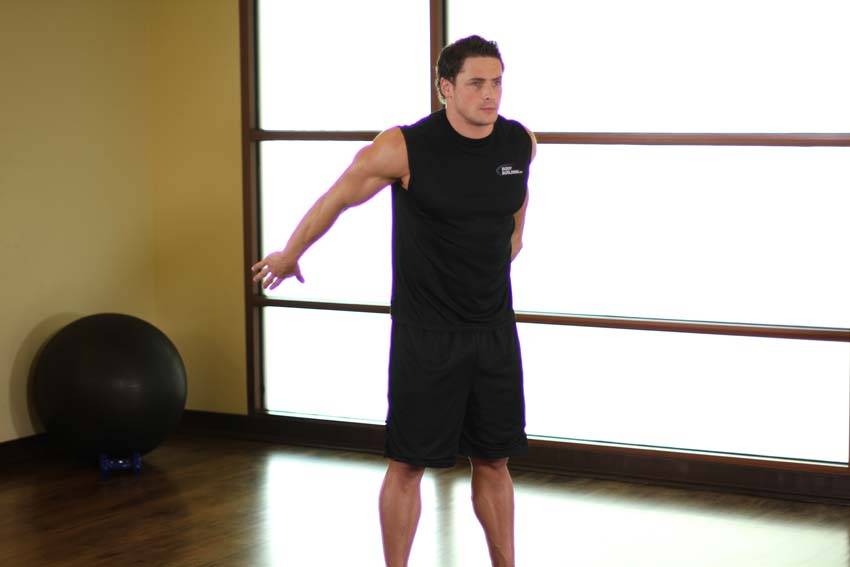
This is a gentle arm-swinging movement that warms up your upper back and shoulders before more demanding activity. By gradually increasing how high your arms swing, you coax the muscles and joints through a growing range of motion without forcing anything. It's a smart first move before gardening, lifting, or any overhead work — it tells your back 'we're about to move' rather than surprising it.
Category
Warm-up
Difficulty
Beginner
Equipment
Bodyweight
MET
2.3
Primary muscles
The movement
Form cues
- 01
Stand with your feet shoulder-width apart and let your arms hang relaxed at your sides.
- 02
Keep your knees soft — a very slight bend, not locked straight.
- 03
Start the first swing low, bringing both arms only to chest height, then let them fall back down.
- 04
Each swing, reach a little higher — aim to get your arms overhead by the 8th to 10th rep.
- 05
Keep your elbows straight but not rigid as your arms rise and fall.
- 06
Let your upper back round slightly as your arms come forward — that gentle rounding is the stretch working.
- 07
Breathe out as your arms swing up, breathe in as they come back down.
- 08
Move at a steady, controlled pace — this is not a fast flap, it's a slow, deliberate swing.
Dosage
How long, how many
Sets
2
Reps
8-10
Rest
30 sec
Watch for
Common mistakes
Starting too high too fast — if your first swing is already at shoulder height, you've skipped the warm-up purpose; begin small and build gradually.
Locking the elbows straight and stiff — if your arms feel rigid or your shoulders hitch up toward your ears, soften the elbows slightly.
Holding your breath — if you feel tension building in your neck or shoulders, check that you're actually exhaling on the upswing.
Swinging so fast the movement becomes uncontrolled — if your torso is rocking back and forth, slow down until only your arms are moving.
Arching the lower back as arms go overhead — if you feel a pinch in your low back at the top of the swing, tighten your stomach slightly to keep your spine neutral.
Scale it
Easier and harder variations
Easier
Sit upright in a sturdy chair and do the same arm swings from seated — your feet flat on the floor, swinging arms forward and up.
Use this if standing balance is a concern or if you tire quickly on your feet.
Harder
At the top of each swing, pause for a full second with arms overhead before lowering — this adds a brief hold that deepens the stretch.
Use this once the basic movement feels easy and your range of motion has improved.
Note
If one shoulder is sore or recently injured, swing only the unaffected arm and let the other arm rest at your side — or limit the range to pain-free height only.
Use this during shoulder recovery or if you have a rotator cuff issue on one side.
Sources
Form descriptions and cues are sourced from wger (CC-BY-SA 4.0) and the Free Exercise DB (public domain), edited for the 60+ audience. MET value cites Ainsworth BE, et al. 2011 Compendium of Physical Activities. Med Sci Sports Exerc 43(8):1575-1581.
- free-exercise-db · Unlicense / Public Domain
- claude