
Warm-up · Beginner
Chair Upper Body Stretch
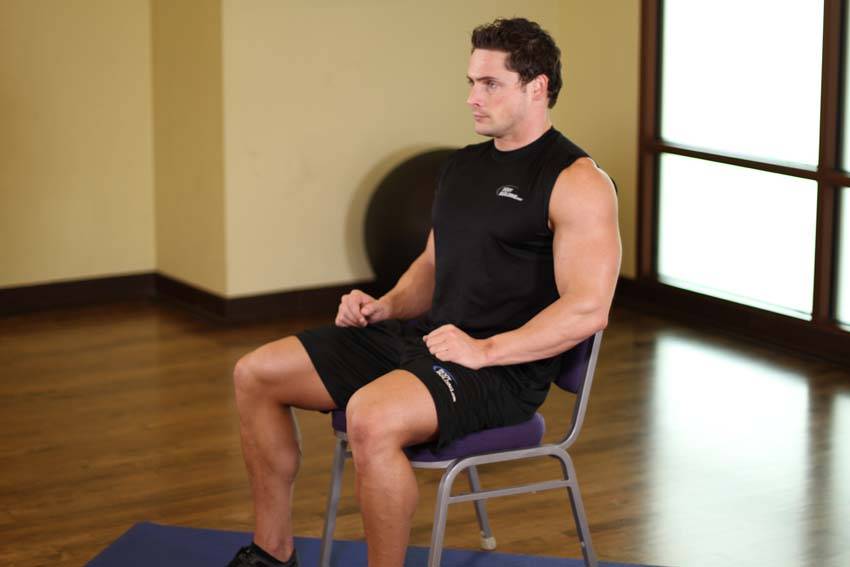
This seated stretch opens up the shoulders, chest, and the front of the arms — areas that tend to tighten from sitting, driving, or working at a desk. You use the back of a sturdy chair as an anchor to gently pull your upper body forward into the stretch. No special equipment needed, and it can be done anywhere you have a solid chair. It's a great way to start a workout or unwind after one.
Category
Warm-up
Difficulty
Beginner
Equipment
Other
MET
2.3
Primary muscles
Secondary muscles
The movement
Form cues
- 01
Sit near the front edge of the chair so your feet are flat on the floor, hip-width apart.
- 02
Reach both hands back and grip the top of the chair back firmly — use a full-hand grip, not just fingertips.
- 03
Straighten your arms as much as comfortable, letting your hands stay anchored on the chair.
- 04
Sit tall first — lengthen your spine before you lean forward.
- 05
Slowly lean your chest forward and slightly downward until you feel a gentle pull across your shoulders and chest.
- 06
Keep your chin level — don't let your head drop or jut forward.
- 07
Breathe steadily and hold the stretch for 20 to 30 seconds without bouncing or forcing it deeper.
- 08
Release slowly by sitting upright before letting go of the chair.
Dosage
How long, how many
Sets
3
Reps
1 hold per set
Rest
30 sec
Watch for
Common mistakes
Rounding the back — if your shoulders are hunching forward, sit taller and think about lifting your chest before leaning in.
Gripping with only the fingertips — this reduces control and can strain the fingers; wrap your whole hand around the chair back.
Holding your breath — if you notice you've gone quiet and stiff, exhale and let your chest soften into the stretch.
Jerking or bouncing to go deeper — a stretch should be steady; if you're pulsing, slow down and hold still.
Leaning so far forward you lose your balance — keep your feet firmly planted and only go as far as feels stable and controlled.
Scale it
Easier and harder variations
Easier
Place your hands lower on the chair back, closer to shoulder height, to reduce the range of motion and intensity of the stretch.
Use this if you feel sharp discomfort in the shoulders or have limited shoulder mobility.
Harder
Interlace your fingers behind your back instead of holding the chair, then gently lift your clasped hands away from your body as you lean forward.
Try this once the chair version feels easy and your shoulder flexibility has improved.
Note
If one shoulder is sore or recently injured, grip the chair with only the unaffected hand and let the other arm rest at your side, stretching only as far as pain-free.
Use for shoulder injuries, recent surgery, or significant asymmetry in shoulder range of motion.
Sources
Form descriptions and cues are sourced from wger (CC-BY-SA 4.0) and the Free Exercise DB (public domain), edited for the 60+ audience. MET value cites Ainsworth BE, et al. 2011 Compendium of Physical Activities. Med Sci Sports Exerc 43(8):1575-1581.
- free-exercise-db · Unlicense / Public Domain
- claude