
Strength · Beginner
Band Good Morning
The good morning is a hinge movement where you bow forward at the hips while keeping your back flat, then stand back up. A resistance band looped behind your neck adds gentle tension that trains your hamstrings, glutes, and lower back to work together — the same muscles that help you pick things up off the floor and protect your spine all day long. It's a low-impact way to build the posterior chain strength that keeps you upright and moving well.
Category
Strength
Difficulty
Beginner
Equipment
Resistance band
MET
3.5
Primary muscles
Secondary muscles
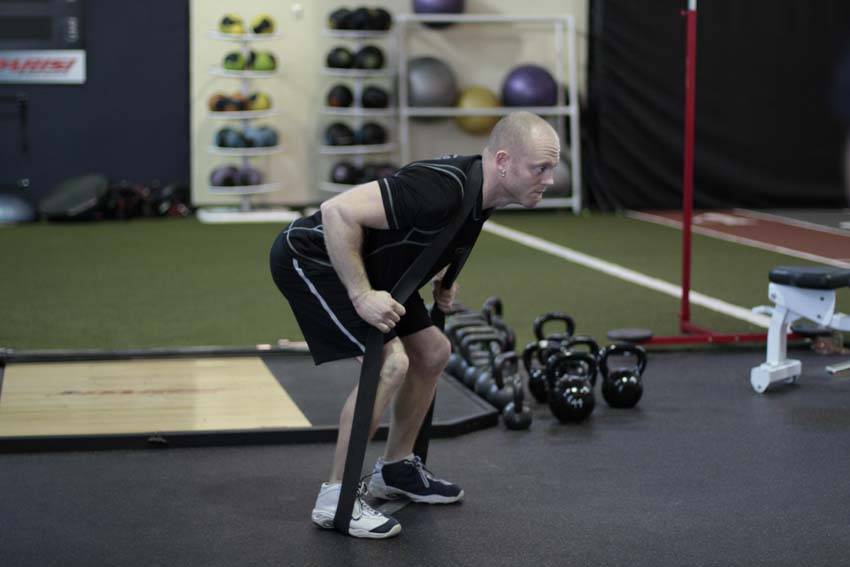
The movement
Form cues
- 01
Stand on the center of the band with feet about hip-width apart, toes pointing slightly outward.
- 02
Bend forward at the hips to loop the far end of the band behind your neck, resting it across your upper shoulders — not on your neck bones.
- 03
Stand tall before you begin: chest up, shoulders back, soft bend in the knees.
- 04
Take a breath in, then push your hips straight back like you're trying to touch the wall behind you.
- 05
Keep your back flat — imagine balancing a broomstick along your spine from tailbone to head.
- 06
Lower until you feel a gentle pull in the backs of your thighs, or until your torso is roughly parallel to the floor — whichever comes first.
- 07
Press your feet into the floor and drive your hips forward to stand back up, exhaling as you rise.
- 08
Pause fully upright at the top before starting the next rep.
Dosage
How long, how many
Sets
3
Reps
8-12
Rest
60 sec
Watch for
Common mistakes
Rounding the lower back — if your tailbone tucks under or your mid-back hunches, you've gone too far; stop a few inches higher.
Bending the knees too much and turning it into a squat — keep a slight, fixed bend in the knees throughout and focus all the movement at the hips.
Letting the band slide up onto the neck — reposition it across the meaty part of your upper shoulders before each set.
Moving too fast on the way down — a rushed descent means momentum is doing the work instead of your muscles; take at least two seconds to lower.
Looking straight up at the ceiling — keep your gaze about two feet in front of you on the floor so your neck stays in line with your spine.
Scale it
Easier and harder variations
Easier
Use a lighter or longer band to reduce resistance, and only hinge until your torso reaches a 45-degree angle rather than going parallel to the floor.
Use this when you're new to the hinge pattern or feel any strain in your lower back.
Harder
Widen your stance slightly and pause for two full seconds at the bottom of each rep before standing back up.
Use this once the standard version feels controlled and easy for all reps.
Note
If you have lower back sensitivity, perform a hip hinge holding a chair back for support and skip the band entirely until your back tolerates the movement comfortably.
Use this after a lower back flare-up or if you feel any sharp pain during the standard version.
Sources
Form descriptions and cues are sourced from wger (CC-BY-SA 4.0) and the Free Exercise DB (public domain), edited for the 60+ audience. MET value cites Ainsworth BE, et al. 2011 Compendium of Physical Activities. Med Sci Sports Exerc 43(8):1575-1581.
- free-exercise-db · Unlicense / Public Domain
- claude