
Strength · Beginner
Band-Assisted Pull-Up
A pull-up with a resistance band looped over the bar gives you a boost at the hardest part of the movement, making this classic upper-body exercise genuinely doable. It builds the large muscles of your back, strengthens your grip, and works the core all at once. That pulling strength translates directly to real life — lifting grocery bags, opening heavy doors, and getting up from the floor.
Category
Strength
Difficulty
Beginner
Equipment
Other
MET
3.5
Primary muscles
Secondary muscles
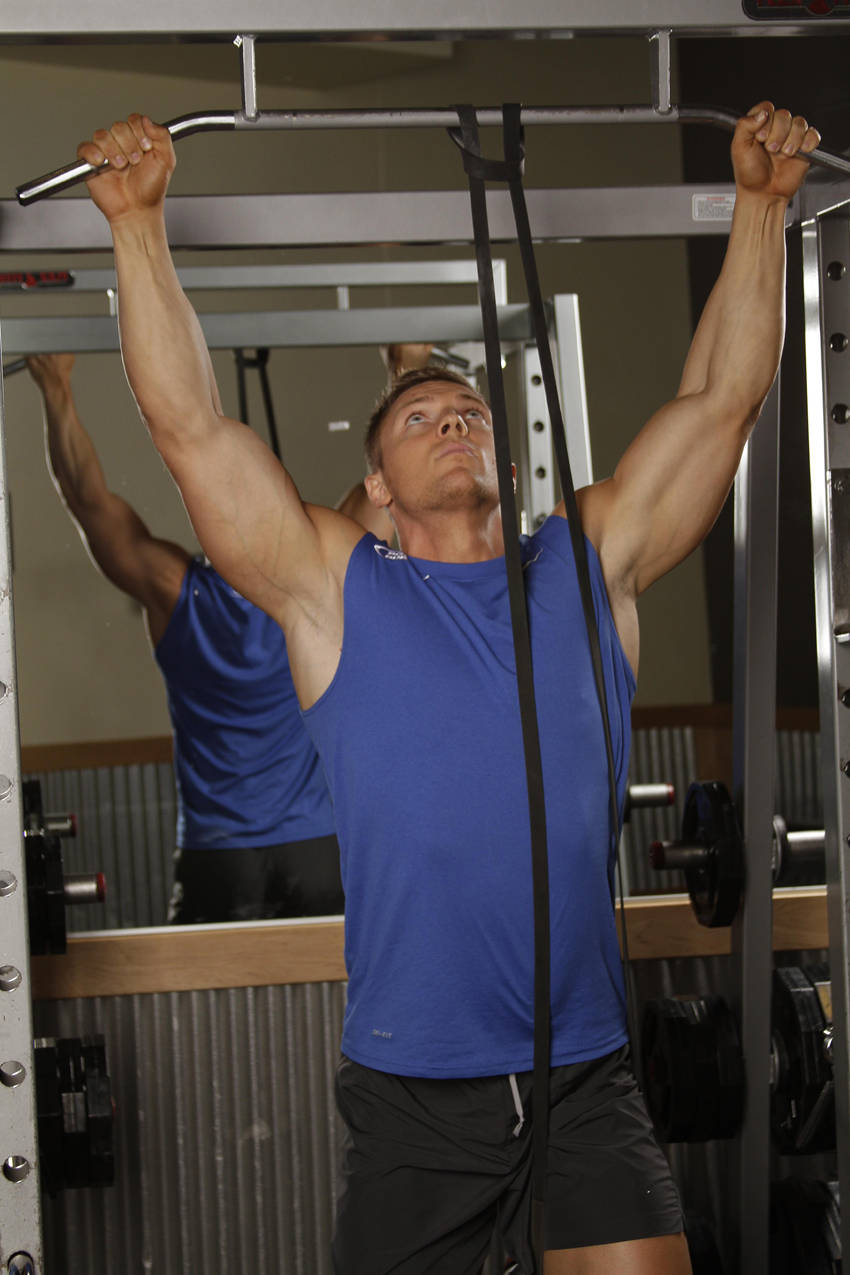
The movement
Form cues
- 01
Loop the band over the center of the pull-up bar and pull the bottom loop down until it hangs at knee height.
- 02
Place one bent knee firmly into the loop — the band should sit just below your kneecap, not at your ankle.
- 03
Grip the bar slightly wider than shoulder-width with your palms facing away from you.
- 04
Let your arms fully straighten and your shoulders relax upward before you begin each rep — this is your starting position.
- 05
Squeeze your shoulder blades together and down, as if you're trying to tuck them into your back pockets.
- 06
Pull your elbows straight down toward your hips — think 'elbows to ribs,' not 'chin to bar.'
- 07
Keep your body still throughout; if your hips are swinging, you're using momentum instead of muscle.
- 08
Pause for a full second at the top with your chin clearing the bar, then lower yourself slowly — count three seconds on the way down.
Dosage
How long, how many
Sets
3
Reps
5-8
Rest
90 sec
Watch for
Common mistakes
Swinging the hips to get up — if your lower body is rocking, you're relying on momentum; pause, reset, and pull with a still body.
Shrugging the shoulders toward the ears at the start — this means your shoulder blades aren't set; relax them down before you pull.
Bending the elbows before pulling the shoulder blades — the shoulders should move first, then the elbows follow.
Dropping too fast on the way down — if the descent takes less than two seconds, you're losing half the benefit; control the lowering.
Gripping the bar so tightly your forearms fatigue before your back — a firm but relaxed grip lets the bigger back muscles do the work.
Using a band that's too light too soon — if you can't complete the rep without jerking, move to a thicker band that gives more assistance.
Scale it
Easier and harder variations
Easier
Use a thicker or doubled resistance band to provide more assistance, or place both knees in the loop instead of one.
Use this when you cannot complete even one controlled rep with a single band.
Harder
Switch to a thinner band that provides less assistance, or pause for two full seconds at the top of each rep before lowering.
Use this when the current band makes the movement feel easy for all reps.
Note
If you have shoulder or elbow discomfort, substitute a seated cable row or a resistance-band lat pulldown performed from a chair, keeping the same 'elbows to ribs' pulling motion.
Use this when overhead pulling causes pain in the shoulder, elbow, or a replaced joint.
Sources
Form descriptions and cues are sourced from wger (CC-BY-SA 4.0) and the Free Exercise DB (public domain), edited for the 60+ audience. MET value cites Ainsworth BE, et al. 2011 Compendium of Physical Activities. Med Sci Sports Exerc 43(8):1575-1581.
- free-exercise-db · Unlicense / Public Domain
- claude