
Strength · Beginner
Balance Board Stand
A balance board is a slightly wobbly platform that challenges your body to make constant small adjustments just to stay upright. That constant micro-correction work strengthens the muscles around your ankles, knees, and hips while sharpening the reflexes that catch you before a stumble becomes a fall. It looks simple, but your legs will feel it. Regular practice builds the kind of quiet, automatic stability that makes everyday surfaces — uneven sidewalks, wet floors, grassy yards — feel far less threatening.
Category
Strength
Difficulty
Beginner
Equipment
Other
MET
3.5
Primary muscles
Secondary muscles
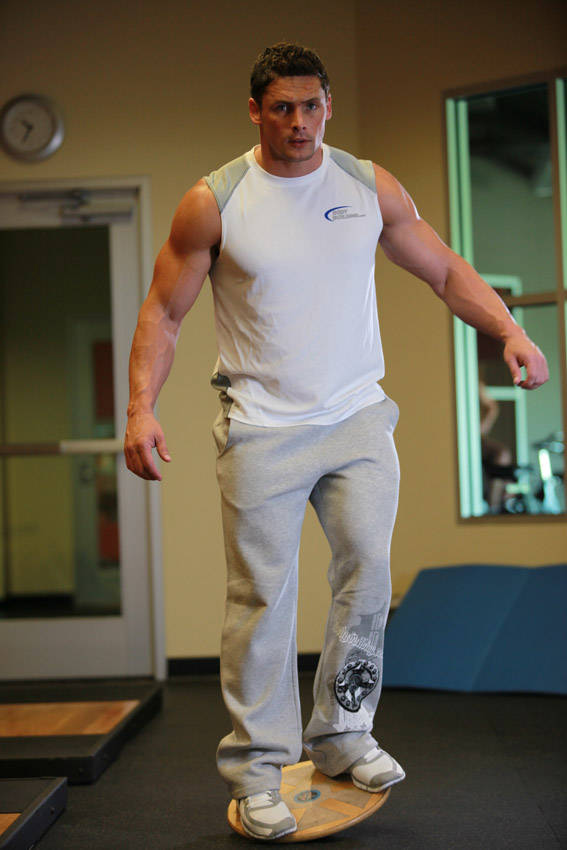
The movement
Form cues
- 01
Place the board on a flat, non-slip surface and stand directly beside a wall or sturdy chair before stepping on.
- 02
Step onto the center of the board with both feet about hip-width apart, toes pointing forward.
- 03
Let your knees soften — a slight bend, not a deep squat — so your legs can absorb the board's movement.
- 04
Keep your weight centered over the middle of your feet, not rocked back onto your heels or forward onto your toes.
- 05
Look at a fixed point on the wall in front of you at eye level — your eyes help your balance more than you'd expect.
- 06
Let your arms hang relaxed at your sides or hold them slightly out for counterbalance — don't grip a railing unless you need it.
- 07
Breathe steadily and let the board tilt; small tilts are the whole point, not something to fight against.
- 08
Work up to holding a steady balance for 30 to 60 seconds before stepping off carefully.
Dosage
How long, how many
Sets
3
Reps
30-60 sec hold
Rest
60 sec
Watch for
Common mistakes
Locking the knees straight — if your legs feel rigid and the board feels uncontrollable, bend your knees a little more.
Gripping the floor with your toes — if your feet feel cramped or tense, consciously spread your toes flat on the board.
Staring down at your feet — this actually throws off your balance; pick a spot on the wall and keep your eyes there.
Standing too close to the edge of the board — if one side keeps bottoming out immediately, check that both feet are centered over the pivot.
Holding your breath — if you notice you're tense and silent, exhale slowly; tension in your torso makes balancing harder.
Stepping off the board without support — always have a hand near a wall or chair when dismounting, especially when fatigued.
Scale it
Easier and harder variations
Easier
Keep one hand lightly touching a wall or the back of a sturdy chair the entire time. Touch, don't grip — let your legs do the work.
Use this when you're new to the board or on any day your balance feels off.
Harder
Close your eyes for 5 to 10 second intervals while balancing. Removing vision forces your ankles and legs to work much harder.
Try this once you can hold a steady balance for 45 seconds with eyes open and no hand support.
Note
If ankle or knee discomfort makes the board feel unsafe, practice single-leg standing on flat ground first — stand on one foot near a counter and hold for 20 to 30 seconds per side.
Use this as a stepping stone if you have a recent ankle sprain, knee replacement, or significant joint pain.
Sources
Form descriptions and cues are sourced from wger (CC-BY-SA 4.0) and the Free Exercise DB (public domain), edited for the 60+ audience. MET value cites Ainsworth BE, et al. 2011 Compendium of Physical Activities. Med Sci Sports Exerc 43(8):1575-1581.
- free-exercise-db · Unlicense / Public Domain
- claude