
Strength · Beginner
Back Flyes With Bands
This exercise uses a resistance band anchored to a fixed post to work the rear shoulders and upper back by pulling your arms out to your sides against the band's tension. It's a practical move for counteracting the rounded-shoulder posture that comes from years of desk work, driving, or looking at screens. Stronger rear shoulders also help protect the rotator cuff and make everyday reaching and lifting feel easier.
Category
Strength
Difficulty
Beginner
Equipment
Resistance band
MET
3.5
Primary muscles
Secondary muscles
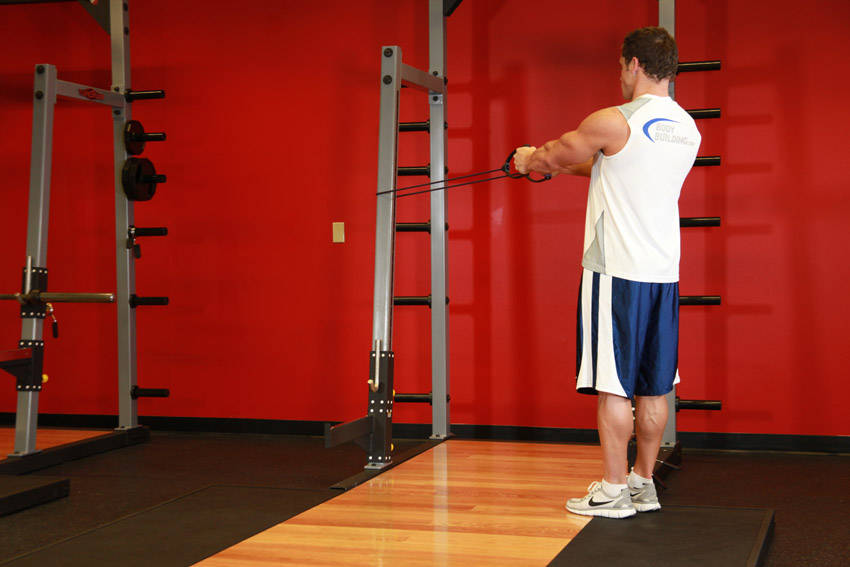
The movement
Form cues
- 01
Loop the band around a sturdy post at about chest height and grab one handle in each hand.
- 02
Step back until the band has noticeable tension with your arms straight out in front of you.
- 03
Stand with feet shoulder-width apart, knees soft — not locked straight.
- 04
Keep your arms at shoulder height and parallel to the floor throughout the movement.
- 05
Squeeze your shoulder blades together as you pull your arms out to your sides, like you're trying to pinch a pencil between them.
- 06
Stop when your arms are fully extended to your sides — don't yank them behind you.
- 07
Pause for one count at the end of the pull, then slowly let the band bring your arms back to the start.
- 08
Breathe out as you pull out, breathe in as you return.
Dosage
How long, how many
Sets
3
Reps
8-12
Rest
60 sec
Watch for
Common mistakes
Bending the elbows during the pull — if your arms are folding, you're turning this into a row; keep them long and nearly straight.
Shrugging your shoulders up toward your ears — if your neck feels cramped, drop your shoulders down before each rep.
Leaning back to muscle the band — if your torso is tilting away from the post, step closer and use a lighter band.
Letting the band snap your arms back too fast — if the return feels uncontrolled, slow it down; that's where half the benefit is.
Standing too close to the anchor point — if there's no tension at the start position, step back until you feel the band working.
Scale it
Easier and harder variations
Easier
Step closer to the anchor point to reduce band tension, or use a lighter band. You can also do one arm at a time, holding a wall or chair with your free hand for balance.
Use this if you struggle to keep your arms parallel to the floor for the full set, or if you feel strain in your neck or lower back.
Harder
Step farther from the anchor point to increase band tension, or use a heavier band. Add a two-count pause at full extension before returning.
Use this once 12 reps feel easy and controlled with your current band.
Note
If you have a shoulder replacement or rotator cuff issue, lower the anchor point to waist height and perform the movement with your arms angled slightly downward rather than at full shoulder height. Check with your physical therapist before adding resistance.
Use this if shoulder-height movement causes pain or was restricted by your doctor or PT.
Sources
Form descriptions and cues are sourced from wger (CC-BY-SA 4.0) and the Free Exercise DB (public domain), edited for the 60+ audience. MET value cites Ainsworth BE, et al. 2011 Compendium of Physical Activities. Med Sci Sports Exerc 43(8):1575-1581.
- free-exercise-db · Unlicense / Public Domain
- claude