
Strength · Beginner
Alternating Floor Press
You lie on your back and press kettlebells overhead one arm at a time, alternating sides. The floor acts as a natural stopper, so there's no risk of lowering the weight too far — making this a safer entry point into pressing movements than a bench press. It builds chest, shoulder, and tricep strength while the alternating pattern quietly challenges your core to stay steady. If you've avoided overhead or chest work due to shoulder concerns, the limited range of motion here is often more forgiving.
Category
Strength
Difficulty
Beginner
Equipment
Other
MET
3.5
Primary muscles
Secondary muscles
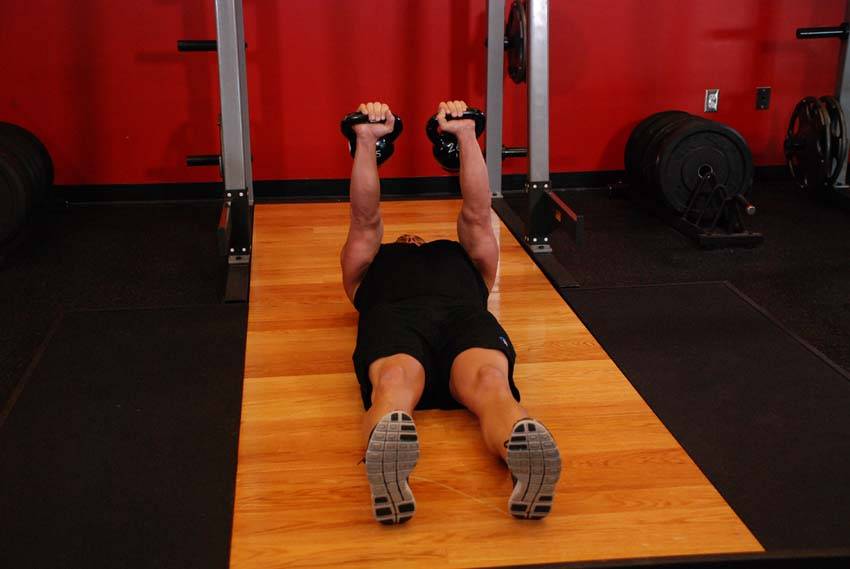
The movement
Form cues
- 01
Lie flat on your back with your knees bent and feet flat on the floor, hip-width apart.
- 02
Place a kettlebell on each side of your chest, gripping the handles firmly with palms facing your feet.
- 03
Press both kettlebells straight up until your arms are fully extended — this is your starting position.
- 04
Lower one kettlebell slowly toward your chest, keeping your elbow at roughly a 45-degree angle from your body — not flared straight out to the side.
- 05
Let the back of your upper arm rest briefly on the floor, then press that kettlebell back up to the locked-out position.
- 06
As you press up, rotate your wrist slightly so your palm faces inward at the top.
- 07
Keep the arm that's staying up steady and still while the other arm moves — your torso should not rock or twist.
- 08
Squeeze your stomach muscles like someone's about to poke you, and press your lower back gently toward the floor throughout.
- 09
Alternate sides with control — this is not a race.
Dosage
How long, how many
Sets
3
Reps
8-12
Rest
60 sec
Watch for
Common mistakes
Flaring the elbow straight out to the side — if your elbow points directly away from your body at 90 degrees, you'll feel it in your shoulder joint; angle it closer to 45 degrees instead.
Letting the resting arm drift or wobble while the other arm moves — if the kettlebell you're holding up is swaying, slow down and reset both arms at the top before each rep.
Arching the lower back off the floor — if you can slide a hand under your back during the press, you're overarching; press your back down gently and re-engage your stomach.
Rushing through the lowering phase — if the kettlebell drops quickly and thuds to your chest, you're losing control; take at least two counts to lower it.
Gripping only with the fingertips instead of the full hand — if the handle feels like it might slip, wrap your whole hand around it and keep your wrist straight, not bent back.
Scale it
Easier and harder variations
Easier
Use a single light dumbbell held in both hands and press straight up with both arms together before switching to one-arm work.
Use this if kettlebells feel awkward to position or if one shoulder is noticeably weaker than the other.
Harder
After pressing one kettlebell up, hold it locked out for a full two-count pause before lowering — this increases the demand on your stabilizing muscles.
Use this once you can complete 3 sets of 12 reps with steady, controlled form.
Note
If you have shoulder discomfort, reduce the range of motion by placing a folded towel under each upper arm so the elbow only lowers to the towel, not all the way to the floor.
Use this if pressing through the full range causes pinching or pain at the front of the shoulder.
Sources
Form descriptions and cues are sourced from wger (CC-BY-SA 4.0) and the Free Exercise DB (public domain), edited for the 60+ audience. MET value cites Ainsworth BE, et al. 2011 Compendium of Physical Activities. Med Sci Sports Exerc 43(8):1575-1581.
- free-exercise-db · Unlicense / Public Domain
- claude