
Strength · Beginner
Alternating Deltoid Raise
This exercise works the front and side portions of your shoulder by lifting a light dumbbell in two directions — straight forward and out to the side — alternating between them. Strong shoulders make it easier to reach overhead, carry groceries, and push yourself up from a chair. Because you alternate directions, you train the whole shoulder without overloading any one part. It's a good starting point if you've been inactive or are rebuilding shoulder strength.
Category
Strength
Difficulty
Beginner
Equipment
Dumbbell
MET
3.5
Primary muscles
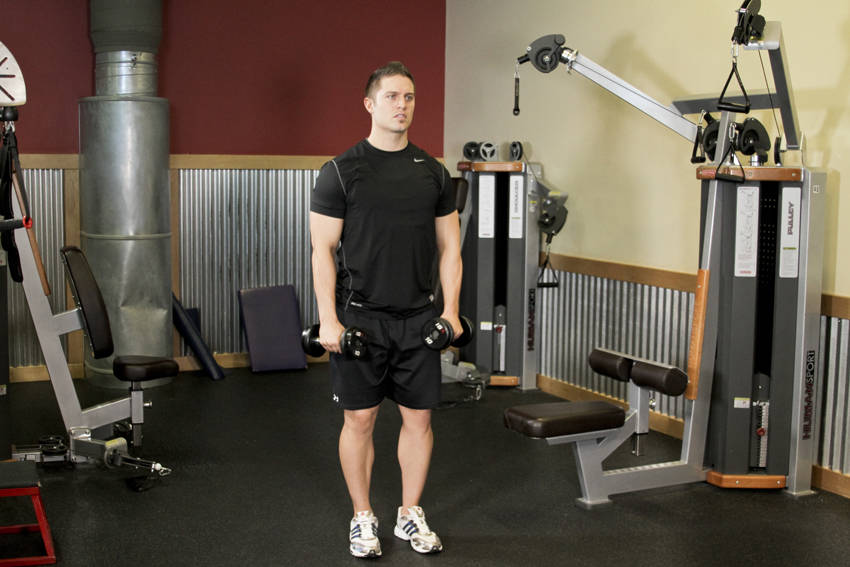
The movement
Form cues
- 01
Stand with your feet shoulder-width apart and a slight bend in your knees — not locked straight.
- 02
Hold one dumbbell in each hand, palms facing your thighs, arms hanging naturally at your sides.
- 03
Keep a soft bend in your elbows throughout — never lock them straight.
- 04
For the front raise: lift one arm forward until your hand is at shoulder height, then lower it slowly back down.
- 05
For the side raise: lift the opposite arm out to the side until your hand reaches shoulder height, then lower it slowly.
- 06
Keep your thumb slightly higher than your pinky as you lift to the side — like you're pouring a glass of water.
- 07
Squeeze your stomach muscles gently on every lift to keep your lower back from arching.
- 08
Move at a steady, controlled pace — about two seconds up and two seconds down.
Dosage
How long, how many
Sets
3
Reps
8-12
Rest
60 sec
Watch for
Common mistakes
Using momentum to swing the weights up — if your torso rocks back as you lift, the weight is too heavy; drop down a size.
Raising above shoulder height — going higher shifts stress onto your neck and upper trap; stop when your arm is parallel to the floor.
Locking the elbow straight — a rigid arm puts strain on the joint; keep a gentle bend the entire time.
Shrugging your shoulders toward your ears during the lift — if your neck disappears, consciously press your shoulders down before you raise.
Rushing through reps — if the weights are clanking or dropping fast, slow down; the lowering phase is half the work.
Scale it
Easier and harder variations
Easier
Use very light dumbbells (2–3 lbs) or even full water bottles, and only raise to chest height rather than shoulder height.
Use this if you feel shoulder discomfort at full height or are just returning to exercise.
Harder
Pause for two full seconds at the top of each raise before lowering — this removes momentum and forces your muscles to work harder.
Try this once 8–12 reps feel easy with your current weight.
Note
Sit upright in a sturdy chair with no armrests and perform the raises seated; this takes stress off your lower back and lets you focus on shoulder control.
Use the seated version if standing causes lower back pain or balance concerns.
Sources
Form descriptions and cues are sourced from wger (CC-BY-SA 4.0) and the Free Exercise DB (public domain), edited for the 60+ audience. MET value cites Ainsworth BE, et al. 2011 Compendium of Physical Activities. Med Sci Sports Exerc 43(8):1575-1581.
- free-exercise-db · Unlicense / Public Domain
- claude