
Strength · Beginner
Alternating Cable Shoulder Press
This exercise has you pressing one arm overhead at a time using a cable machine, while the other arm holds steady at shoulder height. The cable provides smooth, consistent resistance throughout the full movement — easier on the joints than free weights for many people. Alternating sides also challenges your core to stay stable while your upper body works, which carries over directly to everyday tasks like reaching into high cabinets or lifting items onto a shelf.
Category
Strength
Difficulty
Beginner
Equipment
Cable
MET
3.5
Primary muscles
Secondary muscles
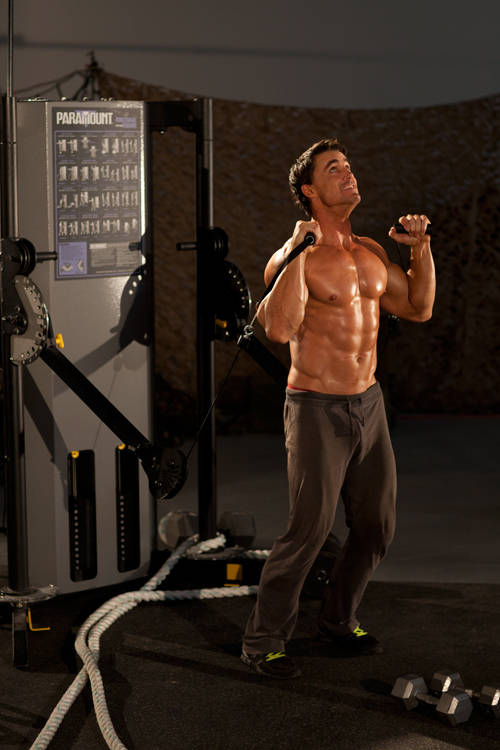
The movement
Form cues
- 01
Set both cable pulleys to the lowest position and select a light, manageable weight to start.
- 02
Stand facing away from the machine, feet shoulder-width apart, with one foot slightly forward for balance.
- 03
Hold both handles at shoulder height with palms facing forward and elbows bent — this is your starting position.
- 04
Brace your stomach like you're bracing for a gentle tap, and keep it that way throughout the set.
- 05
Press one handle straight up overhead until your elbow is fully extended, but not locked hard.
- 06
Keep your wrist straight — don't let it bend backward as you push up.
- 07
Lower that arm slowly back to shoulder height, then press the opposite arm up in the same controlled manner.
- 08
Keep your chin level and your chest up — avoid tilting your head back to watch your hand.
Dosage
How long, how many
Sets
3
Reps
8-12
Rest
60 sec
Watch for
Common mistakes
Arching the lower back — if your ribs flare out and your back curves, the weight is too heavy or your core isn't braced.
Leaning away from the pressing arm — if your torso tips sideways, reduce the weight and focus on staying upright.
Rushing the lowering phase — if your arm drops quickly back to the start, you're missing half the muscle work; lower it in two to three counts.
Letting the wrist bend backward under the handle — this strains the wrist joint; keep your knuckles pointing straight up at the top.
Holding your breath — exhale as you press up, inhale as you lower; holding your breath raises blood pressure unnecessarily.
Scale it
Easier and harder variations
Easier
Sit in a sturdy chair while pressing to remove the balance challenge and reduce lower-back strain.
Use this if standing feels unsteady or if lower-back fatigue sets in quickly.
Harder
Stand on one foot while pressing to significantly increase the core and balance demand.
Try this once you can complete three sets with steady posture and no side-leaning.
Note
If you have a shoulder issue, limit the press to just below the point where pain begins — even pressing to ear height still builds strength safely.
Use a reduced range of motion if overhead movement causes shoulder discomfort; check with your doctor or physical therapist before progressing.
Sources
Form descriptions and cues are sourced from wger (CC-BY-SA 4.0) and the Free Exercise DB (public domain), edited for the 60+ audience. MET value cites Ainsworth BE, et al. 2011 Compendium of Physical Activities. Med Sci Sports Exerc 43(8):1575-1581.
- free-exercise-db · Unlicense / Public Domain
- claude