
Strength · Beginner
Alternate Incline Dumbbell Curl
You sit back on an incline bench and curl one dumbbell at a time, alternating arms. The incline angle stretches the bicep slightly more than a standard seated curl, which means the muscle works through a longer range of motion and tends to build more strength over time. It's a straightforward move that also keeps your wrists and forearms engaged without putting stress on your back or knees.
Category
Strength
Difficulty
Beginner
Equipment
Dumbbell
MET
3.5
Primary muscles
Secondary muscles
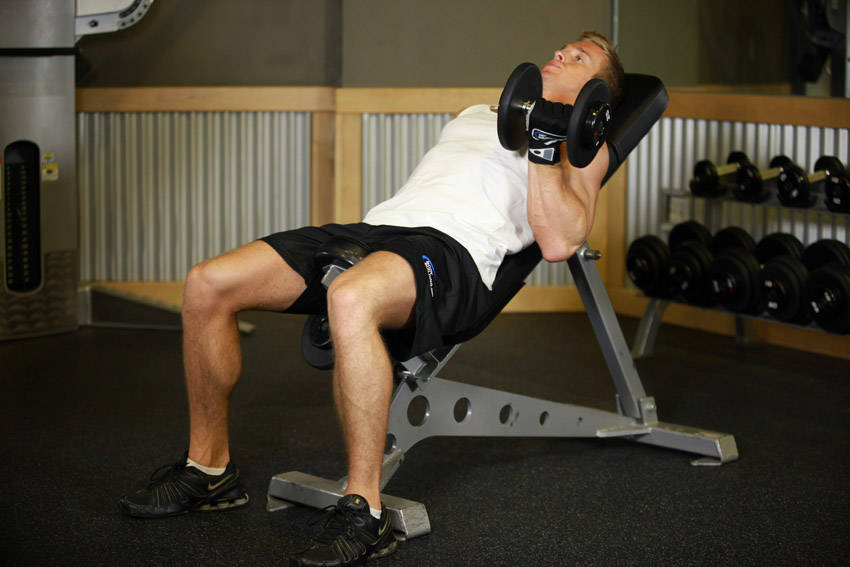
The movement
Form cues
- 01
Set the bench to about a 45-60 degree incline and sit all the way back so your spine is fully supported.
- 02
Let your arms hang straight down at your sides — the dumbbells should point toward the floor before you begin.
- 03
Pin your upper arms against your sides and keep them there for the entire set; only your forearms should move.
- 04
Curl one dumbbell upward while rotating your palm to face the ceiling as it rises — finish with your palm facing your shoulder.
- 05
Pause for a full second at the top and feel the squeeze in your upper arm before lowering.
- 06
Lower the dumbbell slowly — take about two seconds on the way down — then begin the other arm.
- 07
Breathe out as you curl up, breathe in as you lower the weight.
Dosage
How long, how many
Sets
3
Reps
8-12
Rest
60 sec
Watch for
Common mistakes
Swinging the elbow forward — if your elbow drifts in front of your shoulder during the curl, you're using momentum instead of muscle; keep it pinned back against the bench.
Rushing the lowering phase — dropping the dumbbell quickly cuts your work in half; if the weight falls rather than lowers, go lighter.
Shrugging the shoulders up toward the ears — if your shoulders creep up during the curl, consciously press them down and back into the pad before each rep.
Gripping the dumbbell too tightly — a white-knuckle grip tires your forearms early and can aggravate wrist or elbow discomfort; hold firmly but not rigidly.
Using too much weight and losing the rotation — if your palm never fully faces up at the top, the weight is too heavy to complete the movement correctly; drop down a size.
Scale it
Easier and harder variations
Easier
Use lighter dumbbells and curl both arms at the same time rather than alternating, so you can focus on learning the motion without coordinating sides.
If alternating feels awkward at first or you find it hard to keep track of form while switching arms.
Harder
Add a 2-second pause at the top of each rep and take 3-4 seconds to lower the weight, making each rep slower and more demanding without adding load.
When the standard tempo feels easy and you want more challenge before moving to heavier dumbbells.
Note
If your elbow or wrist is bothering you, try a neutral-grip curl — keep your palm facing inward (toward your body) throughout the movement rather than rotating — to reduce stress on the joint.
For mild elbow tendon sensitivity or wrist discomfort; stop and check with your doctor if pain persists.
Sources
Form descriptions and cues are sourced from wger (CC-BY-SA 4.0) and the Free Exercise DB (public domain), edited for the 60+ audience. MET value cites Ainsworth BE, et al. 2011 Compendium of Physical Activities. Med Sci Sports Exerc 43(8):1575-1581.
- free-exercise-db · Unlicense / Public Domain
- claude