
Strength · Beginner
Air Bike
The air bike is a floor exercise where you lie on your back and alternate bringing opposite elbows and knees toward each other in a cycling motion. It works the muscles across your entire midsection — front, sides, and deep stabilizers — without any equipment. Building core strength this way helps protect your lower back and makes everyday movements like getting up from a chair or reaching across a table feel easier and more controlled.
Category
Strength
Difficulty
Beginner
Equipment
Bodyweight
MET
3.5
Primary muscles
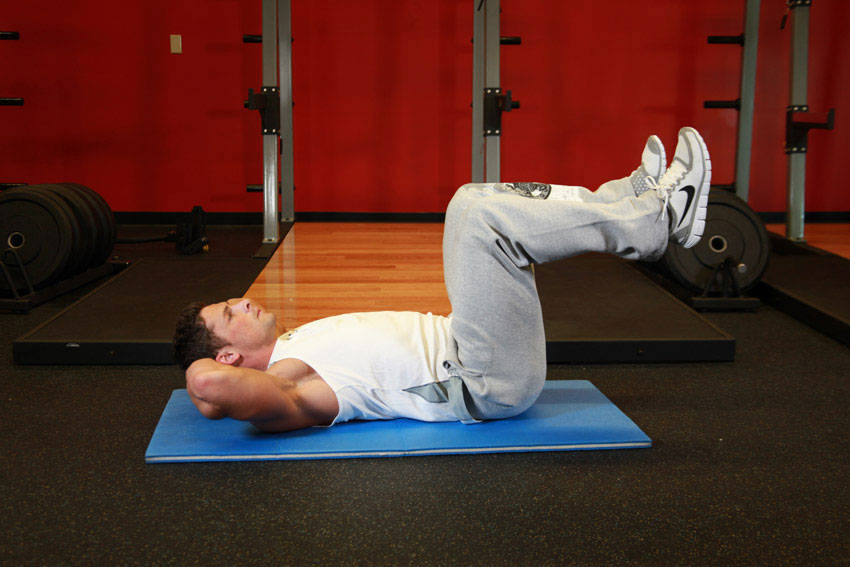
The movement
Form cues
- 01
Lie on your back and press your lower back firmly into the floor — there should be no gap between your spine and the ground.
- 02
Place your hands lightly behind your ears, not laced behind your head, so your elbows stay wide.
- 03
Lift both knees until your shins are parallel to the floor — this is your starting position before any movement begins.
- 04
Squeeze your stomach muscles like someone's about to poke you, and hold that tension throughout the entire set.
- 05
Bring your right elbow toward your left knee by rotating your ribcage, not by yanking your neck forward.
- 06
At the same time, extend your right leg out long and low — the lower it goes, the more your core has to work.
- 07
Switch sides in a slow, controlled pedaling rhythm: left elbow to right knee, right leg extends.
- 08
Breathe out each time you rotate toward a knee, and breathe in as you switch sides.
Dosage
How long, how many
Sets
3
Reps
8-12
Rest
60 sec
Watch for
Common mistakes
Pulling on the neck — if your neck aches or your chin juts forward, your hands are yanking your head instead of just resting there. Loosen your grip and lead with your shoulder, not your elbow.
Rushing through the reps — if you're swinging back and forth quickly, you're using momentum instead of muscle. Slow down until you feel your side muscles doing the work.
Lower back lifting off the floor — if you feel your back arching up, your extended leg is dropping too low. Raise that leg higher until your back stays flat.
Barely rotating — if both shoulders stay on the floor the whole time, you're only doing a crunch, not a twist. Focus on lifting one shoulder blade off the ground with each rep.
Holding your breath — if you feel your face getting red or tense, you've stopped breathing. Match your exhale to each rotation and keep a steady rhythm.
Scale it
Easier and harder variations
Easier
Keep both feet flat on the floor and simply rotate your upper body side to side, touching one hand toward the opposite knee. No leg cycling until the rotation feels comfortable.
Use this if lifting both legs off the floor causes lower back strain or feels unsteady.
Harder
Extend your working leg lower toward the floor — hovering just a few inches above it — to increase the demand on your deep core muscles.
Try this once you can complete 12 reps per side with your lower back staying flat the entire time.
Note
If you have a hip or knee replacement, skip the leg cycling entirely and do seated torso rotations in a chair — sit tall, cross your arms over your chest, and slowly rotate your ribcage left and right.
Use this if floor work is not currently an option or if your surgeon has restricted hip flexion range of motion.
Sources
Form descriptions and cues are sourced from wger (CC-BY-SA 4.0) and the Free Exercise DB (public domain), edited for the 60+ audience. MET value cites Ainsworth BE, et al. 2011 Compendium of Physical Activities. Med Sci Sports Exerc 43(8):1575-1581.
- free-exercise-db · Unlicense / Public Domain
- claude