
Strength · Beginner
3/4 Sit-Up
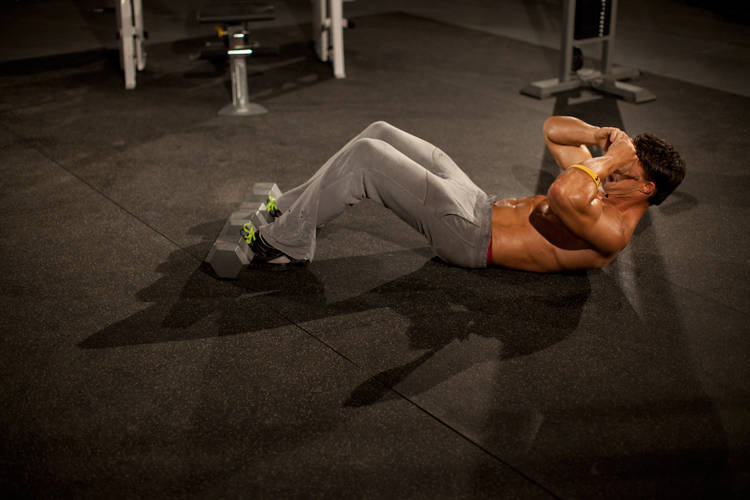
A 3/4 sit-up is a controlled crunch where you raise your torso all the way up but only lower it three-quarters of the way back down — stopping just before your shoulder blades touch the floor. That partial range keeps your core muscles working the whole time instead of resting at the bottom. It builds the abdominal strength that supports your lower back, helps you get up from the floor, and makes everyday bending and lifting easier.
Category
Strength
Difficulty
Beginner
Equipment
Bodyweight
MET
3.5
Primary muscles
The movement
Form cues
- 01
Lie on your back with knees bent and feet flat on the floor, about hip-width apart.
- 02
Place your hands lightly behind your head or cross them over your chest — don't lace your fingers and pull on your neck.
- 03
Press your lower back gently into the floor before you begin, as if you're trying to close the gap between your back and the mat.
- 04
Breathe out as you curl your chest toward your knees, leading with your ribcage — not your chin.
- 05
Stop when your torso is upright and your chest is over your hips, then pause for a half-second.
- 06
Breathe in as you slowly lower back down, stopping when your shoulder blades are about two inches off the floor.
- 07
Hold that lowered position for a moment before starting the next rep — don't let gravity drop you the rest of the way.
Dosage
How long, how many
Sets
3
Reps
8-12
Rest
60 sec
Watch for
Common mistakes
Yanking on your neck — if your neck aches during the movement, your hands are pulling your head forward instead of just resting there.
Using momentum to swing up — if you feel a jerk at the start of each rep, slow down and let your stomach muscles do the lifting.
Going all the way back down to the floor — if your shoulder blades fully touch the mat between reps, you've gone too far and lost the benefit of the exercise.
Holding your breath — if you feel your face flushing or tension building in your head, you're probably holding; match your exhale to the upward curl.
Lifting with your hip flexors instead of your abs — if you feel the work mainly in the tops of your thighs rather than your stomach, try pressing your lower back into the floor more firmly before each rep.
Scale it
Easier and harder variations
Easier
Cross your arms over your chest and only come up halfway — just until your shoulder blades clear the floor — before lowering back to the 3/4 position.
Use this if a full sit-up feels like too much or causes neck strain.
Harder
Hold your arms straight out in front of you, parallel to the floor, throughout the movement to remove the leverage advantage of having them at your chest.
Use this once the standard version feels easy for all reps.
Note
If you have lower back sensitivity, place a folded towel under your lower back for light support and limit your range to whatever feels comfortable — even a small crunch counts.
Use this if you feel sharp or pinching pain in your lower back during the movement, and check with your doctor if it persists.
Sources
Form descriptions and cues are sourced from wger (CC-BY-SA 4.0) and the Free Exercise DB (public domain), edited for the 60+ audience. MET value cites Ainsworth BE, et al. 2011 Compendium of Physical Activities. Med Sci Sports Exerc 43(8):1575-1581.
- free-exercise-db · Unlicense / Public Domain
- claude