
Cardio · Intermediate
Stepmill Stair Climber
The stepmill is a continuously rotating staircase that gives you a genuine stair-climbing workout indoors. It builds strength in your thighs, glutes, and calves while giving your heart and lungs a solid workout — all with less pounding on your joints than running. Because it mimics real-life stair climbing, it directly trains the movement you use every day at home, in buildings, and getting in and out of vehicles.
Category
Cardio
Difficulty
Intermediate
Equipment
Machine
MET
2.8
Primary muscles
Secondary muscles
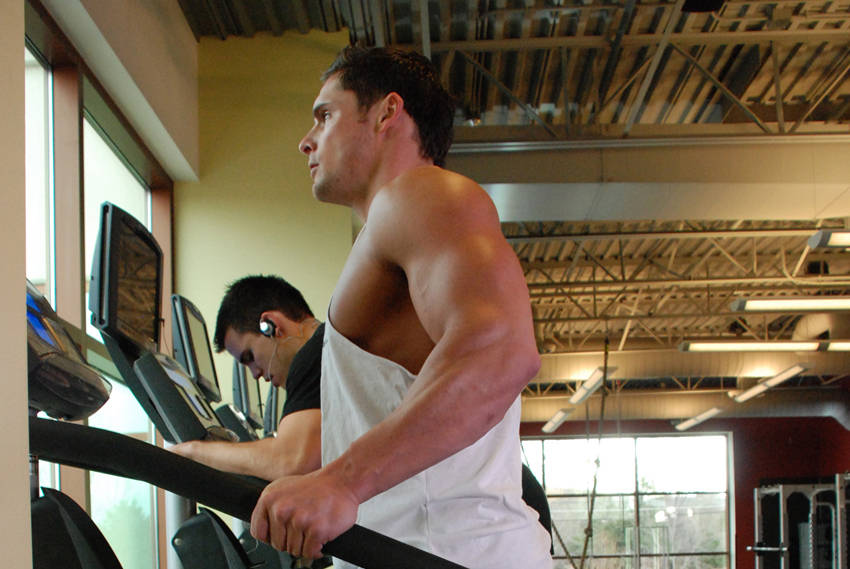
The movement
Form cues
- 01
Step onto the machine before starting it, and grip the handrails firmly until you find your rhythm.
- 02
Set the speed low — one to two steps per second is plenty to start.
- 03
Stand tall with your chest up rather than hunching over the console.
- 04
Place your whole foot on each step, not just your toes, so your heel carries some of the load.
- 05
Push down through your heel as you step to engage your glutes, not just your knees.
- 06
Keep your grip on the rails light once you feel steady — use them for balance, not to hold your body weight up.
- 07
Look straight ahead or slightly down at the steps, not up at the screen, so your neck stays relaxed.
- 08
Breathe steadily — if you can't say a short sentence out loud, slow the machine down a notch.
Dosage
How long, how many
Sets
1
Reps
10-20 minutes
Rest
60 sec
Watch for
Common mistakes
Leaning heavily on the handrails — if your arms are bearing your weight, you're cheating your legs and putting strain on your wrists and shoulders. Lighten your grip so your legs do the work.
Taking tiny, shuffling half-steps — if your heels never fully land on the step, you're overloading your calves and knees. Step fully so your whole foot contacts the surface.
Starting too fast — if you're gasping within the first two minutes, the speed is too high. Dial it back and build up gradually over several sessions.
Hunching forward over the console — if your shoulders are up near your ears and your back is rounded, straighten up. Slouching compresses your spine and makes breathing harder.
Skipping steps to go faster — if you're lunging upward two steps at a time, you're turning a steady cardio exercise into a high-impact move that stresses your knees. Keep a consistent one-step rhythm.
Scale it
Easier and harder variations
Easier
Use both handrails the entire time and keep the speed at its lowest setting. Focus on completing 5 to 10 minutes before worrying about duration or intensity.
If you're new to the machine, returning after a long break, or feel unsteady on moving stairs.
Harder
Release the handrails entirely once you feel steady, and increase the speed one level every two minutes until you reach a pace that makes conversation difficult.
Once you can comfortably complete 15 minutes at a moderate pace without gripping the rails.
Note
If knee pain flares, reduce speed immediately and check that you're landing your full foot — not just your toes — on each step. If pain continues, switch to a recumbent bike, which removes the step-down impact entirely.
For those with knee replacement, knee arthritis, or recent lower-body injury.
Sources
Form descriptions and cues are sourced from wger (CC-BY-SA 4.0) and the Free Exercise DB (public domain), edited for the 60+ audience. MET value cites Ainsworth BE, et al. 2011 Compendium of Physical Activities. Med Sci Sports Exerc 43(8):1575-1581.
- free-exercise-db · Unlicense / Public Domain
- claude