
Pilates · Beginner
Pilates Oblique Crunches
This exercise targets the muscles along the sides of your abdomen — the obliques — which are essential for twisting, reaching, and keeping your torso stable during everyday movements. You lie on your back and curl one shoulder toward the opposite knee, working the rotational strength that protects your spine and helps you turn to check a blind spot or reach across your body. It's low-impact, requires no equipment, and can be done on a mat or carpeted floor.
Category
Pilates
Difficulty
Beginner
Equipment
Bodyweight
MET
3.0
Primary muscles
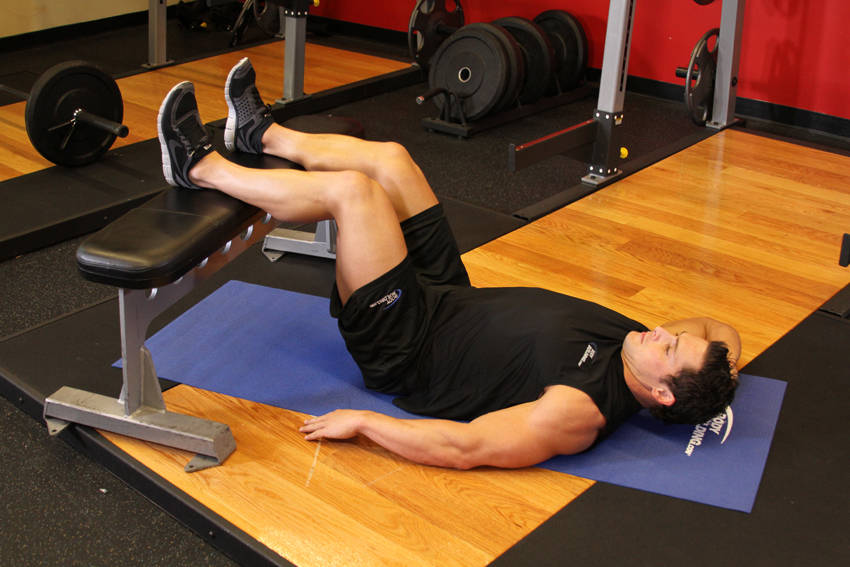
The movement
Form cues
- 01
Lie on your back with your knees bent and feet flat on the floor, hip-width apart.
- 02
Place one hand lightly behind your ear — fingertips only, not gripping your head.
- 03
Rest your other arm flat on the floor beside you for light support.
- 04
Press your lower back gently into the floor so there's no gap between your spine and the mat.
- 05
Breathe out and slowly curl your right shoulder up and across toward your left knee — you're rotating, not just sitting up straight.
- 06
Lift only until your shoulder blade clears the floor; you don't need to touch elbow to knee.
- 07
Pause for a beat at the top, then breathe in as you lower back down with control — don't just drop.
- 08
Complete all reps on one side before switching, or alternate sides one at a time.
Dosage
How long, how many
Sets
3
Reps
8-12
Rest
60 sec
Watch for
Common mistakes
Pulling on your neck — if your neck aches during the movement, your hand is yanking your head forward instead of just resting there. Loosen your grip and let your stomach do the work.
Lifting straight up instead of rotating — if both shoulders are rising equally, you're doing a regular crunch. Focus on bringing one shoulder across toward the opposite knee.
Holding your breath — if you feel your face tighten or get red, you've stopped breathing. Exhale on the way up, inhale on the way down.
Rushing through the reps — if the movement feels effortless, you're likely using momentum. Slow down so each rep takes about two seconds up and two seconds down.
Feet lifting off the floor — if your heels pop up as you crunch, press them firmly down before you start each rep.
Scale it
Easier and harder variations
Easier
Keep both feet flat on the floor and reduce your range of motion — just lift your shoulder blade an inch or two off the mat until you build strength.
Use this if you feel strain in your neck or lower back, or if you're just starting out.
Harder
Extend your legs so they hover a few inches off the floor while you perform the oblique crunch, adding more demand on your entire core.
Try this once the standard version feels comfortable for 3 sets of 12 with no neck or back discomfort.
Note
If you have neck or back sensitivity, do a seated oblique lean instead: sit upright in a sturdy chair, arms crossed over your chest, and slowly rotate your upper body a few inches to each side without leaning forward.
Use this if lying on the floor is uncomfortable or if you have a recent neck or lumbar issue.
Sources
Form descriptions and cues are sourced from wger (CC-BY-SA 4.0) and the Free Exercise DB (public domain), edited for the 60+ audience. MET value cites Ainsworth BE, et al. 2011 Compendium of Physical Activities. Med Sci Sports Exerc 43(8):1575-1581.
- free-exercise-db · Unlicense / Public Domain
- claude