
Pilates · Beginner
Exercise Ball Crunch
The exercise ball crunch is a core-strengthening move that uses an inflated stability ball to support your lower back while you curl your shoulders upward. Because the ball creates a slight backward arch at the start, your abdominal muscles work through a longer range of motion than they do on a flat floor. Strong abs help protect your lower back, improve your posture, and make everyday tasks — lifting, reaching, getting up from a chair — feel easier. This is a beginner-friendly move that's gentler on the spine than traditional floor crunches.
Category
Pilates
Difficulty
Beginner
Equipment
Stability Ball
MET
3.0
Primary muscles
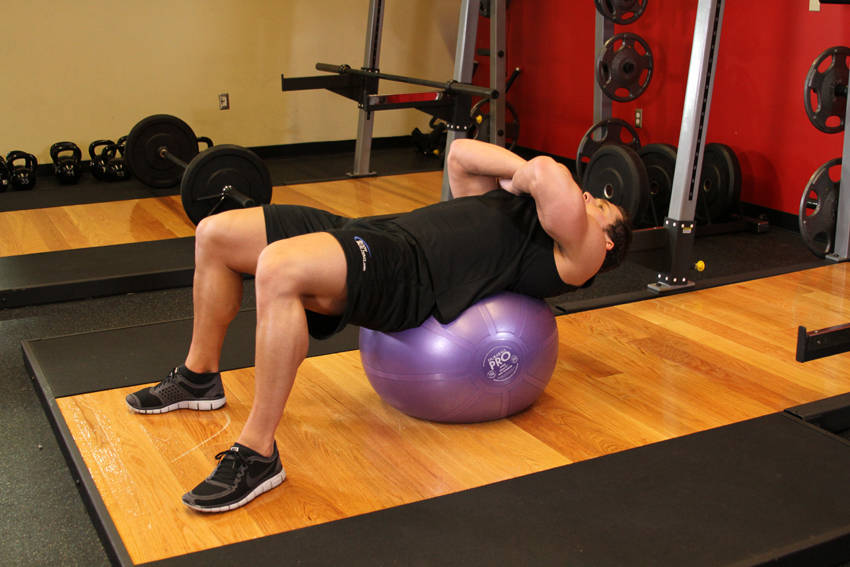
The movement
Form cues
- 01
Sit on the center of the ball, then walk your feet forward until the ball rolls under your lower back — it should cradle the curve just above your hips.
- 02
Plant both feet flat on the floor, hip-width apart, with knees bent at roughly a right angle.
- 03
Cross your arms over your chest or let them rest along your sides — keep your hands away from the back of your neck.
- 04
Let your upper back drape gently over the ball so you feel a mild stretch in your abs before you begin.
- 05
Breathe out and slowly curl your shoulders and chest upward, as if you're trying to bring your ribs toward your hips — stop when you feel a firm squeeze in your stomach.
- 06
Keep your lower back pressed against the ball the entire time — it should not lift off.
- 07
Hold the top position for one full second, then breathe in and slowly lower back to the starting stretch.
- 08
Move at a steady, controlled pace — two counts up, two counts down — rather than bouncing or jerking.
Dosage
How long, how many
Sets
3
Reps
8-12
Rest
60 sec
Watch for
Common mistakes
Pulling on the neck — if your chin is jutting forward or your neck feels strained, your arms have crept up behind your head; move them back to your chest or sides.
Bouncing off the ball — if the movement feels fast and easy, you're using momentum instead of muscle; slow down until you feel your abs doing the work on every inch of the motion.
Lower back lifting off the ball — if you can feel a gap between your back and the ball at the top, you've curled too far; reduce the range until your back stays in contact throughout.
Feet sliding or lifting — if your heels are coming up or your feet are creeping inward, press them more firmly into the floor and widen your stance slightly.
Holding your breath — if you feel your face flushing or your neck tightening, you've forgotten to breathe; exhale on the way up, inhale on the way down.
Scale it
Easier and harder variations
Easier
Place the ball against a wall before sitting on it so it can't roll, giving you a stable surface while you build confidence with the movement.
Use this if the ball feels wobbly or you're nervous about balance.
Harder
Extend your arms straight overhead (parallel to the ceiling) instead of crossing them on your chest — the extra lever length makes your abs work significantly harder.
Try this once you can complete 12 reps with good form and no neck strain.
Note
If you have lower back sensitivity, keep the range of motion very small — just lift your shoulder blades an inch or two off the ball rather than curling all the way up, and stop immediately if you feel any sharp pain.
Use this during a flare-up or when returning from a lower back strain; check with your doctor or physical therapist before progressing.
Sources
Form descriptions and cues are sourced from wger (CC-BY-SA 4.0) and the Free Exercise DB (public domain), edited for the 60+ audience. MET value cites Ainsworth BE, et al. 2011 Compendium of Physical Activities. Med Sci Sports Exerc 43(8):1575-1581.
- free-exercise-db · Unlicense / Public Domain
- claude