
Pilates · Beginner
Decline Reverse Crunch
The decline reverse crunch uses a tilted bench to add a gentle challenge to a classic ab exercise. You lie on your back and draw your knees toward your chest, lifting your hips slightly off the bench — working the lower portion of your abdominals in a way that regular crunches often miss. Because the movement is controlled and low-impact, it's a solid choice for building core strength without putting strain on your neck or back.
Category
Pilates
Difficulty
Beginner
Equipment
Bodyweight
MET
3.0
Primary muscles
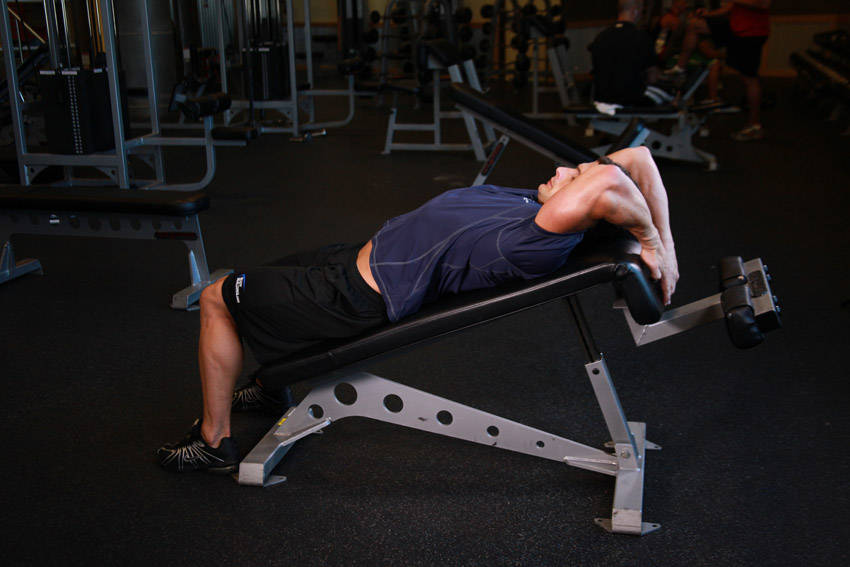
The movement
Form cues
- 01
Grip the top of the bench firmly with both hands before you begin — your hands anchor you throughout the whole movement.
- 02
Lie flat on your back with your legs extended and a soft bend in your knees, not locked straight.
- 03
Squeeze your stomach muscles like you're bracing for a light tap to the belly — keep that tension the whole time.
- 04
Breathe out as you slowly draw your knees toward your chest, letting your hips curl up off the bench.
- 05
Stop when your knees are close to your chest — you should feel your lower abs working, not your hip flexors pulling.
- 06
Hold the top position for one full second before you lower back down.
- 07
Breathe in as you lower your legs slowly — resist the urge to let them drop.
- 08
Stop just before your heels touch the bench, then begin the next rep from that tension.
Dosage
How long, how many
Sets
3
Reps
8-12
Rest
60 sec
Watch for
Common mistakes
Using momentum to swing the legs up — if your hips are bouncing rather than rolling, slow down and use your abs to do the lifting.
Gripping the bench so hard your shoulders creep up toward your ears — keep your shoulders relaxed and pressed down.
Letting the lower back arch away from the bench at the bottom — if you feel your back lifting, don't lower your legs quite as far.
Holding your breath — if you feel your face tightening or going red, you've forgotten to breathe out on the way up.
Rushing through the lowering phase — if your legs drop quickly, you're losing half the work the exercise is meant to do.
Scale it
Easier and harder variations
Easier
Do this on a flat bench or on the floor instead of a decline bench — the angle is less demanding and easier to control.
Use this if the decline angle feels too steep or causes discomfort in your lower back.
Harder
Extend your legs fully toward the ceiling at the top of each rep before slowly lowering them back down.
Try this once you can complete 12 reps with steady control and no back arching.
Note
If you have lower back sensitivity, keep both feet flat on the bench throughout and only tilt your pelvis slightly — skip the full hip lift.
Use this version if any full hip lift causes pain or sharp discomfort in the lower back.
Sources
Form descriptions and cues are sourced from wger (CC-BY-SA 4.0) and the Free Exercise DB (public domain), edited for the 60+ audience. MET value cites Ainsworth BE, et al. 2011 Compendium of Physical Activities. Med Sci Sports Exerc 43(8):1575-1581.
- free-exercise-db · Unlicense / Public Domain
- claude