
Pilates · Beginner
Decline Oblique Crunch
This exercise uses a decline bench to add a gentle extra challenge to a rotational crunch, targeting the muscles along the sides of your abdomen. Those side muscles — your obliques — are what help you twist to reach a seatbelt, turn to back out of a driveway, or catch yourself if you stumble. The decline angle increases the range of motion compared to a flat crunch, so you get more work done with fewer repetitions. It's a beginner-friendly move as long as you keep the motion slow and controlled.
Category
Pilates
Difficulty
Beginner
Equipment
Bodyweight
MET
3.0
Primary muscles
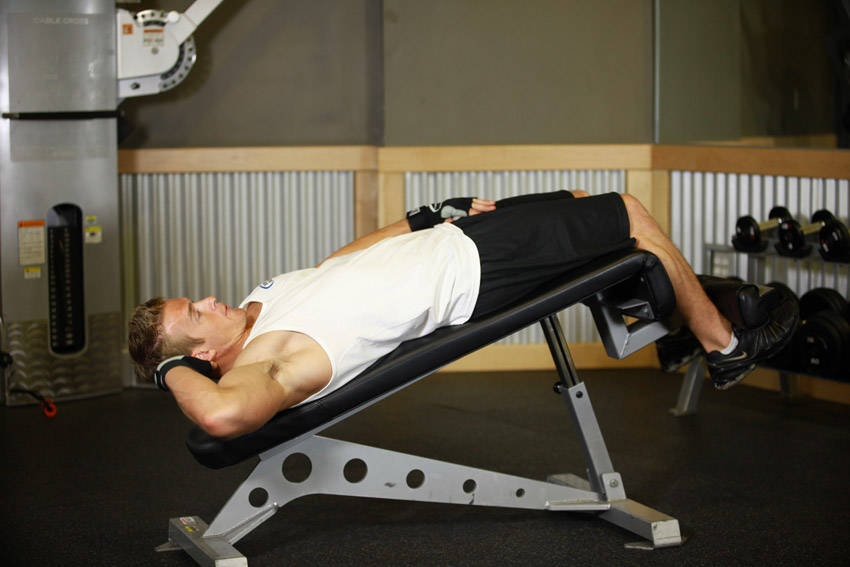
The movement
Form cues
- 01
Hook your feet securely under the ankle pads before you lie back — test the hold before you start.
- 02
Lower yourself slowly onto the bench until your back is flat and your arms are relaxed at your sides.
- 03
Place one hand lightly against the side of your head — fingertips near your ear, not pulling on your neck.
- 04
Rest your other hand on the opposite thigh so you can feel your torso rotate during the movement.
- 05
Squeeze your stomach muscles like someone is about to poke you in the belly before you move an inch.
- 06
Curl your upper body upward and rotate toward your raised knee — lead with your shoulder, not your elbow.
- 07
Pause for a full second at the top when your elbow is close to the opposite knee, then lower slowly.
- 08
Breathe out as you crunch up, breathe in as you lower back down — don't hold your breath.
Dosage
How long, how many
Sets
3
Reps
8-12
Rest
60 sec
Watch for
Common mistakes
Yanking on your neck — if your neck aches after a set, your hand is pulling your head instead of just resting there. Loosen your grip and let your abs do the lifting.
Using momentum to swing up — if you feel a jerk at the bottom of each rep, you're bouncing rather than controlling the movement. Slow down and pause briefly at the lowest point.
Twisting with the elbow instead of the shoulder — if your elbow swings across but your chest stays flat, you're missing the rotation. Think about pointing your shoulder toward the opposite knee.
Holding your breath through the hard part — if you feel your face getting red or tense, you've stopped breathing. Exhale on the way up, every single rep.
Coming up too high and losing the arch in your lower back — if your lower back rounds and lifts off the bench, you've gone past the useful range. Stop when your shoulder blades clear the bench.
Scale it
Easier and harder variations
Easier
Do the same rotating crunch on a flat surface — lie on a mat with knees bent and feet flat on the floor. The flat position removes the extra challenge of the decline angle.
Use this if the decline bench feels too intense, if you have trouble securing your feet, or if you're just starting out with core work.
Harder
Hold a light weight plate or a small dumbbell against your chest as you crunch. Start with 2-5 pounds and only add more when 12 reps feel genuinely easy.
Use this once you can complete 3 sets of 12 reps with good form and no neck strain.
Note
If you have lower back sensitivity, skip the decline bench entirely and do seated torso rotations in a sturdy chair — sit tall, cross your arms over your chest, and slowly rotate side to side without leaning back.
Use this if lying on a decline bench causes any sharp or radiating back pain, or if you've recently had a back flare-up.
Sources
Form descriptions and cues are sourced from wger (CC-BY-SA 4.0) and the Free Exercise DB (public domain), edited for the 60+ audience. MET value cites Ainsworth BE, et al. 2011 Compendium of Physical Activities. Med Sci Sports Exerc 43(8):1575-1581.
- free-exercise-db · Unlicense / Public Domain
- claude