
Pilates · Beginner
Pilates Crunches
A controlled abdominal exercise done lying on your back, where you lift only your shoulders a few inches off the floor. Unlike a full sit-up, the small range of motion keeps stress off your lower back while still working your core muscles directly. Strong abdominals help support your spine, improve posture, and make everyday tasks — carrying groceries, getting up from a chair — noticeably easier.
Category
Pilates
Difficulty
Beginner
Equipment
Bodyweight
MET
3.0
Primary muscles
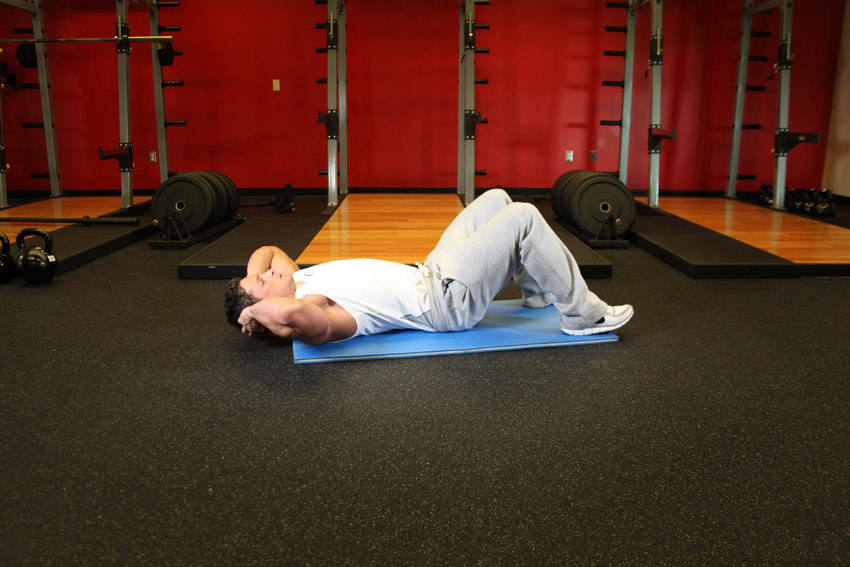
The movement
Form cues
- 01
Lie on your back with knees bent and feet flat on the floor, hip-width apart.
- 02
Rest your fingertips lightly on the sides of your head, just behind your ears — don't lace your fingers together or pull on your neck.
- 03
Press the small of your back firmly into the floor before you move — you should feel the gap between your lower back and the floor close.
- 04
Breathe out as you slowly curl your shoulders up, lifting them only about four inches off the floor — your lower back stays down the whole time.
- 05
At the top, squeeze your stomach muscles hard for one full second, as if bracing for a gentle punch.
- 06
Breathe in as you lower your shoulders back down slowly — don't let them drop or flop.
- 07
Keep your chin pointing toward the ceiling rather than tucking it to your chest — imagine holding a tennis ball under your chin with a little space to spare.
Dosage
How long, how many
Sets
3
Reps
8-12
Rest
60 sec
Watch for
Common mistakes
Pulling on your neck — if your neck aches during or after, your hands are yanking your head forward instead of just resting there. Lighten your grip and lead with your chest.
Lifting too high — if your lower back peels off the floor, you've gone past the crunch and into a sit-up. Stop the moment your back starts to rise.
Using momentum — if you're rocking or bouncing to get up, slow down. Each rep should feel like a deliberate squeeze, not a swing.
Holding your breath — if you feel your face getting red or tense, you've forgotten to exhale on the way up. Breathe out every time you lift.
Letting the chin drop to the chest — if your neck feels strained and you're staring at your knees, raise your gaze slightly toward the ceiling to take the tension off.
Scale it
Easier and harder variations
Easier
Cross your arms over your chest instead of placing hands behind your head — this removes the temptation to pull on your neck and makes the movement feel more manageable.
Use this when neck discomfort or limited shoulder mobility makes the standard arm position uncomfortable.
Harder
Hold the lifted position for three to five seconds before lowering, focusing on keeping that stomach squeeze the entire time.
Use this once you can complete 12 reps with steady control and no neck strain.
Note
Place a small rolled towel under your lower back for support, and only lift your shoulders an inch or two — even a tiny controlled contraction counts.
Use this if you have lower back sensitivity or are returning to exercise after a back flare-up. Stop if you feel sharp or radiating pain.
Sources
Form descriptions and cues are sourced from wger (CC-BY-SA 4.0) and the Free Exercise DB (public domain), edited for the 60+ audience. MET value cites Ainsworth BE, et al. 2011 Compendium of Physical Activities. Med Sci Sports Exerc 43(8):1575-1581.
- free-exercise-db · Unlicense / Public Domain
- claude