
Pilates · Beginner
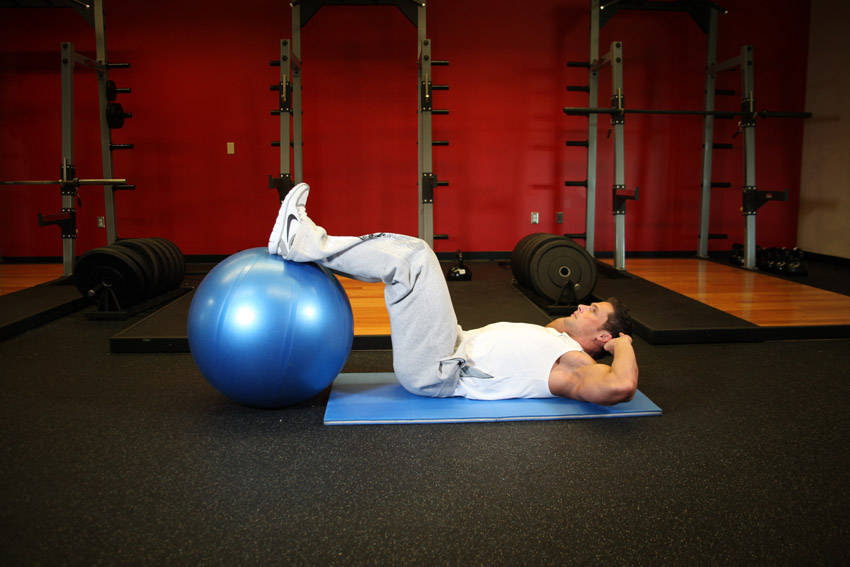
Pilates Crunch - Legs on Exercise Ball
This is a classic abdominal crunch done with your lower legs resting on an exercise ball, which takes pressure off your lower back and helps you focus the work where it belongs — your stomach muscles. The ball keeps your hips in a neutral position so you're not straining your neck or hip flexors to get the movement done. It's a gentle, controlled exercise that builds the core strength you need for everyday tasks like getting up from a chair or carrying groceries.
Category
Pilates
Difficulty
Beginner
Equipment
Bodyweight
MET
3.0
Primary muscles
The movement
Form cues
- 01
Lie on your back and rest your calves and heels on top of the ball, with your knees bent at roughly a right angle.
- 02
Place your feet a few inches apart and let your toes tilt slightly inward until they nearly touch — this helps stabilize the ball.
- 03
Rest your fingertips lightly on the sides of your head, just above your ears — don't lace them behind your neck.
- 04
Press the small of your back gently into the floor before you move — you should feel the gap between your lower back and the floor close.
- 05
Breathe out slowly as you curl your shoulders up off the floor, lifting only three to four inches — think of bringing your ribs toward your hips, not your chin toward your knees.
- 06
Squeeze your stomach muscles firmly at the top and hold for one full second before coming back down.
- 07
Breathe in as you lower your shoulders back to the floor with control — don't let gravity drop you.
Dosage
How long, how many
Sets
3
Reps
8-12
Rest
60 sec
Watch for
Common mistakes
Pulling on your neck — if your neck aches during the movement, your hands are probably yanking your head forward; keep your elbows wide and your hands barely touching your head.
Lifting too high — if your lower back peels off the floor, you've gone too far; your shoulders should rise only a few inches and your lower back should stay planted the whole time.
Rushing through the reps — if the ball is rolling around or you feel a jerk at the top, you're using momentum instead of muscle; slow down until each rep feels deliberate.
Holding your breath — if you feel your face tighten or get lightheaded, you've stopped breathing; exhale on the way up, inhale on the way down, every single rep.
Letting the ball drift away — if your knees straighten during the movement, the ball has rolled out; reset so your knees stay at 90 degrees before continuing.
Scale it
Easier and harder variations
Easier
Skip the ball and rest your feet flat on the floor with knees bent — this gives you a stable base while you build the movement pattern.
Use this if the ball feels unsteady or you're new to floor exercises.
Harder
Cross your arms over your chest instead of supporting your head, which removes that small assist and makes your core work a little harder.
Try this once you can complete 12 reps with steady form and no neck strain.
Note
If you have lower back sensitivity, place a folded towel under your tailbone for extra support and reduce your range of motion to just a small shoulder lift — even an inch of controlled movement counts.
Use this during lower back flare-ups or when recovering from back discomfort.
Sources
Form descriptions and cues are sourced from wger (CC-BY-SA 4.0) and the Free Exercise DB (public domain), edited for the 60+ audience. MET value cites Ainsworth BE, et al. 2011 Compendium of Physical Activities. Med Sci Sports Exerc 43(8):1575-1581.
- free-exercise-db · Unlicense / Public Domain
- claude