
Pilates · Beginner
Cable Seated Crunch
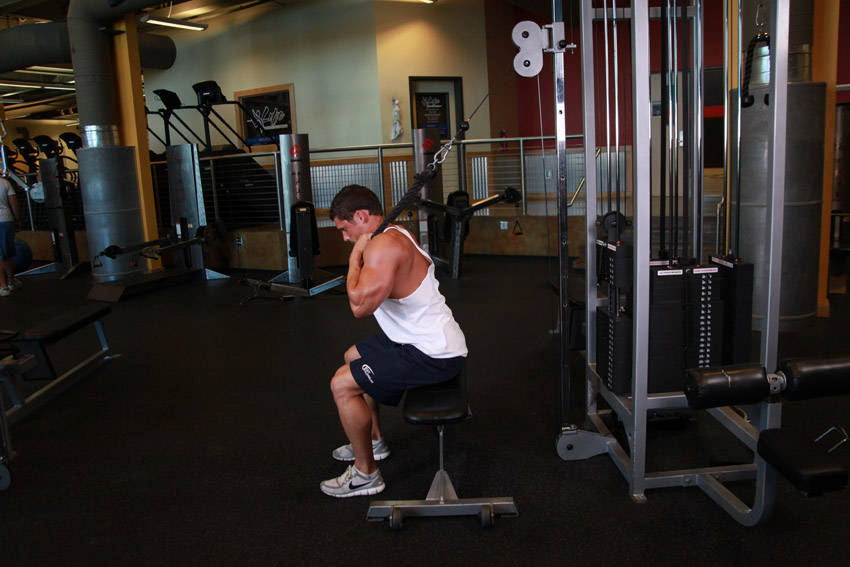
This exercise uses a cable machine to add steady resistance to a crunching motion while you sit on a bench. It targets the abdominal muscles without putting pressure on your lower back the way floor crunches can. The cable keeps tension on your core throughout the entire movement, making each rep more effective than bodyweight alone. It's a practical way to build the trunk strength that helps you lift, carry, and stay upright through daily life.
Category
Pilates
Difficulty
Beginner
Equipment
Cable
MET
3.0
Primary muscles
The movement
Form cues
- 01
Sit on the bench facing away from the cable machine, close enough that the rope hangs directly overhead.
- 02
Grip the rope handles with both palms facing each other, then rest your hands firmly on top of your shoulders — don't let them drift forward.
- 03
Plant both feet flat on the floor, hip-width apart, and keep them there for the entire set.
- 04
Let the cable pull your lower back into a gentle arch before you begin — this is your starting position.
- 05
Keeping your hips still and pressed into the bench, curl your chest downward toward your thighs.
- 06
Breathe out steadily as you crunch down, and stop when your elbows are close to your knees.
- 07
Pause for one count at the bottom, then slowly return upright as you breathe in — take about two seconds on the way back.
- 08
Keep the movement smooth and controlled; the cable should stay taut the entire time.
Dosage
How long, how many
Sets
3
Reps
8-12
Rest
60 sec
Watch for
Common mistakes
Pulling with the arms instead of the abs — if your elbows are doing most of the work and your hands are pulling away from your shoulders, reset your grip and focus on curling your ribcage toward your hips.
Rocking the hips forward to get more range — if your seat lifts off the bench, you've lost the isolation; sit back down and shorten the range of motion.
Using too much weight and jerking through the movement — if you can't control the return trip and the weight snaps you back upright, drop the stack until you can move smoothly.
Holding your breath — if you feel your face flushing or you're straining silently, exhale on the way down and inhale on the way up.
Letting the hands drift away from the shoulders — if there's a gap between your hands and your shoulders, the load shifts to your neck and arms instead of your core.
Scale it
Easier and harder variations
Easier
Use the lightest weight on the stack and focus only on the curling motion, even if the range of movement is small. A short, controlled crunch beats a full crunch done sloppily.
If you're new to cable machines or find it hard to feel your abs working.
Harder
Pause for three full seconds at the bottom of each rep before returning upright, keeping your abs squeezed the entire time.
When 12 reps feel easy and you want more challenge without adding weight.
Note
If you have lower back sensitivity, skip the starting arch entirely — begin from a neutral, upright spine and crunch only as far as feels comfortable, stopping well before any discomfort.
Lower back pain or recent back injury — check with your doctor or physical therapist before loading this movement.
Sources
Form descriptions and cues are sourced from wger (CC-BY-SA 4.0) and the Free Exercise DB (public domain), edited for the 60+ audience. MET value cites Ainsworth BE, et al. 2011 Compendium of Physical Activities. Med Sci Sports Exerc 43(8):1575-1581.
- free-exercise-db · Unlicense / Public Domain
- claude