
Pilates · Beginner
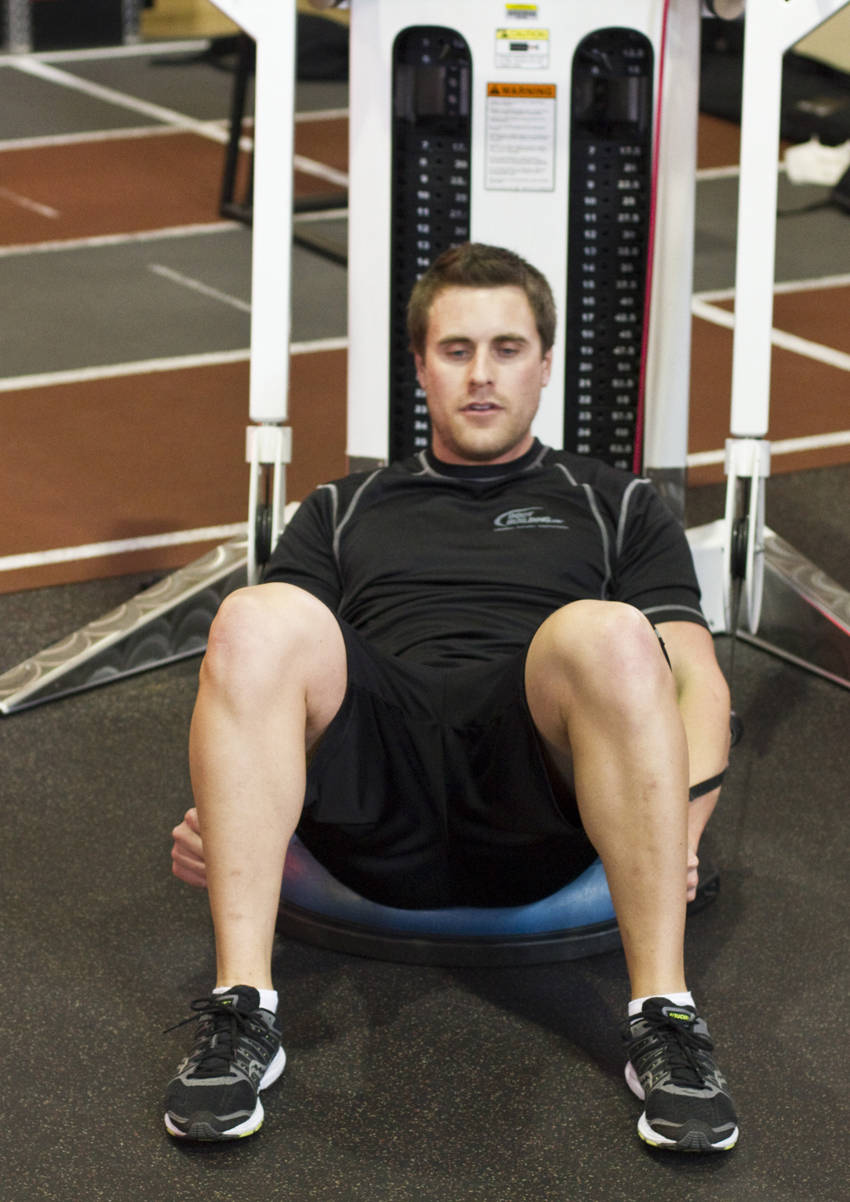
Bosu Ball Cable Crunch With Side Bends
This exercise combines a cable-assisted crunch on a Bosu Ball with standing side bends to work both the front and sides of your midsection. The Bosu Ball lets your lower back arch over a curved surface, giving your abs a fuller range of motion than a flat floor crunch. Strong core muscles support your spine, help you stand taller, and make everyday tasks like getting up from a chair or carrying groceries much easier.
Category
Pilates
Difficulty
Beginner
Equipment
Cable
MET
3.0
Primary muscles
The movement
Form cues
- 01
Set the cable pulleys to their lowest position and attach a handle to each side before you do anything else.
- 02
Place the Bosu Ball flat-side down directly in front of the cable machine, close enough that you can reach both handles when lying back.
- 03
Sit on the Bosu Ball, then slowly lean back so the dome supports the curve of your lower back — your hips should hover just above the floor without resting on it.
- 04
Hold one cable handle in each hand and extend your arms straight out in front of you, pointing them toward your knees.
- 05
Squeeze your stomach muscles like someone is about to poke you, then lift your shoulders and upper back off the ball in a slow, controlled crunch — keep your arms straight and parallel to the cable line.
- 06
Hold the top of the crunch for one breath, then lower yourself back down slowly until your abs feel a gentle stretch over the ball.
- 07
After completing your crunches, carefully sit upright on the ball so your back lifts off it — keep your core braced the whole time.
- 08
Let your arms hang straight at your sides, then reach one hand down toward your heel, pause, return to center, and repeat on the other side for the side-bend portion.
Dosage
How long, how many
Sets
3
Reps
8-12
Rest
60 sec
Watch for
Common mistakes
Pulling with your arms instead of your abs — if your elbows bend during the crunch, you're using your arms to yank yourself up rather than letting your core do the work.
Letting your hips drop to the floor — your rear end should stay lifted throughout; if it touches down, you've lost the arch that makes this movement effective.
Rushing the lowering phase — if you flop back onto the ball quickly, you're missing half the exercise; lower yourself over two to three full seconds.
Holding your breath — if you feel your face flush or your neck tighten, you've forgotten to breathe; exhale as you crunch up, inhale as you lower back down.
Swinging the torso during side bends instead of a controlled lateral reach — if your whole upper body rocks forward or back, slow down and keep your chest facing straight ahead.
Placing the Bosu Ball too far from the machine — if the cables pull your arms backward at an angle rather than straight out, scoot the ball closer to the pulley base.
Scale it
Easier and harder variations
Easier
Skip the Bosu Ball and perform the cable crunch seated on a stable bench or mat, which removes the balance challenge entirely.
Use this if you feel unsteady on the Bosu Ball or have significant balance concerns.
Harder
Add a one- to two-second pause at the top of each crunch before lowering, and increase the cable weight by one small plate once you can complete 12 reps with full control.
Use this once the standard version feels easy and your form is consistent.
Note
If you have lower back sensitivity, reduce the arch over the ball by sitting more upright, or replace this exercise with a seated abdominal compression — sit tall in a chair, brace your core, and hold for five seconds at a time.
Use this during a lower back flare-up or if arching over the ball causes any sharp or radiating pain.
Sources
Form descriptions and cues are sourced from wger (CC-BY-SA 4.0) and the Free Exercise DB (public domain), edited for the 60+ audience. MET value cites Ainsworth BE, et al. 2011 Compendium of Physical Activities. Med Sci Sports Exerc 43(8):1575-1581.
- free-exercise-db · Unlicense / Public Domain
- claude