
Mobility · Beginner
Dynamic Chest Stretch
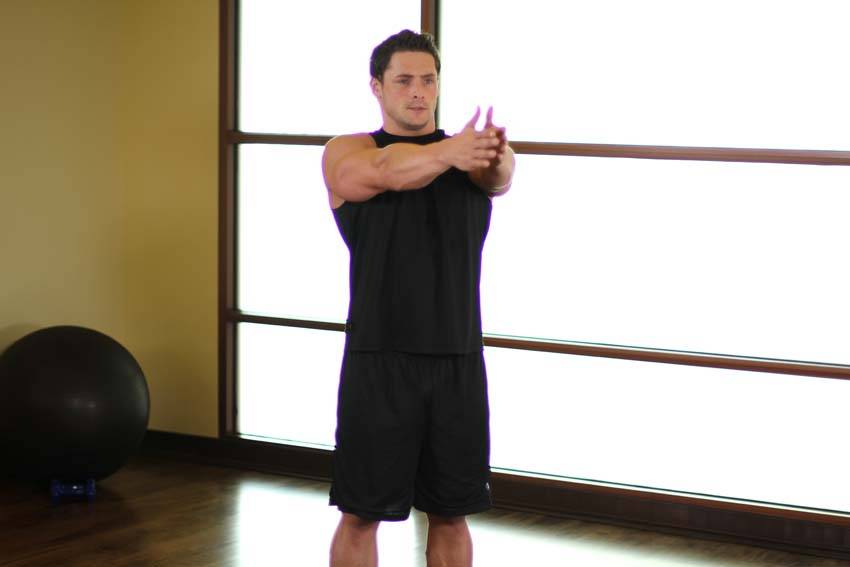
This movement sweeps your arms open and closed in a controlled swinging motion to loosen the chest and the muscles across your upper back. It's a great way to undo the forward-rounded posture that builds up from sitting, driving, or working at a screen. Because it's dynamic — meaning it moves rather than holds — it warms the joints gently and preps your shoulders for almost any upper-body activity.
Category
Mobility
Difficulty
Beginner
Equipment
Bodyweight
MET
2.3
Primary muscles
Secondary muscles
The movement
Form cues
- 01
Stand with your feet shoulder-width apart and a soft bend in your knees — not locked straight.
- 02
Extend both arms straight out in front of you at shoulder height, palms facing each other.
- 03
In one smooth motion, swing both arms out to your sides and as far back as they'll comfortably go — like you're opening a big pair of curtains.
- 04
Let your chest lift and your shoulder blades squeeze together at the end of each swing.
- 05
Bring your arms back to center and let your hands lightly meet — that's one repetition.
- 06
Start slowly for the first two or three reps, then gradually pick up speed as your shoulders loosen.
- 07
Keep your chin level and your gaze forward — don't let your head jut forward as your arms swing back.
- 08
Breathe out as your arms open wide, breathe in as they return to center.
Dosage
How long, how many
Sets
3
Reps
8-12
Rest
30 sec
Watch for
Common mistakes
Bending the elbows — if your arms are bent, you lose most of the stretch across the chest; keep them long throughout the movement.
Shrugging the shoulders up toward the ears — if your shoulders are riding high, consciously drop them down before each swing.
Swinging so fast that control is lost — if your torso is twisting or your balance is shifting, slow down until the movement feels steady.
Not reaching far enough back — if you feel no stretch across the front of your chest, push your arms a little further behind your body on each rep.
Locking the knees — if your lower back feels strained, check that your knees have a slight bend to absorb the movement.
Scale it
Easier and harder variations
Easier
Sit tall in a sturdy chair with feet flat on the floor and perform the same arm swing — all the benefit, no balance challenge.
Use this if standing balance is uncertain or if you're just starting out.
Harder
Hold a light resistance band looped around both wrists to add gentle tension throughout the entire swing.
Use this once the bodyweight version feels easy and you want more work through the chest and upper back.
Note
Reduce the range of motion — swing only as far as is pain-free, even if that's just a few inches to each side, and skip the speed increase.
Use this if you have a shoulder, rotator cuff, or recent upper-body injury; check with your provider before progressing range.
Sources
Form descriptions and cues are sourced from wger (CC-BY-SA 4.0) and the Free Exercise DB (public domain), edited for the 60+ audience. MET value cites Ainsworth BE, et al. 2011 Compendium of Physical Activities. Med Sci Sports Exerc 43(8):1575-1581.
- free-exercise-db · Unlicense / Public Domain
- claude