
Mobility · Beginner
Dynamic Back Stretch
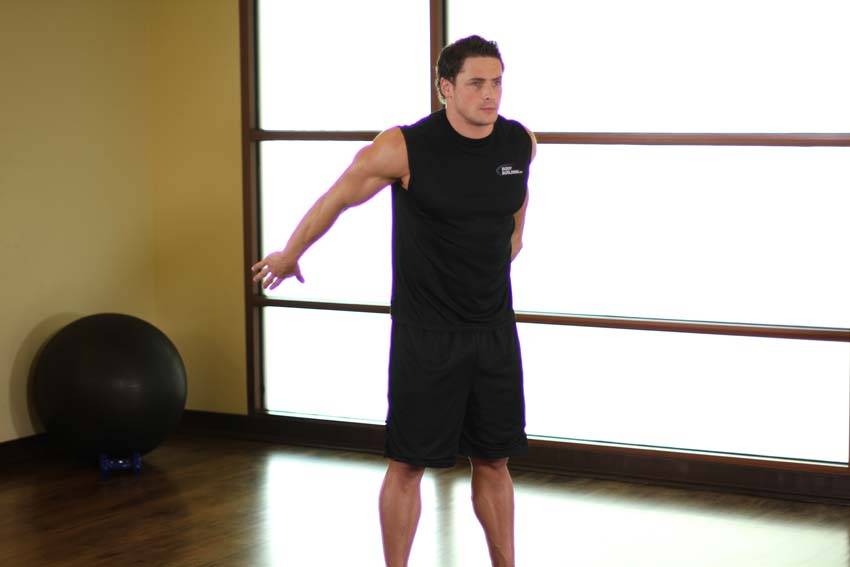
This is a gentle arm-swinging movement that warms up your upper back and shoulders by gradually taking them through a full range of motion. Unlike a held stretch, the swinging action gets blood flowing into the muscles before you ask them to work. It's a smart first move before any upper-body activity, or simply a way to shake off stiffness after sitting for a while.
Category
Mobility
Difficulty
Beginner
Equipment
No equipment
MET
2.3
Primary muscles
The movement
Form cues
- 01
Stand with your feet shoulder-width apart and let your arms hang relaxed at your sides.
- 02
Keep a soft bend in your knees — not locked straight, not squatting.
- 03
Start by swinging both arms forward and upward together, keeping them as straight as comfortable.
- 04
Let the arms swing back down and use that momentum to carry them a little higher on the next swing.
- 05
Add a small amount of height with each swing over 8-10 repetitions until your arms reach above your head.
- 06
Keep your shoulders relaxed and away from your ears — don't let them scrunch up as your arms rise.
- 07
Breathe steadily throughout; exhale as your arms swing upward.
Dosage
How long, how many
Sets
3
Reps
8-10
Rest
30 sec
Watch for
Common mistakes
Swinging too hard too soon — if your shoulders feel a sharp pull on the first rep, you're going too fast. Build height gradually over several swings.
Locking the elbows rigidly straight — this strains the joint. Keep a very slight softness in the elbow throughout the movement.
Holding your breath — you may notice your chest tightening if you forget to breathe. Exhale on the upswing to stay relaxed.
Letting the lower back arch sharply as arms go overhead — if you feel your ribs flaring forward, squeeze your stomach gently to keep your torso upright.
Scale it
Easier and harder variations
Easier
Sit upright in a sturdy armless chair and swing your arms forward from there, stopping at shoulder height until you feel comfortable going higher.
Use this if standing balance is a concern or if you're working through significant shoulder stiffness.
Harder
Hold a light resistance band with both hands shoulder-width apart and perform the swings against the band's tension to add gentle resistance through the full range.
Try this once the movement feels easy and your shoulders move freely through the full swing.
Note
Limit the swing to the pain-free range only — even swinging to chest height counts. Never push into discomfort.
Use this if you have a recent shoulder injury, rotator cuff issue, or post-surgical shoulder. Check with your doctor or physical therapist before going overhead.
Sources
Form descriptions and cues are sourced from wger (CC-BY-SA 4.0) and the Free Exercise DB (public domain), edited for the 60+ audience. MET value cites Ainsworth BE, et al. 2011 Compendium of Physical Activities. Med Sci Sports Exerc 43(8):1575-1581.
- free-exercise-db · Unlicense / Public Domain
- claude