
Mobility · Beginner
Dancer's Stretch
The Dancer's Stretch is a seated spinal rotation that gently loosens the lower back and outer hips — two areas that tend to stiffen up from long hours of sitting. You use your arm as a lever to guide the twist, so you control exactly how far you go. Regular practice can make turning to check your blind spot while driving, or reaching across your body, noticeably easier.
Category
Mobility
Difficulty
Beginner
Equipment
Bodyweight
MET
2.3
Primary muscles
Secondary muscles
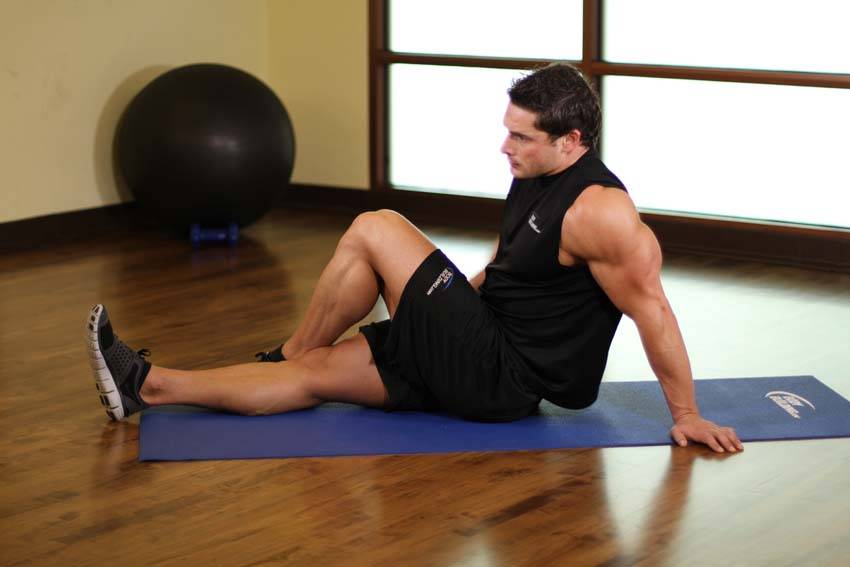
The movement
Form cues
- 01
Sit on the floor with your left leg stretched straight out in front of you.
- 02
Bend your right knee and cross your right foot over your left leg, planting it flat on the floor beside your left knee.
- 03
Sit up as tall as you can — imagine a string gently pulling the top of your head toward the ceiling.
- 04
Place your left elbow or forearm against the outside of your right knee, using it as a gentle brace.
- 05
Press your right hand into the floor behind your right hip for support.
- 06
Breathe in, and as you breathe out, slowly rotate your chest and shoulders to the right.
- 07
Turn only as far as feels like a comfortable stretch — no sharp pinching or pain.
- 08
Hold for 10 to 20 seconds, breathing normally, then slowly unwind and switch sides.
Dosage
How long, how many
Sets
2
Reps
1 hold each side
Rest
30 sec
Watch for
Common mistakes
Rounding the lower back — if you feel like you're slumping or curling forward, sit on a folded blanket to tilt your pelvis upright before twisting.
Forcing the twist with your arm — if your shoulder is straining, ease off and let the rotation come from your torso, not from yanking your knee.
Holding your breath — if you notice you've gone silent and tense, exhale slowly and let the stretch deepen on its own.
Letting the straight leg roll outward — check that your left foot is pointing up toward the ceiling, not flopped to the side.
Rushing through the hold — if you're releasing before 10 seconds, set a mental count; the stretch needs time to take effect.
Scale it
Easier and harder variations
Easier
Sit on a folded blanket or firm pillow to raise your hips — this makes it much easier to sit tall and rotate without straining.
Use this if your lower back rounds immediately when you sit on the floor, or if your hips feel very tight.
Easier
Do the stretch seated in a sturdy chair: cross your right ankle over your left knee, then slowly rotate your upper body to the right, resting your left hand on your right knee.
Use this if getting down to the floor is difficult or uncomfortable.
Harder
Extend your top arm and reach it behind you as you rotate, turning your gaze over your back shoulder to deepen the spinal rotation.
Try this once the basic stretch feels easy and you want a fuller range of motion through the upper back.
Note
If you have a herniated disc or recent back flare-up, skip the rotation entirely and simply sit tall with the leg crossed, holding the position without twisting.
Use this during a back pain flare; return to the full twist once cleared by your doctor or physical therapist.
Sources
Form descriptions and cues are sourced from wger (CC-BY-SA 4.0) and the Free Exercise DB (public domain), edited for the 60+ audience. MET value cites Ainsworth BE, et al. 2011 Compendium of Physical Activities. Med Sci Sports Exerc 43(8):1575-1581.
- free-exercise-db · Unlicense / Public Domain
- claude