
Mobility · Beginner
Chest Stretch on Stability Ball
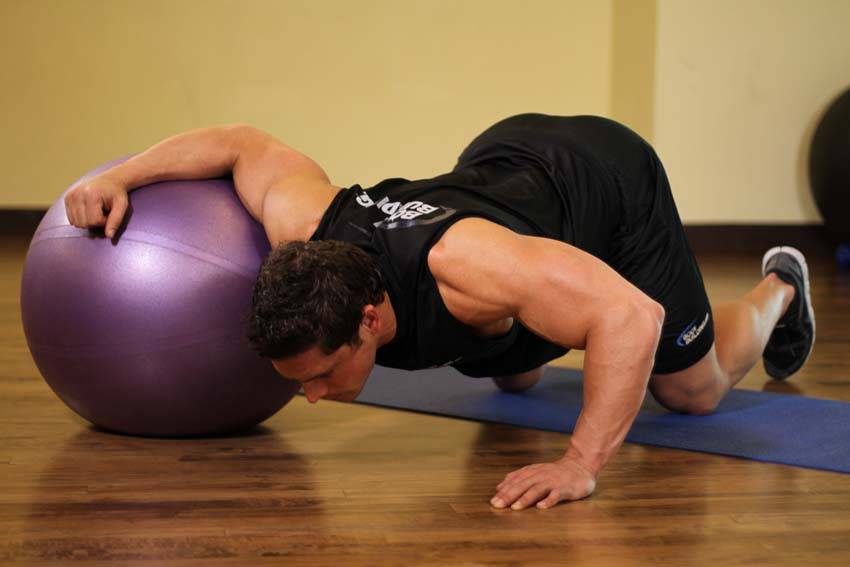
This stretch opens up the chest and the front of the shoulders by letting gravity do the work as you rest one arm on a stability ball. Tight chest muscles are extremely common after years of desk work, driving, or hunching forward, and they can pull your shoulders into a rounded posture that strains your neck and upper back. A few minutes of this stretch a few times a week can help restore a more upright, comfortable posture and make reaching and lifting feel easier.
Category
Mobility
Difficulty
Beginner
Equipment
Stability Ball
MET
2.3
Primary muscles
The movement
Form cues
- 01
Place the stability ball against a wall so it can't roll away on you.
- 02
Kneel on a folded towel or mat to protect your knees, then face the ball from the side.
- 03
Rest one elbow on top of the ball with your upper arm pointing out to the side at roughly shoulder height.
- 04
Keep your elbow bent at about 90 degrees so your forearm points straight up toward the ceiling.
- 05
Slowly lower your chest and shoulder toward the floor, letting the ball support your arm's weight.
- 06
Stop when you feel a gentle pull across the front of your chest and shoulder — you should not feel any sharp pain.
- 07
Breathe steadily and let your chest sink a little deeper with each exhale; hold for 20 to 30 seconds.
- 08
Lift back up slowly, then switch sides and repeat.
Dosage
How long, how many
Sets
2
Reps
1 hold per side
Rest
30 sec
Watch for
Common mistakes
Dropping too far too fast — if you feel a sharp pinch in the shoulder rather than a broad stretch across the chest, ease back up a few inches.
Holding your breath — you'll notice your shoulders staying tense and the stretch not deepening; breathe out slowly to help your muscles release.
Letting the ball roll away — if your arm is sliding forward, your elbow isn't anchored and you're losing the stretch; press the ball against a wall.
Arching the lower back sharply to get more stretch — if your hips are sinking toward the floor, tighten your stomach slightly to keep your spine neutral.
Rushing through the hold — a 5-second dip doesn't do much; set a timer and stay for the full 20 to 30 seconds to let the tissue actually lengthen.
Scale it
Easier and harder variations
Easier
Do the stretch in a doorway instead: stand in a doorframe, place your bent arm against the door jamb at shoulder height, and gently rotate your body away until you feel the chest stretch. No kneeling required.
Use this if kneeling on the floor is uncomfortable or getting up and down is difficult.
Harder
Lower your arm so it's closer to horizontal — elbow at shoulder height or slightly below — and hold for 45 to 60 seconds to deepen the stretch.
Try this once the standard position feels easy and you want a more thorough release.
Note
If you have a shoulder replacement or rotator cuff issue, skip this stretch and instead do a gentle doorway stretch with your arm no higher than chest level, and only go as far as your surgeon or physical therapist has cleared you.
Use after shoulder surgery or during a shoulder flare-up.
Sources
Form descriptions and cues are sourced from wger (CC-BY-SA 4.0) and the Free Exercise DB (public domain), edited for the 60+ audience. MET value cites Ainsworth BE, et al. 2011 Compendium of Physical Activities. Med Sci Sports Exerc 43(8):1575-1581.
- free-exercise-db · Unlicense / Public Domain
- claude