
Mobility · Beginner
Chair Upper Body Stretch
This seated stretch opens up the shoulders, chest, and the fronts of your arms — areas that tend to tighten from years of desk work, driving, or simply spending time in a forward-leaning posture. You use the back of a sturdy chair as an anchor, which makes the stretch safe and easy to control. It takes less than a minute and can be done anywhere you have a chair.
Category
Mobility
Difficulty
Beginner
Equipment
Other
MET
2.3
Primary muscles
Secondary muscles
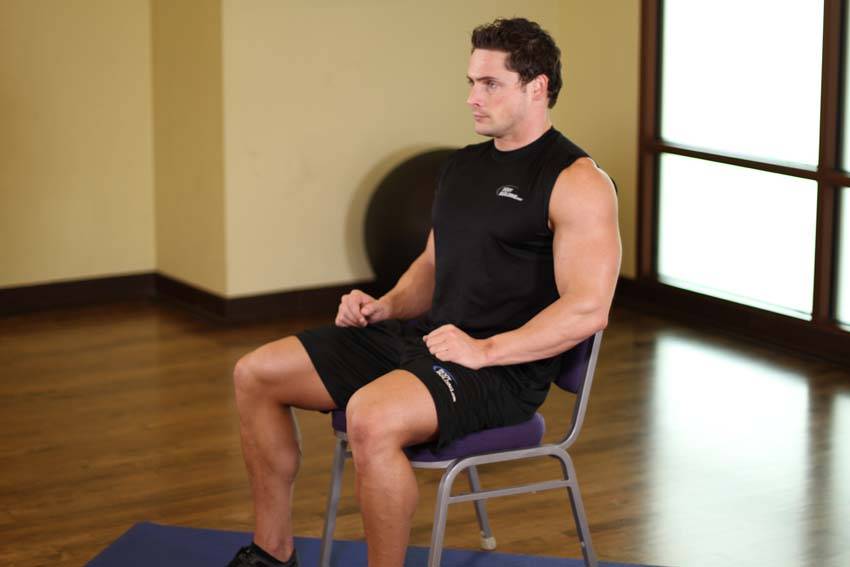
The movement
Form cues
- 01
Sit on the front edge of the chair seat so your feet are flat on the floor, hip-width apart.
- 02
Reach both hands back and grip the top or sides of the chair back — whichever lets you hold firmly without twisting.
- 03
Straighten your arms as much as comfortably possible, so you feel a gentle pull across your chest and shoulders.
- 04
Lift your chest slightly upward and forward, like you're trying to show the ceiling your shirt buttons.
- 05
Keep your chin level — don't let your head drop forward or jut out.
- 06
Breathe slowly and hold the stretch for 20 to 30 seconds without bouncing or forcing deeper.
- 07
Release by relaxing your arms and sitting upright before repeating.
Dosage
How long, how many
Sets
3
Reps
1 hold per set
Rest
30 sec
Watch for
Common mistakes
Rounding the upper back — if your shoulders are curling forward instead of opening back, you're losing the stretch; think about squeezing your shoulder blades gently together.
Gripping too wide or too narrow — if your wrists feel strained, adjust your hand position on the chair back until your arms feel even and comfortable.
Holding your breath — if you notice your chest feels tight and nothing is releasing, take a slow exhale and let your shoulders drop slightly.
Leaning so far forward that you feel unstable — you should feel a stretch, not a balance challenge; keep your hips firmly on the seat edge.
Bending the elbows to get a deeper stretch — bent arms reduce the pull on the chest and biceps; straighten them as much as your range allows.
Scale it
Easier and harder variations
Easier
Instead of gripping the chair back, clasp your hands behind your lower back and gently straighten your arms — this gives a milder stretch with no balance demands.
Use this if reaching back to grip the chair feels awkward or causes shoulder discomfort.
Harder
After settling into the stretch, slowly roll your shoulders back and down two or three times to deepen the chest opening before holding still for the full 30 seconds.
Use this once the basic stretch feels easy and you want a bit more range-of-motion work.
Note
If one shoulder is sore or recently injured, grip the chair back with only the unaffected arm and let the other arm rest at your side — stretch only as far as feels comfortable.
Use this during shoulder recovery or if you have significant range-of-motion difference between sides.
Sources
Form descriptions and cues are sourced from wger (CC-BY-SA 4.0) and the Free Exercise DB (public domain), edited for the 60+ audience. MET value cites Ainsworth BE, et al. 2011 Compendium of Physical Activities. Med Sci Sports Exerc 43(8):1575-1581.
- free-exercise-db · Unlicense / Public Domain
- claude