
Mobility · Beginner
Chair Leg Extended Stretch
This seated stretch lengthens the hamstrings — the muscles running along the back of your thighs — while keeping you safely supported in a chair. Tight hamstrings contribute to lower back discomfort and make everyday movements like bending and climbing stairs harder than they need to be. Because you're seated, there's no balance risk, making this a great starting point if you've been sedentary or are working around a sore back.
Category
Mobility
Difficulty
Beginner
Equipment
Other
MET
2.3
Primary muscles
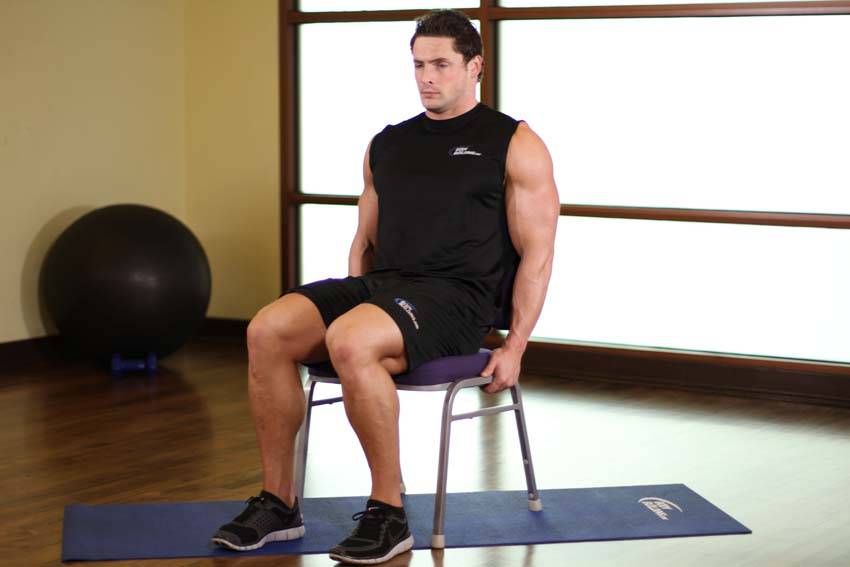
The movement
Form cues
- 01
Sit toward the front half of the chair so your back isn't resting against it — you want to sit tall on your own.
- 02
Grip the sides of the seat with both hands to anchor yourself and keep your torso upright.
- 03
Slowly straighten one leg out in front of you until the knee is fully extended — don't lock it with a snap.
- 04
Flex your foot so your toes point up toward the ceiling, which deepens the stretch along the back of your thigh.
- 05
Hold the extended position for 2-3 seconds, feeling a gentle pull behind your knee and thigh — not pain.
- 06
Sweep the leg out to the side as far as comfortable, then bring it back to center before lowering it down.
- 07
Lower the foot all the way to the floor with control — don't let it drop.
- 08
Complete all reps on one side before switching to the other leg.
Dosage
How long, how many
Sets
3
Reps
8-12
Rest
60 sec
Watch for
Common mistakes
Rounding the lower back — if you're slumping, you're stretching your back instead of your hamstrings; sit up tall and think about lengthening your spine.
Locking the knee with a hard snap — straighten the leg smoothly and stop just short of forcing the joint fully locked.
Skipping the foot flex — if your toes are pointed down or relaxed, you're leaving most of the stretch on the table; toes should point toward the ceiling.
Rushing through the movement — swinging the leg quickly means the muscles never have time to release; move slowly enough that you can feel the stretch.
Gripping the chair so tightly your shoulders hunch up around your ears — hold firmly but keep your shoulders dropped and relaxed.
Scale it
Easier and harder variations
Easier
Only raise the leg partway — a small bend in the knee is fine if you feel a strong pull or discomfort behind the knee before you reach full extension.
Use this if you have very tight hamstrings, recent hamstring strain, or sharp pain behind the knee when straightening.
Harder
Hold the extended position for 20-30 seconds instead of 2-3 seconds, breathing slowly and letting the muscle release a little more with each exhale.
Use this when the basic movement feels easy and you want a deeper, sustained stretch.
Note
If you have a knee replacement or knee pain, keep a slight bend in the knee throughout — never force full extension — and skip the side sweep portion entirely.
Use this with a replaced knee or any active knee inflammation.
Sources
Form descriptions and cues are sourced from wger (CC-BY-SA 4.0) and the Free Exercise DB (public domain), edited for the 60+ audience. MET value cites Ainsworth BE, et al. 2011 Compendium of Physical Activities. Med Sci Sports Exerc 43(8):1575-1581.
- free-exercise-db · Unlicense / Public Domain
- claude