
Mobility · Beginner
Arm Circles
Arm circles move your shoulder joints through a full range of motion, warming up the muscles and lubricating the joint with synovial fluid. They're a simple way to loosen stiffness in the shoulders and upper back before more demanding activity or just to shake off the tension of sitting. No equipment needed, and you can do them standing anywhere.
Category
Mobility
Difficulty
Beginner
Equipment
Bodyweight
MET
2.5
Primary muscles
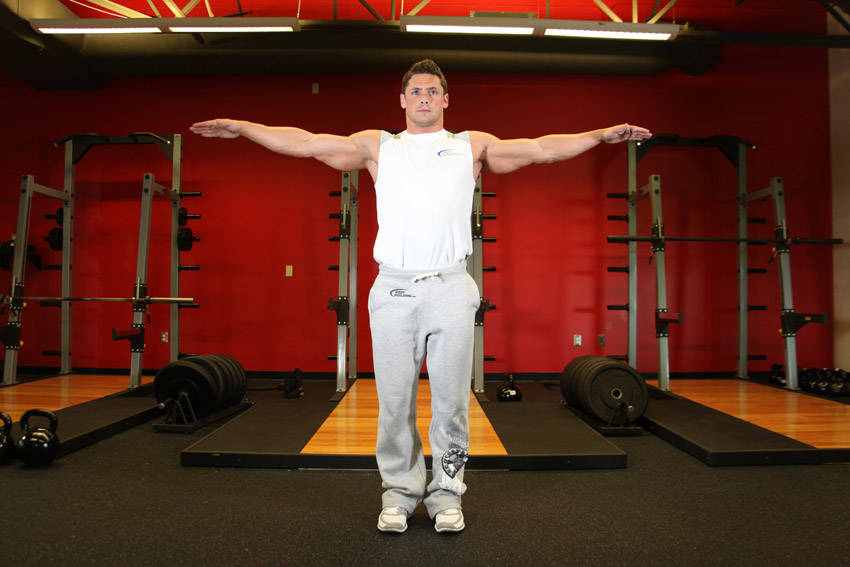
The movement
Form cues
- 01
Stand with your feet about shoulder-width apart and let your arms hang naturally at your sides.
- 02
Raise both arms straight out to your sides until they are level with your shoulders, palms facing down.
- 03
Keep your arms long and relatively straight — a soft bend at the elbow is fine, but don't let them droop.
- 04
Begin drawing slow, smooth circles about the size of a dinner plate, moving forward (toward the front of your body) first.
- 05
Keep your neck relaxed and your gaze forward — resist the urge to watch your hands.
- 06
After 10 seconds or about 10 circles, pause and reverse direction, circling toward the back of your body.
- 07
Breathe steadily throughout — don't hold your breath.
Dosage
How long, how many
Sets
2
Reps
10-15
Rest
30 sec
Watch for
Common mistakes
Shrugging the shoulders up toward the ears — if your neck feels crunched, consciously drop your shoulders down before continuing.
Making the circles too large too fast — if your arms are swinging wildly or your torso is rocking, slow down and shrink the circle.
Letting the arms drop below shoulder height — if you feel your arms sinking, reset them level with the floor before continuing.
Holding the breath — if you notice silence, you've probably stopped breathing; exhale slowly and find a rhythm.
Scale it
Easier and harder variations
Easier
Sit upright in a sturdy chair with feet flat on the floor and perform the same circular motion with arms extended to the sides.
Use if standing balance is a concern or if fatigue sets in quickly.
Harder
Hold a light object in each hand — a small water bottle works well — to add gentle resistance and increase shoulder muscle engagement.
Use once the basic movement feels easy and you want a mild strengthening challenge.
Note
Reduce the circle to the size of a softball and keep the movement slow and pain-free; stop if you feel sharp or pinching pain in the shoulder.
Use if you have a history of rotator cuff issues, a replaced shoulder, or current shoulder discomfort.
Sources
Form descriptions and cues are sourced from wger (CC-BY-SA 4.0) and the Free Exercise DB (public domain), edited for the 60+ audience. MET value cites Ainsworth BE, et al. 2011 Compendium of Physical Activities. Med Sci Sports Exerc 43(8):1575-1581.
- free-exercise-db · Unlicense / Public Domain
- claude