
Kettlebell · Intermediate
Kettlebell Windmill
The kettlebell windmill is a side-bending movement where you hold a weight overhead with one arm while hinging sideways to touch the floor with your free hand. It builds core strength and stability, opens up the hips and hamstrings, and trains your shoulder to stay steady under load — all in one slow, controlled motion. It's more demanding than it looks, so take your time learning the pattern before adding weight.
Category
Kettlebell
Difficulty
Intermediate
Equipment
Other
MET
9.8
Primary muscles
Secondary muscles
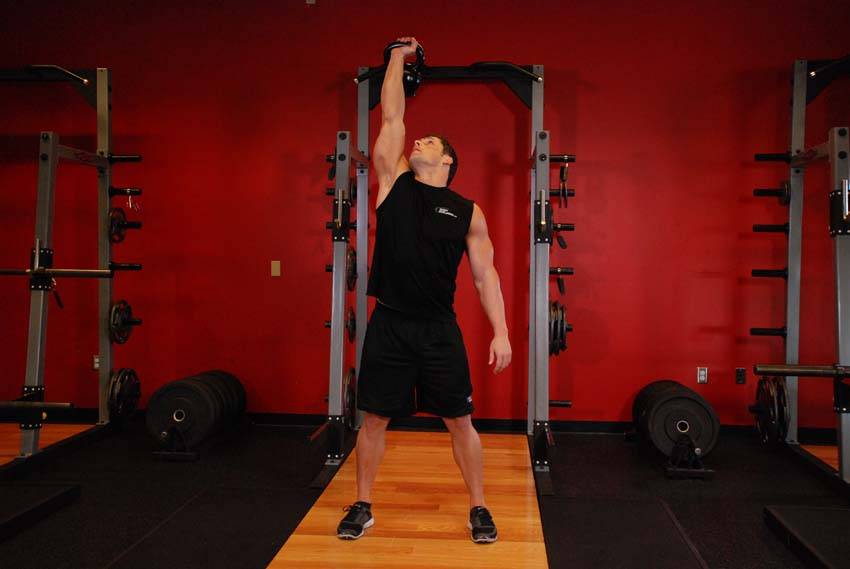
The movement
Form cues
- 01
Stand with feet a little wider than hip-width and turn both feet about 45 degrees away from the arm that will hold the kettlebell overhead.
- 02
Press the kettlebell straight overhead with one arm and lock that elbow out completely — it stays locked for the entire movement.
- 03
Keep your eyes on the kettlebell the whole time; your gaze travels with it as you move.
- 04
Push your hips out to the side of the raised arm, like you're trying to bump a door open with that hip.
- 05
Slide your free hand down the inside of your front leg, bending at the hip — not the waist — as you lower toward the floor.
- 06
Keep your back knee soft, not locked, and feel the stretch across the back of your rear leg as you descend.
- 07
Pause briefly at the bottom, then press your hip back in and stand tall to return — don't rush the way up.
- 08
Breathe in on the way down and breathe out as you drive back to standing.
Dosage
How long, how many
Sets
3
Reps
5-8
Rest
90 sec
Watch for
Common mistakes
Bending at the waist instead of the hip — if your back is rounding like a question mark, you've lost the hinge; think about pushing your hip out first before you start lowering.
Letting the overhead elbow bend — if the kettlebell starts drifting toward your head, stop and reset; a bent elbow puts real stress on the shoulder.
Losing sight of the kettlebell — if you're looking at the floor instead of the weight, you lose the shoulder alignment that keeps the lift safe.
Going too heavy too soon — if you're wobbling or rushing, the weight is too much; this movement rewards patience and light loads while you learn it.
Feet pointed straight ahead — if your feet aren't turned out at an angle, your hips can't move freely and you'll feel jammed; check your foot position before each rep.
Scale it
Easier and harder variations
Easier
Do the movement without any weight — just raise your arm overhead with a closed fist and practice the hip-hinge pattern until the path feels natural.
Use this when you're learning the movement or if overhead pressing feels uncomfortable.
Easier
Hold a light dumbbell instead of a kettlebell, or use a full water bottle, to keep the load manageable while you build the pattern.
Good if you don't have a light enough kettlebell to start safely.
Harder
Increase the kettlebell weight by a small increment once you can complete all reps with a locked elbow, steady gaze, and no wobble at the bottom.
Progress here only after the form feels completely solid — this is not a movement to rush.
Note
If you have a shoulder issue, skip the overhead press entirely and practice the hip-hinge side bend with both hands free, focusing on hip mobility and core control.
For anyone with shoulder impingement, a recent rotator cuff injury, or a replaced shoulder joint.
Sources
Form descriptions and cues are sourced from wger (CC-BY-SA 4.0) and the Free Exercise DB (public domain), edited for the 60+ audience. MET value cites Ainsworth BE, et al. 2011 Compendium of Physical Activities. Med Sci Sports Exerc 43(8):1575-1581.
- free-exercise-db · Unlicense / Public Domain
- claude