
Kettlebell · Intermediate
Kettlebell Turkish Get-Up (Full)
The Turkish Get-Up takes you from flat on your back all the way to standing — and back down again — while holding a weight overhead with one arm. It's one of the most complete movements you can do because it trains your whole body to work together, not just isolated muscles. For anyone who wants to stay independent and get up off the floor with confidence, this exercise is hard to beat.
Category
Kettlebell
Difficulty
Intermediate
Equipment
Other
MET
9.8
Primary muscles
Secondary muscles
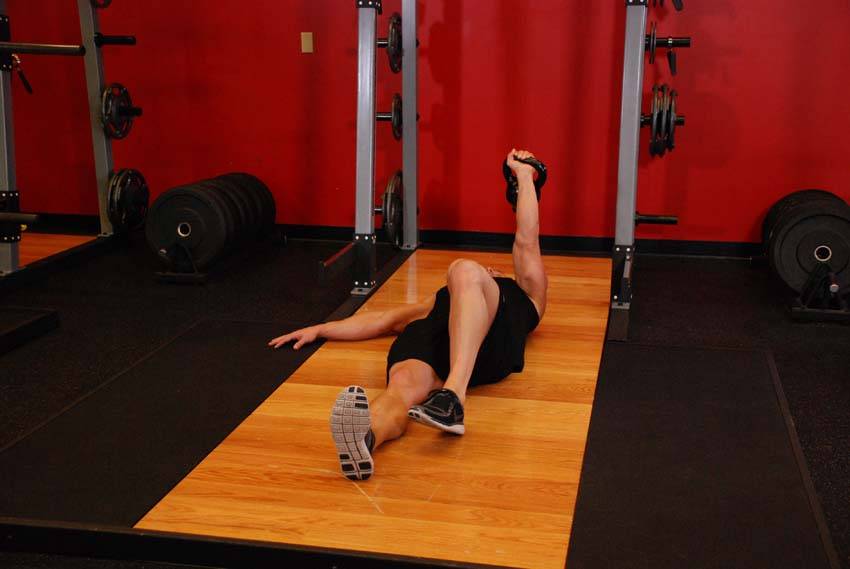
The movement
Form cues
- 01
Lie on your back and hold the kettlebell in your right hand with your arm pointed straight at the ceiling — elbow fully locked.
- 02
Bend your right knee so your right foot is flat on the floor; extend your left arm and left leg out at roughly 45 degrees.
- 03
Keep your eyes on the kettlebell for the entire movement — if you lose sight of it, stop and reset.
- 04
Press through your right foot and roll onto your left forearm, then push up onto your left hand so you're propped up on one arm.
- 05
Lift your hips off the floor by pressing through your left hand and right foot until your body forms a straight diagonal line.
- 06
Sweep your left leg back and place your left knee on the floor directly under your left hip — you're now in a half-kneeling position.
- 07
Lift your left hand off the floor, straighten up tall, then drive through both feet to stand fully upright.
- 08
Reverse every step in the same order — lunge down, hand to floor, sweep leg through, lower hips, roll to forearm, lie back — with the kettlebell overhead the whole time.
Dosage
How long, how many
Sets
3
Reps
3-5
Rest
90 sec
Watch for
Common mistakes
Bending the elbow on the working arm — if the kettlebell drifts toward your head, you've lost the lock; reset before continuing.
Looking away from the kettlebell — if you're watching your feet or the floor, you're removing your best safety check for shoulder position.
Rushing through the transitions — if you're flopping from one position to the next rather than pausing and controlling each step, slow down and find stability before moving on.
Letting the hips sag when sweeping the leg through — if your lower back arches or your hips drop, your core has checked out; squeeze your stomach and glutes to keep the bridge high.
Using too heavy a weight before the pattern is solid — if you can't do the movement smoothly with no weight at all (fist in the air), you're not ready for a kettlebell yet.
Placing the free hand too close to the body when propped up — if your shoulder feels jammed or your elbow is bent, walk that hand out wider so your arm can support you comfortably.
Scale it
Easier and harder variations
Easier
Practice the full movement with no weight — make a fist and point your thumb at the ceiling to mimic the position. Master each phase before adding a kettlebell.
Start here if you've never done this movement before or if you're rebuilding after time off.
Easier
Do only the first half — go from lying to the half-kneeling position, then reverse back down — without standing all the way up.
Use this to build the movement in stages if the full version feels overwhelming.
Harder
Increase the kettlebell weight by one size only when you can complete 3 smooth, controlled reps per side with no wobble or elbow bend.
Progress gradually — this is a technical movement and heavier weight amplifies any form breakdown.
Note
If you have a shoulder issue, skip this exercise entirely until cleared by a physical therapist — holding weight overhead while moving through multiple positions puts significant demand on the shoulder joint.
Shoulder, wrist, or knee injury — get clearance before attempting.
Sources
Form descriptions and cues are sourced from wger (CC-BY-SA 4.0) and the Free Exercise DB (public domain), edited for the 60+ audience. MET value cites Ainsworth BE, et al. 2011 Compendium of Physical Activities. Med Sci Sports Exerc 43(8):1575-1581.
- free-exercise-db · Unlicense / Public Domain
- claude