
Kettlebell · Intermediate
Kettlebell Thruster
The kettlebell thruster combines a squat and an overhead press into one continuous movement, so your legs and shoulders work together rather than separately. That makes it one of the most efficient full-body exercises you can do — you build lower-body strength, shoulder strength, and a bit of cardiovascular endurance all at once. Because the upward drive from your legs helps lift the weight overhead, you're not grinding through a strict press with tired arms.
Category
Kettlebell
Difficulty
Intermediate
Equipment
Other
MET
9.8
Primary muscles
Secondary muscles
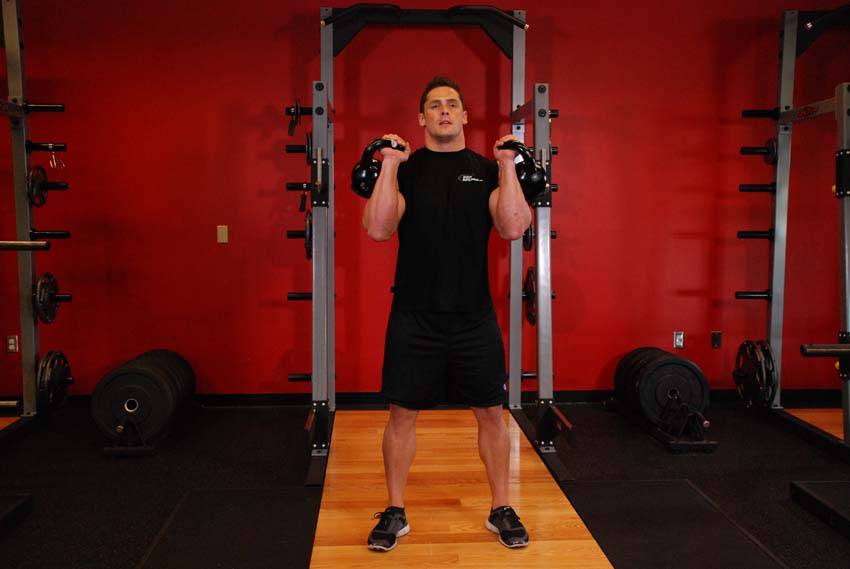
The movement
Form cues
- 01
Stand with feet shoulder-width apart, toes turned out about 15 degrees.
- 02
Hold one kettlebell at each shoulder with your palms facing inward and elbows pointing forward — the bell rests on the back of your wrist, not in your palm.
- 03
Take a breath in, then lower into a squat by pushing your hips back and down, keeping your chest up and your back straight.
- 04
Squat until your thighs are at least parallel to the floor, or as low as feels comfortable without your lower back rounding.
- 05
Push through your heels to stand back up, and as your hips come fully straight, use that upward momentum to press both kettlebells directly overhead.
- 06
Lock your arms out fully at the top so the bells are directly above your shoulders, not in front of your face.
- 07
Lower the kettlebells back to your shoulders with control as you begin the next squat — don't let them crash down.
- 08
Keep your core braced throughout — imagine tightening your stomach as if you expect a gentle punch.
Dosage
How long, how many
Sets
3
Reps
8-12
Rest
60 sec
Watch for
Common mistakes
Pressing before the hips are fully extended — if the bells go up while you're still in a half-squat, you lose the leg drive and strain your lower back. Wait until you're nearly standing before the arms start moving.
Letting the knees cave inward on the way up — if your knees drift toward each other, actively push them out so they track over your second toe.
Leaning too far forward in the squat — if your torso is nearly parallel to the floor, your chest isn't up high enough. Think about lifting your chest before you descend.
Pressing the kettlebells forward instead of straight up — if the bells end up in front of your head rather than over it, your shoulders are working much harder than they need to. Drive the bells straight up toward the ceiling.
Using too heavy a weight and shortening the squat — if you're only dipping a few inches before pressing, drop to a lighter kettlebell and squat to at least parallel.
Scale it
Easier and harder variations
Easier
Use a single, lighter kettlebell held at one shoulder and alternate sides each set, or hold it at your chest with both hands for a goblet-style thruster.
Good starting point if two kettlebells feel unsteady or if your shoulders need time to build up.
Harder
Pause for two full seconds at the bottom of the squat before driving up, which removes momentum and forces your legs to work harder.
Try this once your form is solid and the standard version feels too easy.
Note
If your knees are sensitive, limit the squat depth to a quarter or half squat and focus on the press portion — you still get meaningful shoulder and upper-body work without deep knee flexion.
Use this if knee pain appears during the descent, or if you have a replaced knee and your surgeon has restricted deep squatting.
Sources
Form descriptions and cues are sourced from wger (CC-BY-SA 4.0) and the Free Exercise DB (public domain), edited for the 60+ audience. MET value cites Ainsworth BE, et al. 2011 Compendium of Physical Activities. Med Sci Sports Exerc 43(8):1575-1581.
- free-exercise-db · Unlicense / Public Domain
- claude