
Kettlebell · Intermediate
Kettlebell Sumo High Pull
This exercise combines a wide-stance squat with an upward pulling motion, working your legs, hips, and shoulders in one fluid movement. You start low with the kettlebell between your feet, then drive through your legs while pulling the weight up to shoulder height. It builds full-body strength and coordination, and the hip-hinge pattern it trains is the same one you use every time you pick something up off the floor.
Category
Kettlebell
Difficulty
Intermediate
Equipment
Other
MET
9.8
Primary muscles
Secondary muscles
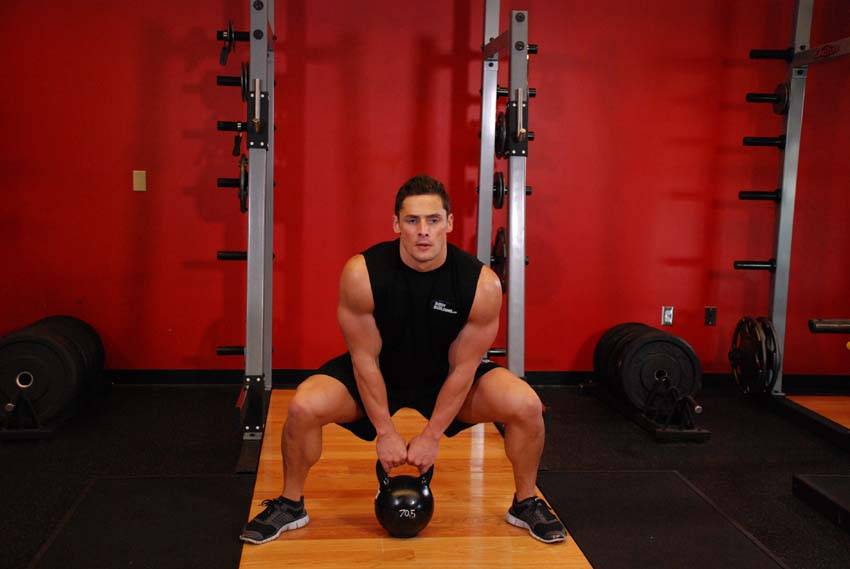
The movement
Form cues
- 01
Stand with feet wider than your shoulders and toes turned out about 45 degrees, like you're straddling a puddle.
- 02
Place the kettlebell on the floor centered between your feet.
- 03
Bend your knees and push your hips back to reach the handle — your chest should stay up, not pointed at the floor.
- 04
Grip the handle with both hands, palms facing your body.
- 05
Take a breath in, brace your stomach like you're bracing for a light punch, then drive through your heels to stand up.
- 06
As your hips and legs straighten, pull the kettlebell straight up your body, leading with your elbows — they should rise above your hands and end up higher than your shoulders.
- 07
At the top, the kettlebell should be at chest or chin height, not swinging away from your body.
- 08
Lower the kettlebell back down by reversing the motion — hips back, knees bend, weight returns to the floor with control.
Dosage
How long, how many
Sets
3
Reps
8-12
Rest
60 sec
Watch for
Common mistakes
Rounding the lower back at the start — if your chest is pointing at the floor when you grip the kettlebell, you need to sit your hips back further and lift your chin.
Letting the knees cave inward on the way up — your knees should track over your second toe the whole time; push them outward as you stand.
Pulling with the arms first instead of driving with the legs — the power should come from your hips and legs straightening, not from yanking with your biceps.
Letting the kettlebell swing out away from your body — it should travel close to your torso the entire way up, not arc forward like a pendulum.
Shrugging the shoulders up around your ears at the top — keep your neck long and focus on the elbows rising, not the shoulders crowding your ears.
Using too much weight before the pattern feels natural — if you can't keep your chest up at the bottom, drop to a lighter kettlebell.
Scale it
Easier and harder variations
Easier
Swap the kettlebell for a light dumbbell held vertically by one end, or practice the movement with no weight at all until the leg drive and elbow lift feel coordinated.
Use this when the full movement feels awkward or you're new to hip-hinge exercises.
Harder
Increase the kettlebell weight by one step, or slow the lowering phase to a 3-count to build more control and muscle.
Once 12 reps feel smooth and the weight isn't challenging in the last few reps.
Note
If you have knee or hip concerns, reduce the depth of your squat — you don't need to go all the way down to the floor. Place the kettlebell on a low box or step so you only hinge partway down.
For those with knee replacements, hip arthritis, or lower back sensitivity.
Sources
Form descriptions and cues are sourced from wger (CC-BY-SA 4.0) and the Free Exercise DB (public domain), edited for the 60+ audience. MET value cites Ainsworth BE, et al. 2011 Compendium of Physical Activities. Med Sci Sports Exerc 43(8):1575-1581.
- free-exercise-db · Unlicense / Public Domain
- claude