
Kettlebell · Intermediate
Kettlebell Single-Leg Deadlift
This exercise has you hinging forward on one leg while lowering a kettlebell toward the floor, then standing back up. It builds strength in the back of your thigh and your glutes — the muscles that power you up stairs, out of chairs, and through every step you take. Because you're balancing on one foot the whole time, it also trains the small stabilizing muscles around your ankle and knee that protect you from falls. It's a challenging move, but the payoff in everyday stability is real.
Category
Kettlebell
Difficulty
Intermediate
Equipment
Other
MET
9.8
Primary muscles
Secondary muscles
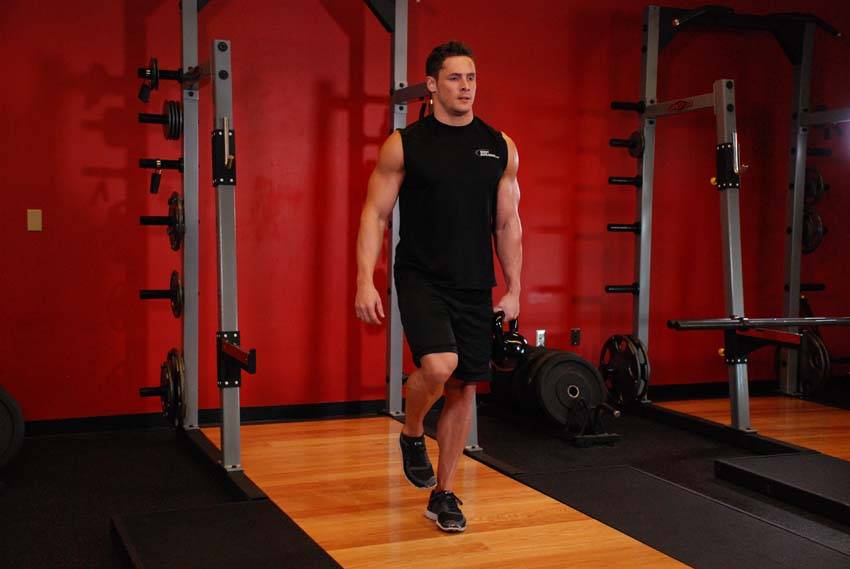
The movement
Form cues
- 01
Hold the kettlebell in your right hand and stand on your right foot, with your left foot just barely off the floor to start.
- 02
Soften the knee of your standing leg — it should never be locked straight.
- 03
Push your hips straight back as you tip your torso forward, letting the kettlebell hang straight down from your shoulder.
- 04
Extend your free leg behind you as a counterweight — think of your body as a seesaw pivoting at your hip.
- 05
Keep your back flat and your chest facing the floor, not twisting to one side.
- 06
Lower until your torso and back leg are roughly parallel to the floor, or as far as your hamstring allows without your back rounding.
- 07
Squeeze your standing-leg glute to drive your hips forward and return to upright — don't yank yourself up with your lower back.
- 08
Pause fully upright before starting the next rep so you reset your balance each time.
Dosage
How long, how many
Sets
3
Reps
8-12
Rest
60 sec
Watch for
Common mistakes
Letting the back round — if you feel your lower back straining instead of your hamstring stretching, you've gone too far down; stop a few inches higher.
Twisting the torso toward the kettlebell side — check that both shoulders stay level, as if balancing a tray across them.
Locking the standing knee straight — a rigid knee puts all the stress on your joint instead of your muscles; keep a soft bend throughout.
Swinging the free leg out to the side for balance — it should trail directly behind you in line with your spine, not drift sideways.
Rushing through reps — if you're wobbling badly on the way back up, you're going too fast; slow down and own each position.
Using too heavy a kettlebell — if your form breaks down before rep five, drop to a lighter weight; balance work demands control, not load.
Scale it
Easier and harder variations
Easier
Hold the back of a sturdy chair with your free hand for balance support, and only hinge as far forward as you can while keeping your back flat.
Start here if you're new to single-leg work or find the balance challenge overwhelming.
Easier
Do a two-legged stiff-leg deadlift with the kettlebell until you build the hamstring strength and body awareness to progress to one leg.
Good stepping stone if the single-leg version feels unstable even with chair support.
Harder
Hold a kettlebell in each hand, or use a single heavier kettlebell, once you can complete all reps with steady balance and a flat back.
Progress here when the movement feels controlled and your balance is solid.
Note
If you have knee or hip replacement concerns, keep the hinge shallow — just 30 to 45 degrees forward — and use the chair for support; check with your physical therapist before going deeper.
For anyone with recent lower-body joint surgery or significant knee or hip pain.
Sources
Form descriptions and cues are sourced from wger (CC-BY-SA 4.0) and the Free Exercise DB (public domain), edited for the 60+ audience. MET value cites Ainsworth BE, et al. 2011 Compendium of Physical Activities. Med Sci Sports Exerc 43(8):1575-1581.
- free-exercise-db · Unlicense / Public Domain
- claude