
Kettlebell · Intermediate
Kettlebell Seated Press
You sit on the floor with your legs spread wide and press a kettlebell straight overhead from shoulder height. Taking the legs out of the equation forces your shoulders and core to do all the stabilizing work, making this a surprisingly honest test of upper-body strength. It's a practical movement — the same pattern you use when lifting something onto a high shelf — and the floor position keeps your lower back from cheating by arching.
Category
Kettlebell
Difficulty
Intermediate
Equipment
Other
MET
9.8
Primary muscles
Secondary muscles
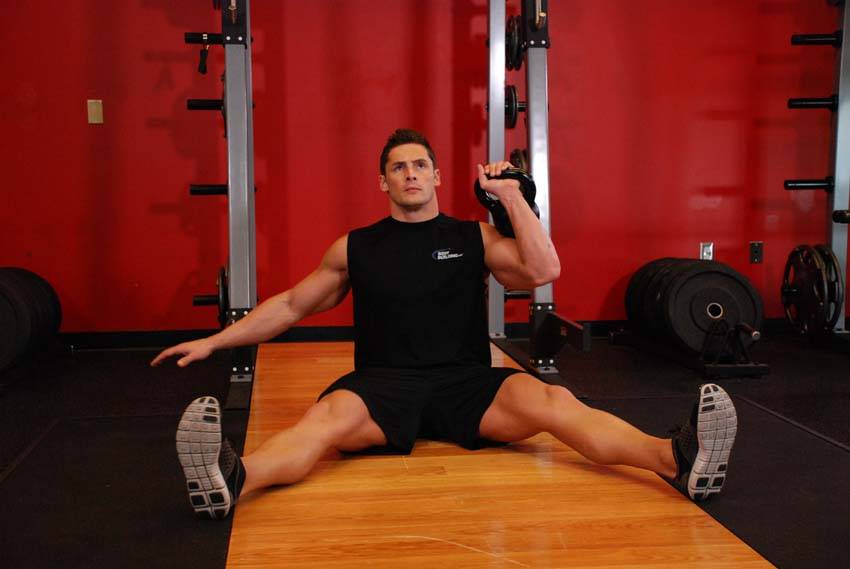
The movement
Form cues
- 01
Sit on the floor and spread your legs wide enough to feel stable — roughly 45 degrees apart — with your feet flexed and toes pointing up.
- 02
Hold the kettlebell at shoulder height with the ball resting against the back of your wrist and forearm, not dangling from your fingers.
- 03
Sit tall as if a string is pulling the crown of your head toward the ceiling — no slouching, no leaning back.
- 04
Squeeze your stomach muscles like someone is about to poke you in the belly before you press.
- 05
Press the kettlebell straight up and slightly forward until your elbow locks out and your bicep is close to your ear.
- 06
Keep your non-pressing hand resting on your thigh or the floor — don't let your torso tilt toward the working side.
- 07
Lower the kettlebell slowly back to your shoulder — take at least two seconds on the way down.
- 08
Finish all reps on one side before switching arms.
Dosage
How long, how many
Sets
3
Reps
8-12
Rest
60 sec
Watch for
Common mistakes
Leaning away from the weight — if your torso tilts like a sinking ship as you press, the kettlebell is too heavy or your core isn't braced. Sit upright the entire rep.
Letting the wrist bend backward — if the kettlebell tips back and your wrist folds, the ball isn't resting on your forearm properly. Re-rack and reset your grip.
Flaring the elbow out to the side at the start — your elbow should point forward and slightly out, not straight to the side, or you'll stress the shoulder joint unnecessarily.
Pressing the bell forward instead of up — if the kettlebell ends up in front of your face rather than over your head, you're pushing out, not up. Aim to finish with the bell directly over your shoulder.
Holding your breath — if you feel your face getting red or your neck tightening, you've forgotten to breathe. Exhale as you press up, inhale as you lower.
Scale it
Easier and harder variations
Easier
Sit in a sturdy chair with feet flat on the floor instead of sitting on the ground. This reduces the balance demand and makes getting up and down much easier.
Use this if getting down to and up from the floor is difficult, or if hip or knee discomfort makes the floor position uncomfortable.
Harder
Press both kettlebells at the same time from the seated floor position. Both sides must work equally, and your core has to work twice as hard to keep you upright.
Use this once you can complete 3 sets of 12 reps per arm with solid form and no torso lean.
Note
If your shoulder is bothering you, switch to a light dumbbell and press only to the point where you feel no pinching — stopping just below full lockout is fine. Never press through sharp pain.
Use this during shoulder recovery or if you have a history of rotator cuff issues. Check with your doctor or physical therapist before loading overhead movements.
Sources
Form descriptions and cues are sourced from wger (CC-BY-SA 4.0) and the Free Exercise DB (public domain), edited for the 60+ audience. MET value cites Ainsworth BE, et al. 2011 Compendium of Physical Activities. Med Sci Sports Exerc 43(8):1575-1581.
- free-exercise-db · Unlicense / Public Domain
- claude