
Kettlebell · Intermediate
Kettlebell Pass Between the Legs
You hold a kettlebell in one hand, hinge forward at the hips, and pass it to your other hand through the space between your legs — then repeat in the opposite direction. The continuous figure-eight motion challenges your core to stay braced while your hips hinge and your hands move, which builds the kind of coordinated, functional strength that helps with everyday bending and carrying tasks. It also keeps your hamstrings and glutes working throughout, making it a solid lower-body and core combination in one movement.
Category
Kettlebell
Difficulty
Intermediate
Equipment
Other
MET
9.8
Primary muscles
Secondary muscles
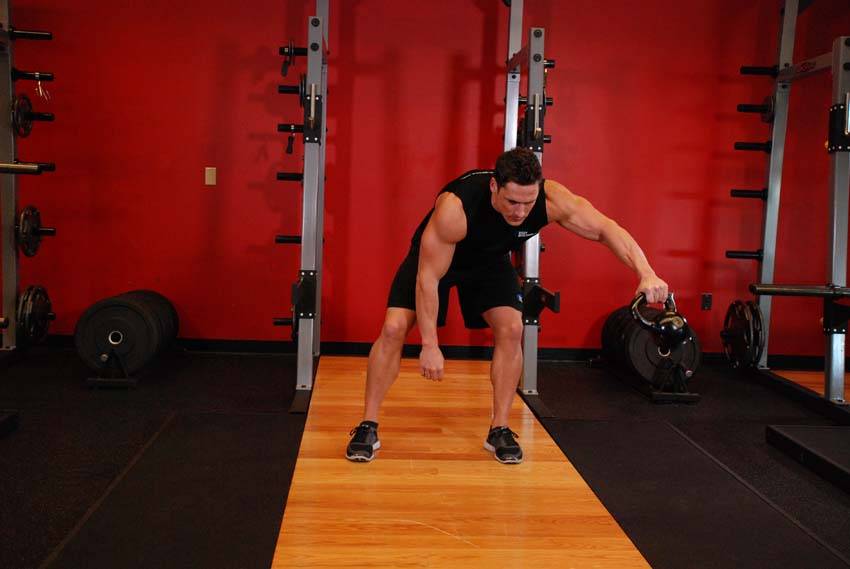
The movement
Form cues
- 01
Stand with feet a little wider than shoulder-width, toes turned out about 15 degrees.
- 02
Hold the kettlebell in one hand at your side before you begin.
- 03
Push your hips back — not down — until your torso leans forward and you can easily reach between your legs.
- 04
Keep your back flat and your chest up; if your back rounds like a C, your hips aren't back far enough.
- 05
Squeeze your stomach muscles like someone's about to poke you before each pass.
- 06
Pass the kettlebell to your other hand through the gap between your legs, then immediately reach that hand behind your opposite leg to receive it from the front.
- 07
Keep your knees bent and tracking over your toes throughout — don't let them drift inward.
- 08
Control the weight on every pass; don't let momentum yank your torso around.
- 09
Keep your head in line with your spine — look at the floor a few feet ahead of you, not straight up.
Dosage
How long, how many
Sets
3
Reps
8-12
Rest
60 sec
Watch for
Common mistakes
Rounding the lower back — if your tailbone tucks under and your back curves, you've lost the hip hinge; reset by pushing your hips further back until your back flattens.
Squatting instead of hinging — if your knees are bending deeply and your torso is upright, you're squatting; the movement should feel like a bow, not a sit-down.
Rushing the pass — if the kettlebell swings wildly or slips, you're moving too fast; slow down until each hand-off is deliberate and controlled.
Holding your breath — if you feel dizzy or your core gives out quickly, you're probably bracing by not breathing; exhale on each pass and inhale as you reset.
Knees caving inward — if your knees drift toward each other during the movement, actively push them outward so they stay over the middle of your foot.
Scale it
Easier and harder variations
Easier
Use a very light dumbbell or a small water bottle instead of a kettlebell while you learn the movement pattern.
Use this when the hip hinge or the coordination of the pass still feels unfamiliar.
Harder
Increase the weight of the kettlebell gradually, or slow each pass to a 3-second count to increase time under tension.
Use this once the movement feels smooth and controlled at your current weight.
Note
If you have lower back sensitivity, limit your forward lean to a comfortable range and place your free hand on your thigh for support between passes rather than reaching fully through.
Use this if a full hip hinge causes any sharp or shooting back pain — and check with your doctor or physical therapist before continuing.
Sources
Form descriptions and cues are sourced from wger (CC-BY-SA 4.0) and the Free Exercise DB (public domain), edited for the 60+ audience. MET value cites Ainsworth BE, et al. 2011 Compendium of Physical Activities. Med Sci Sports Exerc 43(8):1575-1581.
- free-exercise-db · Unlicense / Public Domain
- claude