
Kettlebell · Intermediate
One-Arm Kettlebell Swing
The one-arm kettlebell swing is a hip-hinging movement where you drive a kettlebell forward using a powerful push from your hips and hamstrings — not your arms. It builds strength through your entire backside, from your hamstrings and glutes up through your lower back and shoulders, while also getting your heart rate up. Because it trains the hip hinge pattern, it directly carries over to safer bending, lifting, and getting up from low surfaces. One arm at a time also challenges your core to resist rotation, which is useful balance and stability work.
Category
Kettlebell
Difficulty
Intermediate
Equipment
Other
MET
9.8
Primary muscles
Secondary muscles
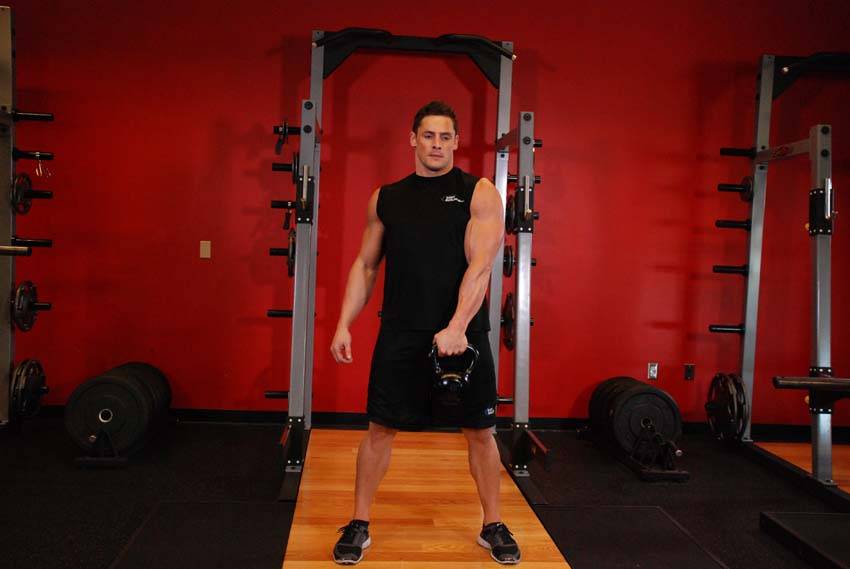
The movement
Form cues
- 01
Stand with feet shoulder-width apart, toes turned out just slightly, kettlebell on the floor about a foot in front of you.
- 02
Hinge at your hips — push them back like you're trying to touch the wall behind you — and grip the kettlebell handle with one hand.
- 03
Before you move the bell, take a breath in and brace your stomach like you're bracing for a punch.
- 04
Hike the kettlebell back between your legs like a football snap, keeping your wrist close to your inner thigh.
- 05
Drive your hips forward sharply — squeeze your glutes hard — to launch the bell upward to about chest height.
- 06
Let your arm stay relaxed; the power comes from your hips, not your shoulder pulling the bell up.
- 07
At the top of the swing, stand tall with hips fully extended — don't lean back or arch your lower back.
- 08
Let the bell fall back down, hinge your hips back to receive it, and flow straight into the next rep.
- 09
Keep your free hand out to the side or lightly touching your thigh — don't let it flail around.
Dosage
How long, how many
Sets
3
Reps
8-12
Rest
60 sec
Watch for
Common mistakes
Squatting instead of hinging — if your knees are bending deeply and your torso is upright, you're squatting the bell up rather than driving with your hips. The movement should feel like a horizontal hip snap, not a leg press.
Using the shoulder to lift the bell — if your shoulder feels like it's doing all the work, your hip drive is too weak. Focus on snapping the hips forward first; the arm just guides the bell.
Rounding the lower back at the bottom — if you feel your back curling under as the bell swings back, you've gone too far. Hinge until your back is flat, not until the bell touches the floor.
Leaning back at the top — if you feel pressure in your lower back at the peak of the swing, you're hyperextending. Stand straight up and squeeze your glutes instead of arching backward.
Gripping the handle too tight throughout — a death grip tires your forearm fast and throws off the swing's rhythm. Hold firmly but let the handle shift slightly in your palm as the bell moves.
Starting too heavy — if you can't control the bell at the bottom or your form breaks down after three reps, the weight is too much. Master the pattern with a lighter bell first.
Scale it
Easier and harder variations
Easier
Practice the hip hinge first with no weight: stand two feet from a wall, push your hips back to tap the wall, then drive forward. Once that feels natural, add a light kettlebell.
Use this if you've never done a kettlebell swing or if the hip hinge pattern feels unfamiliar.
Easier
Do a two-arm kettlebell swing instead — grip the handle with both hands so you can focus on the hip drive without worrying about rotation or balance.
Use this if the one-arm version feels unstable or your grip fatigues before your legs do.
Harder
Increase the kettlebell weight by one size (4 kg / ~9 lbs) once you can complete 3 sets of 12 reps with clean form and no lower-back fatigue.
Use this when the current weight feels controlled and you want to build more strength.
Note
If you have lower-back sensitivity, shorten the range of the hinge — only push your hips back until you feel a mild hamstring stretch, not until your torso is parallel to the floor — and keep the weight light.
Use this if you have a history of lower-back issues or feel any discomfort during the hinge.
Sources
Form descriptions and cues are sourced from wger (CC-BY-SA 4.0) and the Free Exercise DB (public domain), edited for the 60+ audience. MET value cites Ainsworth BE, et al. 2011 Compendium of Physical Activities. Med Sci Sports Exerc 43(8):1575-1581.
- free-exercise-db · Unlicense / Public Domain
- claude