
Kettlebell · Intermediate
One-Arm Kettlebell Floor Press
You lie on your back and press a kettlebell straight up with one arm at a time, using the floor to limit how far your elbow drops. This makes it safer for shoulders than a bench press while still building real chest and triceps strength. The single-arm setup also challenges your core to stay steady against the uneven load — a bonus you don't get from pressing both sides at once.
Category
Kettlebell
Difficulty
Intermediate
Equipment
Other
MET
9.8
Primary muscles
Secondary muscles
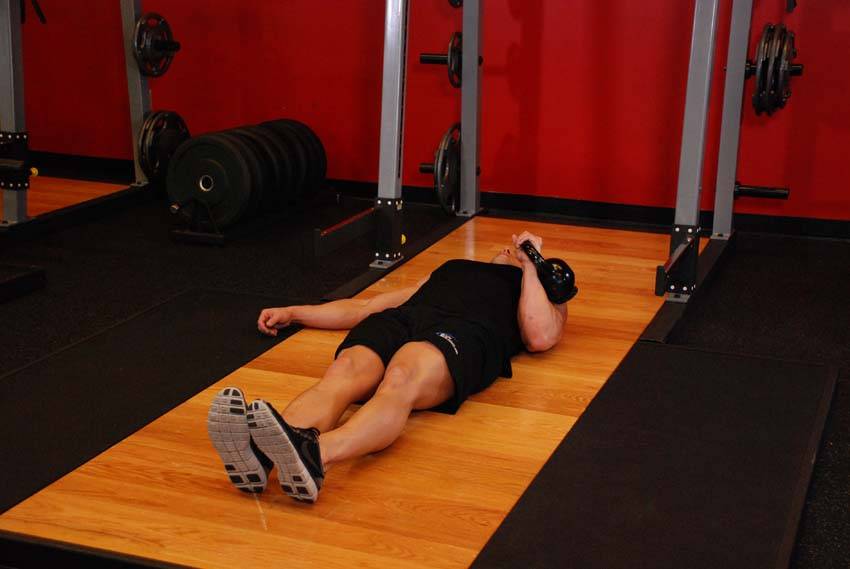
The movement
Form cues
- 01
Lie flat on your back with knees bent and feet flat on the floor, about hip-width apart.
- 02
Hold the kettlebell in one hand with your upper arm resting on the floor and your elbow at roughly a 45-degree angle from your side — not flared straight out.
- 03
Before you press, take a breath in and brace your stomach like you expect a light tap to the belly.
- 04
Press the kettlebell straight up toward the ceiling, rotating your wrist so your palm faces your feet at the top.
- 05
Keep your shoulder blade pressed into the floor throughout — don't let that shoulder shrug or lift off.
- 06
Pause briefly at the top with your elbow just short of locking out, then lower slowly and with control.
- 07
Let your upper arm settle back onto the floor between reps — this is the reset point, not a bounce.
- 08
Finish all reps on one side before switching; keep your hips flat and avoid rolling toward the working arm.
Dosage
How long, how many
Sets
3
Reps
8-12
Rest
60 sec
Watch for
Common mistakes
Elbow flared too wide — if your upper arm is pointing straight out from your shoulder like a T, bring it in toward your hip until it's closer to 45 degrees.
Shoulder lifting off the floor on the press — if your working-side shoulder rises toward your ear, lighten the weight and focus on pressing the blade down into the floor.
Rushing the lowering phase — if the kettlebell drops quickly back to the floor, slow it down; the controlled descent is where much of the strength work happens.
Holding your breath — if you feel your face flushing or tension building in your neck, exhale as you press up and inhale as you lower.
Hips rolling or twisting to one side — if your lower back arches or you feel yourself tilting, the weight is too heavy or your core isn't braced; reset before continuing.
Wrist bending backward under the kettlebell — the handle should sit across the base of your palm, not your fingers; if your wrist aches, re-grip before pressing.
Scale it
Easier and harder variations
Easier
Use a light dumbbell instead of a kettlebell — the handle is easier to grip and the weight sits more naturally in your hand while you learn the movement.
If kettlebell grip feels unstable or the wrist position is uncomfortable.
Harder
Add a one-to-two second pause at the bottom with your upper arm on the floor before each press — this removes any momentum and forces your chest to do all the work from a dead stop.
Once 12 reps feel controlled and easy with your current weight.
Note
If you have shoulder discomfort, keep the movement in a pain-free range by not lowering your elbow all the way to the floor — stop a few inches above it and press from there.
Shoulder impingement, rotator cuff sensitivity, or recent shoulder surgery cleared for light pressing.
Sources
Form descriptions and cues are sourced from wger (CC-BY-SA 4.0) and the Free Exercise DB (public domain), edited for the 60+ audience. MET value cites Ainsworth BE, et al. 2011 Compendium of Physical Activities. Med Sci Sports Exerc 43(8):1575-1581.
- free-exercise-db · Unlicense / Public Domain
- claude