
Kettlebell · Intermediate
Kettlebell Hang Clean
The kettlebell hang clean is a full-body movement where you swing a kettlebell from a hip-hinge position up to your shoulder in one smooth motion. It trains the hamstrings, hips, and back to work together as a chain — the same pattern you use every time you stand up from a low seat or lift something off the floor. Because it's a power movement done at a moderate pace, it also gives your heart a workout alongside your muscles. A light kettlebell and careful attention to form make it accessible even if you're new to kettlebell training.
Category
Kettlebell
Difficulty
Intermediate
Equipment
Other
MET
9.8
Primary muscles
Secondary muscles
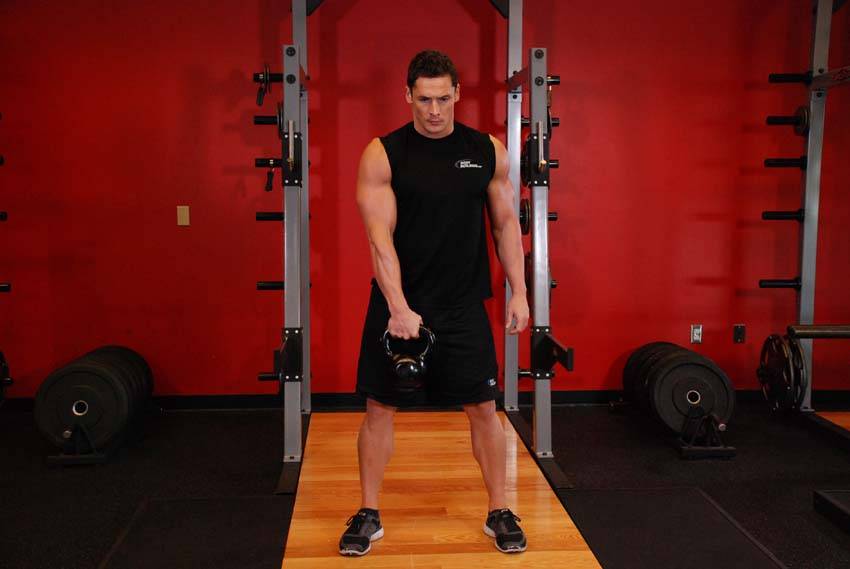
The movement
Form cues
- 01
Stand with feet shoulder-width apart, kettlebell on the floor between your feet, toes turned out slightly.
- 02
Hinge at your hips — push your backside behind you as if reaching for a low shelf — and grip the kettlebell handle with one hand.
- 03
Keep your chest up and eyes looking straight ahead throughout the entire movement, not down at the floor.
- 04
Take a breath in, brace your stomach like you expect a light punch, then drive through your heels to stand up explosively.
- 05
As the kettlebell rises, guide it close to your body — it should travel up your centerline, not swing out in a wide arc.
- 06
At shoulder height, flip your wrist so the kettlebell rolls smoothly onto the back of your forearm and rests at your shoulder — your elbow points forward.
- 07
Pause for a half-second at the shoulder with the kettlebell resting on your forearm, then hinge your hips back and lower it with control to the hanging position.
- 08
Reset your grip and posture before each rep — don't rush the bottom position.
Dosage
How long, how many
Sets
3
Reps
8-12
Rest
60 sec
Watch for
Common mistakes
Rounding the lower back at the bottom — if your lower back feels strained or you can see your shoulders hunching forward in a mirror, push your hips further back and lift your chest before you pull.
Jerking with the arm instead of driving with the legs — if your shoulder or elbow feels the effort more than your hips and thighs, you're arm-pulling; focus on pushing the floor away with your feet first.
Letting the kettlebell swing out in a wide loop — if the bell drifts far from your body on the way up, slow down and think 'zip it up' along your torso.
Slamming the kettlebell onto the forearm — if the catch stings or bruises your wrist, practice the wrist rotation slowly without momentum until the flip feels natural.
Looking down at the floor — dropping your chin causes your upper back to round; pick a spot on the wall at eye level and keep your gaze there.
Using too heavy a kettlebell — if you can't control the catch at the shoulder or your form breaks down after two or three reps, drop to a lighter weight.
Scale it
Easier and harder variations
Easier
Use a very light kettlebell (8–10 kg) and practice the hip hinge and catch separately before combining them into one fluid movement.
If you're new to kettlebells or haven't done hinge-based movements in a while.
Harder
Perform the clean with a heavier kettlebell, or do a double clean with one kettlebell in each hand to increase the total load and coordination demand.
Once single-arm cleans feel smooth and controlled for all reps with your current weight.
Note
If you have lower back sensitivity, limit the range of the hip hinge so you only reach knee height at the bottom, keeping the movement shorter and more upright.
For lower back flare-ups or early return to exercise after a back issue — stop if pain increases.
Sources
Form descriptions and cues are sourced from wger (CC-BY-SA 4.0) and the Free Exercise DB (public domain), edited for the 60+ audience. MET value cites Ainsworth BE, et al. 2011 Compendium of Physical Activities. Med Sci Sports Exerc 43(8):1575-1581.
- free-exercise-db · Unlicense / Public Domain
- claude