
Kettlebell · Beginner
Kettlebell Goblet Squat
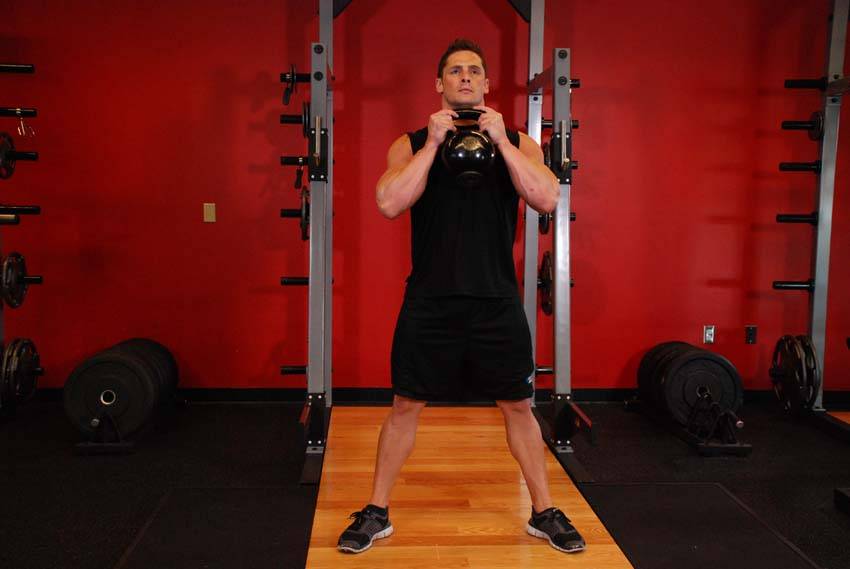
The goblet squat is a squat variation where you hold a kettlebell at chest height, which naturally keeps your torso upright and your weight balanced. That front-loaded position makes it one of the most forgiving squats to learn — your body almost self-corrects. It builds leg and hip strength in a pattern your body uses every time you sit down, stand up, or climb stairs.
Category
Kettlebell
Difficulty
Beginner
Equipment
Other
MET
3.5
Primary muscles
Secondary muscles
The movement
Form cues
- 01
Stand with your feet about shoulder-width apart and turn your toes out 15 to 30 degrees.
- 02
Hold the kettlebell by both handles (the horns) with both hands, keeping it close to your chest — not dangling away from your body.
- 03
Take a breath in, then squeeze your stomach muscles like someone is about to poke you in the belly.
- 04
Push your hips back and bend your knees at the same time, as if lowering yourself onto a low stool.
- 05
Keep your chest tall and your elbows pointed down — if your elbows flare out, the weight is too heavy.
- 06
At the bottom, gently press your elbows against the inside of your knees to nudge them outward so they stay over your toes.
- 07
Press through your whole foot — heel and ball — to stand back up, squeezing your glutes as you reach the top.
- 08
Breathe out as you rise.
Dosage
How long, how many
Sets
3
Reps
8-12
Rest
60 sec
Watch for
Common mistakes
Heels rising off the floor — if your heels lift, your squat is too deep for your current ankle flexibility; only go as low as you can with flat feet.
Knees collapsing inward — if you look down and your knees are pointing toward each other rather than over your toes, actively push them apart.
Leaning too far forward — if the kettlebell is pulling you toward the floor instead of staying at your chest, the weight is too heavy or your core isn't braced.
Holding your breath the whole way down and up — you should breathe in on the way down and out on the way up; holding it raises blood pressure unnecessarily.
Rushing back up — if you bounce out of the bottom, you're using momentum instead of muscle; pause for one count at the bottom and press up with control.
Scale it
Easier and harder variations
Easier
Do a bodyweight squat holding the back of a sturdy chair with both hands until you're comfortable with the movement pattern.
Use this if you're new to squatting, have balance concerns, or want to practice the motion before adding weight.
Easier
Limit your depth to a quarter or half squat — only go as low as a slight bend in the knees — and gradually increase range over weeks.
Good starting point if you have knee or hip stiffness that makes a full squat uncomfortable.
Harder
Add a two-second pause at the bottom of each rep before pressing back up.
Once the standard version feels easy, this builds more strength without needing a heavier weight.
Note
Sit on the edge of a firm chair, hold a light weight at your chest, and practice standing up and sitting back down with control — this is a seated-to-standing squat that removes knee load at the bottom.
Use this if knee pain makes a full squat uncomfortable; check with your doctor or physical therapist before progressing.
Sources
Form descriptions and cues are sourced from wger (CC-BY-SA 4.0) and the Free Exercise DB (public domain), edited for the 60+ audience. MET value cites Ainsworth BE, et al. 2011 Compendium of Physical Activities. Med Sci Sports Exerc 43(8):1575-1581.
- free-exercise-db · Unlicense / Public Domain
- claude