
Kettlebell · Intermediate
Kettlebell Figure 8
You pass a kettlebell in a figure-8 pattern between and around your legs while holding a partial squat. It's a surprisingly effective way to build core stability, hip strength, and coordination all at once. Because the weight is always moving and shifting sides, your trunk muscles have to work constantly to keep you upright and balanced — which translates directly to steadier movement in daily life.
Category
Kettlebell
Difficulty
Intermediate
Equipment
Other
MET
9.8
Primary muscles
Secondary muscles
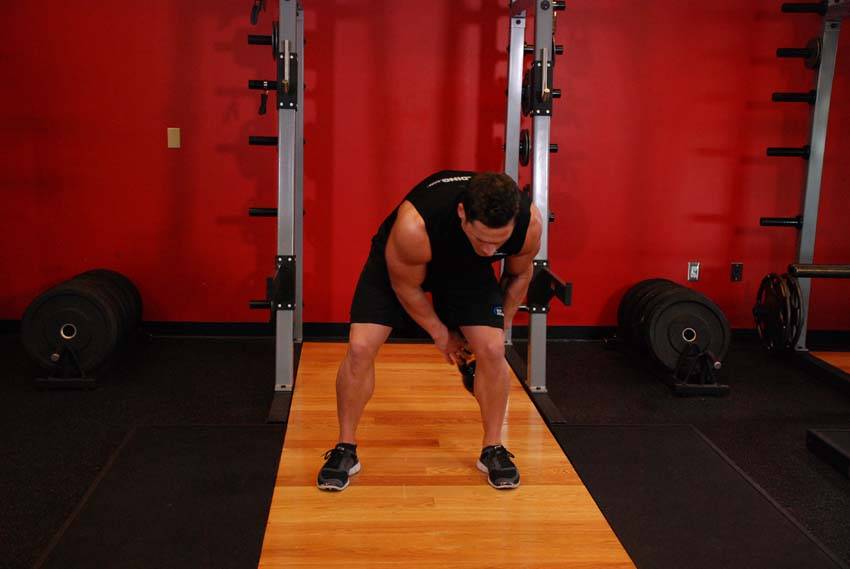
The movement
Form cues
- 01
Stand with your feet about six inches wider than your shoulders and toes turned out slightly.
- 02
Push your hips back and bend your knees until your torso leans forward — think of reaching your rear end toward the wall behind you, not squatting straight down.
- 03
Keep your back flat, not rounded — imagine balancing a glass of water on your lower back.
- 04
Hold the kettlebell in your right hand and swing it inside your right leg, then pass it to your left hand reaching through from behind your left leg.
- 05
Let the left hand catch the kettlebell and swing it around the outside of your left leg, then pass it back through to your right hand from behind.
- 06
Keep your hips steady and at the same height throughout — resist the urge to bob up and down with each pass.
- 07
Squeeze your stomach muscles like someone's about to poke you in the belly to protect your lower back during the movement.
- 08
Keep your eyes forward and your chin level — looking down will pull your whole upper body out of position.
Dosage
How long, how many
Sets
3
Reps
8-12
Rest
60 sec
Watch for
Common mistakes
Rounding the lower back — if your tailbone is tucking under or your back looks like a C, push your hips further back and lift your chest slightly.
Standing up between passes — if you feel your legs straightening each time you hand off the kettlebell, consciously hold your squat position the entire set.
Gripping too tightly and tensing the shoulders up toward your ears — your shoulders should stay down and relaxed; a death-grip on the handle causes unnecessary fatigue.
Passing the kettlebell too far in front of your body — the handoff should happen between and slightly behind your legs, not out in front of your knees.
Using a kettlebell that's too heavy — if you're losing your flat back or stumbling during the pass, drop to a lighter weight immediately.
Rushing the movement — going too fast leads to sloppy handoffs and a twisting spine; slow down until the pattern feels automatic.
Scale it
Easier and harder variations
Easier
Use a very light kettlebell (8–10 lbs) or a small dumbbell held by one end, and slow the movement way down until the passing pattern feels natural.
Use this when you're learning the pattern or if balance feels uncertain.
Harder
Increase the kettlebell weight by 4–8 lbs, or slow each pass to a 3-count to increase time under tension for your core.
Use this once the standard version feels smooth and controlled for all reps.
Note
If you have knee or hip discomfort, reduce how deep you hinge — a shallower hip hinge with less knee bend still works the core and shoulders without stressing the joints.
Use this if you have knee replacement, hip arthritis, or lower back sensitivity.
Sources
Form descriptions and cues are sourced from wger (CC-BY-SA 4.0) and the Free Exercise DB (public domain), edited for the 60+ audience. MET value cites Ainsworth BE, et al. 2011 Compendium of Physical Activities. Med Sci Sports Exerc 43(8):1575-1581.
- free-exercise-db · Unlicense / Public Domain
- claude