
Kettlebell · Intermediate
Kettlebell Farmer Carry
The farmer carry is exactly what it sounds like — you pick up something heavy and walk with it. It builds grip strength, steadies your posture, and trains every muscle that keeps you upright and moving, all at the same time. For everyday life, this translates directly to carrying groceries, luggage, or anything else that needs to get from point A to point B.
Category
Kettlebell
Difficulty
Intermediate
Equipment
Other
MET
2.8
Primary muscles
Secondary muscles
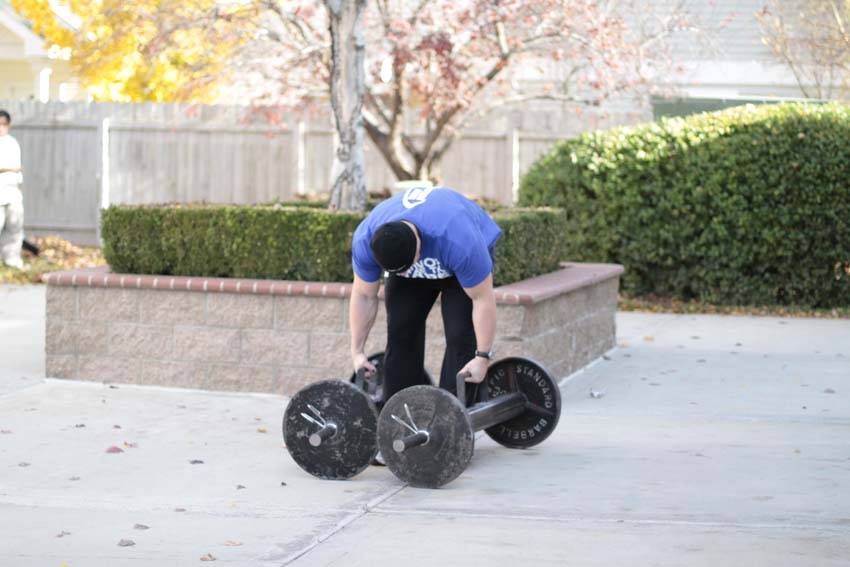
The movement
Form cues
- 01
Stand a kettlebell (or dumbbell) on each side of you, handles at roughly mid-shin height.
- 02
Hinge at your hips and bend your knees to reach the handles — don't round your back to get down there.
- 03
Grip the handles firmly, then drive through your heels to stand tall, as if you're pushing the floor away.
- 04
Once standing, pull your shoulders back and down — picture tucking your shoulder blades into your back pockets.
- 05
Hold your stomach firm, like you're bracing for a gentle punch, and keep that tension the whole walk.
- 06
Walk forward with smooth, controlled steps — no waddling side to side, no leaning toward one weight.
- 07
Keep your chin level and your eyes forward; looking down will pull your whole posture with it.
- 08
To set the weights down, hinge at the hips and bend your knees the same way you picked them up — don't just drop them.
Dosage
How long, how many
Sets
3
Reps
40-50 feet per pass
Rest
60 sec
Watch for
Common mistakes
Shrugging your shoulders up toward your ears — if your neck feels crunched, actively press your shoulders down before you take a step.
Leaning to one side because one weight is heavier — if your torso tilts, the weights are uneven or too heavy; swap for a matched pair.
Rounding your lower back during the pick-up — if you feel your back curving like a C when you grab the handles, bend your knees more and push your chest up before you lift.
Taking long, lunging strides — this throws off your balance; shorten your steps so your feet land under your hips.
Holding your breath — if you feel light-headed or your face turns red, you've forgotten to breathe; exhale on every other step.
Letting the weights swing forward — if the kettlebells are drifting in front of your thighs instead of hanging straight down, slow down and regain control.
Scale it
Easier and harder variations
Easier
Carry a single weight in one hand for a shorter distance — 20 to 30 feet — and switch hands on the way back. This cuts the load in half and lets you find your balance before going heavier.
Good starting point if you're new to carries or have limited grip strength.
Harder
Increase the weight, extend the distance to 75–100 feet per pass, or carry one heavier weight on one side only (a suitcase carry) to challenge your core even more.
Once you can complete 3 passes of 50 feet with solid posture and no side-lean.
Note
If your lower back is sensitive, reduce the weight significantly and focus on a slow, controlled pick-up and set-down rather than distance. Stop if you feel any sharp pain — this is not a movement to push through.
For those managing lower back issues or returning from a back strain.
Sources
Form descriptions and cues are sourced from wger (CC-BY-SA 4.0) and the Free Exercise DB (public domain), edited for the 60+ audience. MET value cites Ainsworth BE, et al. 2011 Compendium of Physical Activities. Med Sci Sports Exerc 43(8):1575-1581.
- free-exercise-db · Unlicense / Public Domain
- claude